Smashing Magazine we smash you with the information that will make your life easier. really.
Microformats: What They Are and How To Use Them
By Smashing Editorial, May 4th, 2007 in How-To | 66 Comments | Forum
Web 2.0 has its positive and its negative sides. Apart from tremendous technological improvements, provided by Ajax, semantically organized content and the growing popularity of RSS-Feeds, the term “Web 2.0″ still hadn’t managed to assert itself as the renewed Web rather than a new revolutionary technology as it is mistakenly being called.
Consequence: many renewed techniques, which somehow seem to be related to the “new” Web, aren’t fully or properly understood. This results in public misunderstandings and keeps both developers and users away from the use (the improvement) of these techniques.
One of the new terms on the horizon is Microformats (sometimes abbreviated µF or uF) - formats, which make it possible to create meta-content which can be not only read, but also understood by machines (which was the basic idea of Semantic Web, which is not Web 2.0). This post is supposed to give you an idea, what Microformats actually mean, which advantages they have and how you can use them to enrich your content and make it more visible and understandable for search engines.
Things you should know about Microformats
- “Designed for humans first and machines second, microformats are a set of simple, open data formats built upon existing and widely adopted standards.” [Microformats: Official definition]
- “Microformats is the generic name given to any format that builds on XML (X)HTML to provide additional metadata about web objects.” [Microcontent Design]
- “Microformats are simple codes that you can use to identify specific kinds of data, like people or events, in your webpages.” [Chris Messina]
- “A microformat is a piece of mark up that allows expression of semantics in an HTML (or XHTML) web page. Programs can extract meaning from a web page that is marked up with one or more microformats.” [Wikipedia: Microformats]
- “With Microformats, you can send & publish things like events, business cards, and product reviews as meaningful XHTML that a person can read in a browser, but a program can import, index and remix as native data.” [Michael McCracken]
- “Microformats are about using the standards we all know [...] to convey as much semantic meaning as possible. They use current XHTML tags such as
address,cite, andblockquoteand attributes such asrel,rev, andtitleto create semantically appropriate blocks of code.” [Microformats Primer] - “Microformats are not a new language, but adapted to current behaviors and usage patterns and is connected with semantic XHTML.” [About Microformats]
- “Microformats principles: solve a specific problem, simple as possible, reuse from widely adopted standards (semantic (X)HTML), modularity / embeddability, decentralized development, content, services. [What are microformats]
- “That’s what microformats are, adding semantics to markup to take it from being machine readable to being machine understandable.” [Microformats: Introduction]
- “There are lots of different microformats, ranging from very fundamental types of information like contacts, locations, and events, to the slightly more domain specific, like reviews and resumes, to the very domain specific, like wines.”[Microformats: Introduction]
Existing Microformats
- hAtom
hAtom is a microformat for content that can be syndicated, primarily but not exclusively weblog postings. hAtom is based on a subset of the Atom syndication format. - hCalendar | hCalendar Creator
hCalendar is a simple, open, distributed calendaring and events format, suitable for embedding in (X)HTML, Atom, RSS, and arbitrary XML. - hCard | hCard Creator
hCard is a format for representing people, companies, organizations, and places, in semantic XHTML. - hResume | hResume Creator
hResume is a microformat for publishing resumes and CVs. - hReview | hReview Creator
hReview is an open, distributed format, suitable for embedding reviews (of products, services, businesses, events, etc.) in (X)HTML, Atom, RSS, and arbitrary XML. rel="nofollow"
Is an HTML attribute value used to instruct search engines that a hyperlink should not influence the link target’s ranking in the search engine’s index. Regarded as a microformat.rel="tag"
By adding rel=”tag” to a hyperlink, a page indicates that the destination of that hyperlink is an author-designated “tag” (or keyword/subject) for the current page. Note that a tag may just refer to a major portion of the current page (i.e. a blog post). e.g. by placing this link on a page,
<a href="http://technorati.com/tag/tech" rel="tag">tech</a>, the author indicates that the page has the tag “tech”.- XFN
XHTML Friends Network (XFN) is a simple way to represent human relationships using hyperlinks developed by Global Multimedia Protocols Group. XFN enables web authors to indicate their relationship(s) to the people in their blogrolls simply by adding a ‘rel’ attribute to their<a href>tags, e.g.:
<a href="http://jeff.example.org" rel="friend met">. - XOXO
XOXO (eXtensible Open XHTML Outlines) is an XML format for outlines built from XHTML modularization. Developed by several authors as an attempt to reuse XHTML building blocks instead of inventing unnecessary new XML elements/attributes, XOXO is both based on existing behavior of publishing outlines, lists, and blogrolls on the Web, and as a general outline format for 1:1 processing of fundamental programming language datastructures. - xFolk
xFolk is a simple and open format for publishing collections of bookmarks.
Advantages of Microformats
- “Say you want to sell your car. [...] What if we could somehow post a listing to our blog, and then easily let services which cared about classifieds listings know that there is a new or updated classified at my site. The missing piece that would enable this is a standard format (after all html doesn’t have a
element).” [Add Microformats Magic to your site] - “Now your information is scattered all over the Web, and you have to pick which sites you want to use. Soon: the combination of blogging and microformats is now reversing this model. Now, your information remains in your blog, and the Web sites come to you. For instance, if you want to sell something, you can blog about it using an hListing, and a site like edgeio will find it when it aggregates classified advertisements across the Web.” [Microformats: Introduction]
- “Microformats enable the publishing and sharing of higher fidelity information on the Web. Small bits of (X)HTML that identify richer data types like people and events in your webpages. Building blocks that enable users to own, control, move, and share their data on the Web.” [What are microformats]
- “Like CSS, microformats let you to do some interesting things through JavaScript and the DOM. After all, microformats are just a bunch of XHTML.” [Microformats Primer]
- Benefits of Microformats: they are (search) machine-readable, accurate and appropriate metadata, meaningful markup.
- With Microformats “you can create more consistent content. You can share your microformat with content providers, ensuring that you’ll get content in the right format. You don’t need to DO anything to that content before you present it to users.” [The Awesome Power of Microformats]
- “So what use would microformats be in a web browser? [...] Future Web browsers are likely going to associate semantically marked up data you encounter on the Web with specific applications, either on your system or online. This means the contact information you see on a Web site will be associated with your favorite contacts application.” [Mozilla Does Microformats]
- “The idea is that i.e. as soon as any page that has an hCard on it you can add to your address book, you can sync it with your PDA, your handheld, and it makes contact information, personal information, on the web a lot more useful.” [Microformats: Evolving the Web]
Microformats are already being used!
- Edgeio.com (Weblog based business as niche for small and large companies), Rubhub.com (determines relationships between websites and peoples, scenarios: find alternative connections for supplies in producer chains,
bookseller, car suppliers, internal contact management within large companies), Technorati.com (indexes hCard, hCalendar, and hReview, and also cumulative data is updated via event-driven pings) - Microformats can be used within Firefox Extensions (Tails, Greasemonkey scripts for hCard, hCalendar, xFolks, etc.) and Blogging Extensions (Structured Blogging for Wordpress)
Articles About Microformats
- microformats - What are microformats?
Designed for humans first and machines second, microformats are a set of simple, open data formats built upon existing and widely adopted standards. Learn more about microformats. The official web-page. - Digital Web Magazine - Microformats Primer
Introductory article on Microformats by Garrett Dimon - Add microformats magic to your site
Heard of the semantic web? Using Microformats everyone can contribute to the richness of the web. John Allsopp explains how. - Digital Web Magazine - The Big Picture on Microformats
“In this article, we’ll review what people are doing with microformats right now, and finish up by looking at a couple of cool projects that might whet your appetite for microformats’ future prospects.” by John Allsopp - Microformats: Evolving the Web
Jeremy Keith - This is a transcript of a panel I sat in on at South by Southwest 2006. My fellow panelists are Chris Messina and Norm! The moderator is Tantek Çelik. - Mozilla Does Microformats
Firefox 3 as Information Broker - Richard MacManus - What are Microformats?
A presentation by Tantek Çelik - Introduction to Microformats
Microformats: Introduction, Structured Data, The Fundamental, Introducing Operator - Microformats and the Decentralized Future of Online Marketing
Firefox’s Alex Faaborg has raised quite a few eyebrows with his piece on Microformats and the possibilities that exist for these platforms in terms of browser implementation - Microformats Challenge Web Feeds and Web APIs!
Microformats are subversive: they not only challenge the approach of full-blown Semantic Web approaches, but even question fundamental Web 2.0 building blocks such as Web Feeds and Web APIs. - The Awesome Power of Microformats
What Are Microformats? - by Kevin Lawver - Usable Microformats
If you’re relatively new to microformats, then this article was written with you in mind. You don’t need to have any prior knowldege to understand what’s going on here.by Andy Hume - Microformats
Microformats - Designed for humans first.by Prof. Dr. Mathias Weske
Microformats Tools

- Microformats Bookmarklet
helps to extract existing hCards and hCalendars and shows and stores existing contacts and events. - Tails Export
An extension for Showing and Exporting Microformats. Currently it supports hCard [export to .vcf file], hCalendar [export to .ics file], hReview, xFolk and Rel-license. - Highlight Microformats with CSS
Those that use Firefox with the Tails extension, read no further. This is not for you. You have it given to you on a plate, you don’t know how lucky you are. This is for those of us using Camino, Safari or Omniweb. - Operator
Operator leverages microformats that are already available on many web pages to provide new ways to interact with web services. It lets you combine pieces of information on Web sites with applications in ways that are useful. For instance, Flickr + Google Maps, Upcoming.org + Google Calendar, Yahoo! Local + your address book, and many more possibilities and permutations. - Microformats Dreamweaver Extension
Microformats Dreamweaver extension (ideally for use with Dreamweaver 8, although should work for MX and above) implements a few simple Insert Bar Objects to help Dreamweaver users to add hCalendar, hCard, rel-license, rel-tag and XFN data to their documents. After installing, you’ll find a new Microformats category on your Insert Bar. Support for more formats is to follow, so check back. - microformats.css
A CSS-based template for existing microformats, based upon the microformats cheatsheet (PDF) - Microformats Cheat Sheet
This Microformats Cheat Sheet covers iCalendar, hCalendar, hReview, vCard, hCard, RelLicense, RelTag, XFN Format and Values and Dates. - Microformats Cheat Sheet
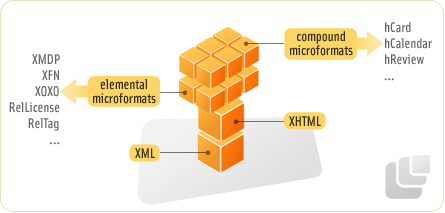
This microformats cheat sheet lists the properties by format and also lists each format and the hierarchy. This includes elemental microformats, compound microformats and some of the standard design patterns used. - Microformats Icons
The starter set contains icons for hCal, hResume, hCard, XFN and a generic TAG icon.
Tutorials, Introductions to Microformats
- Tutorials on Microformats
This series of articles deals with numerous aspects of Microformats, including basic theory and purpose of Microformats, hCard, hCalendar, AHAH, hReview, xFolk, hResume, XOXO and hAtom. - Intro to microformats
Confused, alarmed, disparaged? Let’s clear that up. An extensive introduction to the theory and use of Microformats. - Introduction to Microformats + a look at hCard & hAtom
Mike Jolley explains step-by-step, what Microformats are, how they can be integrated in web-pages and how you can enhance the efficicency of your content using them. - Pairing Wine and Microformats
Microformats in Practice: Dan Cederholm about the use of Microformats in Cork’d. - Microformats in Web Browsers
This is a concept for putting Microformats ‘auto-discovery’ user interface in a web browser. Any web browser (although the sketches were original conceived as a Firefox extension).by Ben Ward - Wikipedia: Microformats
The Wikipedia Entry. - Practical Microformats
Microformats from the Ground Up - an extensive tutorial, by Ryan King and Brian Suda - Using Microformats in WordPress
There are two approaches you can take. One: Manually pasting relevant microformat code created via microformat creators. Step-by-step instructions are as follows.
Blogs & Wikis
- Microformats.org
Designed for humans first and machines second, microformats are a set of simple, open data formats built upon existing and widely adopted standards. Learn more about microformats. - Microformats Wiki
What are microformats? What can you do with them? - microformatique

Microformatique is an unofficial blog covering all things microformats, and “data at the edges”. Latest specifications, presentations, events, publications and more. It’s put togther by John Allsopp
Leave a Reply
Sponsors
- Advertise with us!
Smashing Links
Stay in touch
Popular Posts
- 100 Wordpress Themes
- 83 Wordpress Themes
- 80 AJAX Solutions
- 75 JavaScript Techniques
- 70 Best Photoshop Tutorials
- 70 Best Illustrator Tutorials
- 53 CSS Techniques
- 50 Blog Designs
- 50 Graffiti Artworks
- 50 Brilliant Photos
- 50 Movie Posters
- 40 Free Fonts
- 40 Creative Layouts
- 35 Beautiful Icon Sets
- Beautiful Desktop Wallpapers
- Beautiful Macro Photos
- Beautiful Underwater Photos
- Free Design Templates
- Free CSS Layouts
All Posts
- 35 Designers × 5 Questions
- 50 Designers × 6 Questions
- 404 Error Pages
- AJAX Libraries
- AJAX Solutions
- AJAX Tutorials
- Badges and Pins
- Batch Image Processing
- Black & White Photography
- Block Quotes
- Blog Designs 1, 2, 3, 4, 5
- Blog Headers
- Book Covers
- Brochures and Booklets
- Browsers Round-Up
- Browser Test Suites
- Buzz-Monitoring
- Calendar Designs
- Charts and Diagrams: Tools
- Cheat Sheets
- Code Beautifier
- Copyright Explained
- CSS Coding Techniques
- CSS Designs 1, 2, 3, 4, 5
- CSS Clean Code
- CSS Editors
- CSS Expert Ideas
- CSS Float Theory
- CSS Frameworks
- CSS Free Templates
- CSS Footers
- CSS Forms 1, 2
- CSS Frameworks
- CSS Galleries
- CSS Ideas
- CSS Layouts
- CSS Menus
- CSS Print-Layouts
- CSS Specificity
- CSS Styleguides
- CSS Tables
- CSS Tutorials
- CSS-Techniques
- CSS Tools
- Data Grids and Tables
- Data Visualization 1, 2
- Date Stamps
- Design Books 1, 2
- Design Magazines
- Designer's Checkpoints
- Divine Proportion
- Domain Tools
- Dreamweaver Tutorials
- Drupal
- E-Mail Delivery
- Favicons 1, 2, 3, 4, 5, 6
- Firefox Themes
- Fireworks Tutorials
- Flash Designs
- Flash Slideshows
- Flash Tutorials
- Fonts 1, 2, 3, 4, 5, 6
- Font Management
- Form Design Patterns
- Forums
- Fractals
- Gadgets 1, 2, 3
- Google AdSense
- Google PageRank
- Graffiti
- Graphics Design
- Grid-Based Design 1, 2
- Grunge Design 1, 2
- Hand-Drawing Style 1, 2
- Handwriting and Lettering
- Hotkeys
- HDR Pictures
- HTML Template Systems
- Icon Sets 1, 2, 3, 4, 5
- Icons, Templates 1, 2, 3
- Illustrator Tutorials 1, 2
- JavaScript Techniques
- jQuery
- Laptop Sleeves
- Laptop Designs
- Link Building
- Links in New Windows?
- Macro Photography
- Mascots
- Moleskine Art
- Motion Graphics
- Motion Blur Photos
- Movie Posters
- Music Videos
- Navigation Menus
- Newspaper Designs
- Online Converters
- Online Generators
- Packaging Design
- Pagination
- PDF Magazines
- Photoshop Actions
- Photoshop Tutorials 1, 2
- Pixel Art
- Podcasts
- PNG Transparency
- Portfolios
- Pricing Tables
- Product Designs
- Rain Photography
- RSS Best Design Practices
- RSS Feed Icons
- Screencasting
- Screensavers
- SEO Tools
- Shopping Carts
- Short Movies
- Slideshows & Lightboxes
- Smoke Photography
- Source Code Editors
- Splash Pages
- Start Pages
- Stock Icons
- Space, Nebula wallpapers
- Tab-Based Interfaces
- Tag Clouds
- Textures
- Textures & Backgrounds
- Texture Design
- Tooltips Scripts
- Tutorials
- Typefaces 1, 2
- Type Setting Principles
- Typographic Posters
- Typography In Motion
- Typography Showcase 1 2, 3
- Underwater Photography
- Usability Books
- Usability Glossary
- Usability Nightmares
- Usability Principles
- User Interfaces
- Version Control Systems
- Vintage & Retro Posters
- Vintage & Retro Designs
- Vintage & Retro Tutorials
- Wallpapers 1, 2, 3, 4
- Web 2.0 Tutorials
- Weblog Engines
- Whitespace & Simplicity
- Wordpress Plugins
- Wordpress Themes 1, 2, 3, 4
- Wordpress Toolbox
- WYSIWYG Editors
Fresh Bookmarks
22 Free Seamless Vector Pattern Resources Perfect For Web Design
A collection of resources and articles related to vector patterns.
10 New PHP Content Management Systems
All based on PHP.
25 Beautiful Logos with Sequential Concept
Sequential logos maybe is a new trend among logo designers.
Designing a blog with HTML5
Much of HTML 5’s feature set involves JavaScript APIs that make it easier to develop interactive web pages.
20+ CSS Data Visualization Techniques
Get inspired.
CSS3 – a big storm is coming
With CSS3 media queries and multi-column layouts it will be a whole new ballgame.
Woodgrain: A Free Social Media Icon Set
With 18 social networks represented alongside astandard RSS icon in PNG format,
Webdesign: Five Minute Upgrade
Making Your Design Pop.
45 Stylish Typographical Desktop Wallpapers
These beautifully designed wallpapers are not solely about typography.
The Light CMS Trend
A new trend in CMSs I’m calling “light” CMSs.
Blogroll
- Bittbox
- CatsWhoCode
- Colorburned
- Design Disease
- Designm.ag
- Deziner Folio
- Dr. Web Magazin (.de)
- Dr. Web Shop (.de)
- Freshome Blog
- FudgeGraphics
- I Love Typography
- MakeUseOf.com
- Naldzgraphics
- Noupe.com
- Pro Blog Design
- Search-This
- Six Revisions
- SmileyCat
- Spoon Graphics
- Typesites
- Usability Post
- Walyou
- Webdesigner Depot
- Weburbanist
- Wellmedicated


Alex (May 4th, 2007, 8:17 am)
Very very useful, thank you.
Smartdog (May 4th, 2007, 8:46 am)
Just Smashing!
Top Shelf!
Scott (May 4th, 2007, 9:41 am)
Did you mention the recently published book, Link [microformatique.com]? It’s excellent. I believe you can download the entire appendices from the website, too. Not bad.
As far as hAtom is concerned, all the Link [www.plaintxt.org] are hAtom enabled. Consider them working references.
Webstandard-Team (May 4th, 2007, 4:48 pm)
Useful list of microformat links, thx!
Emerging Microformats (May 4th, 2007, 8:29 pm)
You forget to mention the whole bunch of emerging sites built on microformats: Emurse.com, Edgeio.com, Corkd.com ,
Eventful.com and Pingerati.net.
Bob (May 4th, 2007, 9:42 pm)
Not to take away from the hard work and time that people have invested in microformats, but honestly, they sound like a watered down version of what XML was designed to do, for people who can’t (or won’t) do XML and XSL transformations. They’re basically trying to create a bunch of DTDs that use classes instead of XML tags.
Even without XSL Transformations, most web-based scripting languages have an XML parser these days, I believe. So really, if you wanted to boil it down to simple XML and let people parse it however they choose, wouldn’t that achieve the same thing? The data stays in the same format no matter what system you’re pushing it through; you parse it and style it and display it via whatever method you’re most comfortable with, be it XSL, PHP, Javascript, etc.
Just my $0.02. Slam away.
Carlos Eduardo (May 5th, 2007, 3:21 am)
Today, many people doesn’t understand the real mean of microformats.
I think it will grow, but we have to spread it to more and more people and, sure, use it on our projects, supporting it.
For example, we use some microformats on our projects on my work…
Steve Rose (May 5th, 2007, 3:36 am)
I’m ready to try out microformats to add email addresses to address books, but wouldn’t microformats reveal addresses to spambots? Is there a way to protect them?
Motorcycle Guy (May 5th, 2007, 4:13 am)
Microformats? I don’t really get the point exactly, I don’t really get why these have particular names. Sounds like this is just doing what xml is supposed to do (describe data). I don’t see why every xml file now needs a new name.
Alfred (May 5th, 2007, 4:14 am)
making your contents easier to be stolen?
trun9ie (May 5th, 2007, 5:59 am)
I agree with Alfred. Having your content stolen is not very fun.
puppy (May 5th, 2007, 10:08 am)
I hate articles that don’t describe anything… losers.
Kavoir (May 5th, 2007, 3:09 pm)
Great job! This will really ease people who haven’t heard of microformats in. Now considering writing my own. Thanks!
Frederick Townes (May 5th, 2007, 10:01 pm)
Awesome post - a definitive reference on the topic. I know Dan Cederholm would love this! :) Cheers!
Flo (May 6th, 2007, 3:29 am)
I made a tutorial on how to implement Microformats into Wordpress:
Link [blog.no-panic.at]
Chris Messina (May 10th, 2007, 5:27 am)
Don’t forget the Link [microformats.org] and Link [ma.gnolia.com].
@Alfred: you probably shouldn’t be publishing on the web if you don’t want people to reuse your data/content.
@bob and @Motorcycle guy: Sure, and that’s why microformats are based in XHTML — it *is* XML! Furthermore, the goal is not to create yet another language, but instead to use the technology that *all* browsers already understand, and that millions of web designers are already familiar and fluent with. Why not make webpages better able to store and transmit data?
Matthew Ogston (August 9th, 2007, 8:38 pm)
I’ve just knocked together a simple Link [microformats.co.uk] which some people may find useful…
Sarven Capadisli (February 6th, 2008, 4:05 pm)
I wrote an Link [www.csarven.ca] article, perhaps you would be interested in adding it to the list above.
gubba (February 16th, 2008, 1:26 am)
this site is very good for web designers
i have a problem i want to know how to define when using division tags height and width please give me an tutorials on this
thanx,
gubba