Smashing Magazine - we smash you with the information that will make your life easier. really.
How To Improve Your Branding With Your Content
Branding experts hit the nail on the head when they say that a winning brand conveys why you are your prospects’ only solution. If you can’t achieve that, you should at least convey why you are your prospects’ best solution. Of course, the same logic applies to your clients. So make a compelling claim about your business, product or service, and back it up.
Are you the biggest or most popular provider of your type of product? Do you provide the widest selection of services? Do you leverage strategic partnerships? Create patented technology? Offer convenient locations? Or are you young and small, able to churn out customized solutions swiftly, unlike your much larger and slower competitors?

Image credit: Emily Berezin
Define your strengths and leverage them. Purposefully written Web copy that effectively tells your prospects why they should buy from you or your client can make a world of difference on the sales front. In fact, if done right, it can actually disqualify the competition.

Here’s an example. A client in the medical X-ray field had Web copy that contained vague statements such as, “We’re dedicated to providing you with the highest level of professional service possible.” That’s not a hook. Any business can state that on its website, and most do. Some basic research revealed that the client is the only business in the region that owns and operates the most advanced medical equipment in the industry. As a result, it could provide the most accurate X-rays on the same business day. No competitor in its market could make the same claim.
That simple fact differentiated our client and became a large part of its selling proposition. That’s conveying real value.
You Are What You Write
Through words, we form a personality, set a tone and create expectations – for better or for worse. When communicating in person, you have the luxury of giving and receiving verbal feedback and expressing yourself with body language and facial gestures, all in real time. Your prospects can peer into your eyes to help them decide whether to trust you and accept what you’re telling them.
However, when potential clients visit your website, they don’t have the same opportunity to size you up. Your online visitors can’t look you in the eye, so they look to your messages to help them decide whether to trust your brand, your business and you.
Hence, the words you use on your website should project the personality of your products, services and business. Your Web copy must form and foster a clear verbal identity, reflecting who you are and who you strive to be. It signifies what you stand for and promise to deliver.
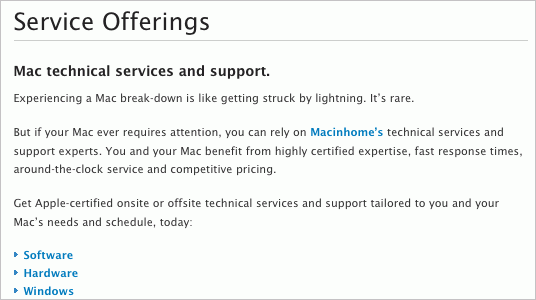
Speak your audience’s language. Your Web writing should put forth a “voice” that resonates with your intended audience. Macinhome connects with Mac enthusiasts by featuring Apple-influenced Web copy, including everything from smart, snappy comments to ending headlines with periods.
Consider the following copy from three auto manufacturers’ websites. Mercedes, in the first excerpt, positions itself as the ultimate luxury vehicle:
“Enjoy bold, spirited styling with an air of sleek confidence. A distinctive radiator grille nose hints at the power that lies beneath the hood. The highly characteristic tail, with dual tailpipes will put a look of awe on the faces of all those you leave in the dust. The SLK-Class is the ultimate combination of classic sporty personality and effortless poise and assurance.”
BMW boasts performance:
“Do bear in mind that 0-100 km/h in 5 seconds limits your chances of actually spotting the BMW M Coupe on the road. For that you can thank a 330 hp in-line six engineered to peak at an astounding 7,900 rpm. Raw power is unleashed precisely through a short-throw, 6-speed manual and is kept in-check by massive compound, cross-drilled brakes.”
Volvo tries to make its name synonymous with safety:
“Preventative safety features like Dynamic Stability and Traction Control (DSTC) help you, the driver, avoid accidents by evading them. And nothing is safer for you than no accident at all. So every Volvo is equipped with a variety of innovative preventative safety features, many of which are, of course, uniquely Volvo, developed by Volvo safety engineers over years of research, design and testing, both in the laboratory and the real world.”
Each individual message builds on its respective brand to create distinctiveness and value, in a bid to engage the targeted audience. And the words that Mercedes, BMW and Volvo choose have a direct impact on each of their bottom lines.
What Does Your Brand Stand For?
Your Web copy needs to define who you are and what you sell and cater to your target market’s specific needs. Moreover, your Web copy requires a distinct and consistent voice that expresses the value of the relationship you’re seeking, accompanied by assurance. Only then can it forge a truly emotional connection with prospective and established customers alike.
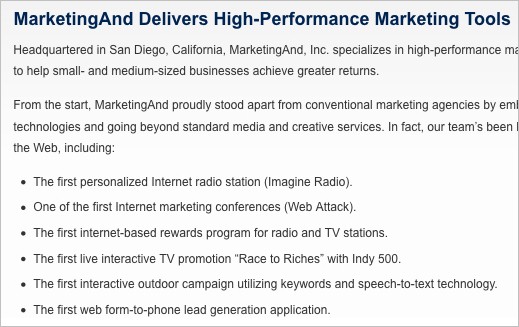
Bring a little bit of “you” into your website. While many businesses post employee photos on websites, why not quote employees in your Web content? By doing so, MarketingAnd not only brings a human element into its website, but effectively positions its staff as industry experts.
To build your brand with words, your Web copy needs to take into account:
- Existing perceptions of your products, services and company,
- The actual position you occupy now on these fronts.
Recognize the gap between these two points and how they compare to where you want to be. The difference needs to be made up through your communications, from your policies to your product packaging to your Web copy.
Following are some key elements to help you foster a relationship between your brand and your customers:
Word association
What are your core strengths? What do you promise customers? Invest time to determine what you’re good at, thus focusing on your strengths. Your words in turn establish a relationship with customers by laying out your benefits, whether functional, emotional or self-expressive.
Image
Your words can sway consumers into associating certain attributes with your brand. This can shift how they see you in relation to the competitors in your marketplace, potentially even altering who you compete with. Some ingenuity can set you apart from the others to the point that your competition appears bland.
Character
Your Web copy should take into account where you come from, who you are and what you stand for. This is your guiding light. Be authentic. One step beyond your character could tarnish your integrity.
Culture
Your website content should reflect the values that give life to your business. While you don’t need to list your core values, your Web copy should draw on this framework. Ensure that it resonates with the values in and around your business.
Personality
Your Web copy needs to bring to light your business’ human characteristics, including everything from age to class to personality traits. Get creative with delivery. For instance, many businesses post employee photos on their websites. But why not actually quote employees in your Web content? It’s a great way to put a human face to your company and promote your staff as industry experts.
Spirit
Does your Web copy represent the emotional elements and values of your business? Demonstrate authenticity and commitment to creating a spirit that’s not only engaging but contagious.
So how can you differentiate your offerings? What’s different about your approach? Perhaps you can leverage:
- Selection
- Experience
- Knowledge
- Credentials
- Expediency
- Style
- Technology
- Geography
- Alliances
- Resources
- Tools
- Customer service
- Or one of many other factors
There’s no value in everyone knowing you if they don’t know what you stand for and what you can do for them. Plus, the more reasons you give people to choose your brand, the less price becomes a factor in their purchasing decision.
Use words that clearly demonstrate how a prospective customer’s world will be made easier, more lucrative, healthier, happier and so on, with you in the picture. This overall message can then be continually reinforced not just on your website, but also in print materials, advertising, trade show presentations, press releases and so on.
Never forget that words, like design, are the foundation of communication. They help us express, understand and learn. They are invaluable to influencing your visitors’ decision-making process and loyalty.
Choose your words wisely. Failing to do so could result in a brand that’s problematic, rather than a means to a solution.
(al)
Rick Sloboda is a Web writer at Webcopyplus, which helps businesses increase online traffic and sales with optimized Web copy. He speaks frequently at Web-related forums and seminars, and conducts Web content studies with organizations in Europe and the US, including Yale University. For more information on writing for the Web, read his blog Web Writing: The Good, Bad and Ugly.
- 68 Comments
- 1
- 2May 16th, 2009 5:24 am
A good article! A true straight and clear information source.
- 3May 16th, 2009 5:32 am
“Hence, Tthe words you use on your website should project the personality of your products, services and business.”
I’m sure that you guys stand for more that typos.
Overall really good article, and good examples of businesses using it today.
(SM) Thanks, it was corrected.
- 4May 16th, 2009 5:48 am
very relevant and to the point.
- 5May 16th, 2009 6:27 am
A very insightful post. It’s all too often that we concentrate on the visual when thinking about branding. But once a logo or colour scheme is set in place, it rarely changes or gets updated. However, web copy (especially a blog) does get updated more often and therefore provides more opportunity to take your branding further – as long as it’s not backwards!
- 6May 16th, 2009 7:10 am
Nice Article Rick…I even like the main image of diff brands.
DKumar M.
@instantshift - 7May 16th, 2009 8:27 am
“Branding experts hit the nail on the head when they say that a winning brand conveys why you are your prospects’ only solution”
Very true. In marketing this is akin to being “top of mind”–the very first brand a customer thinks of. All brands considered is called the “consideration set.”
Segment, target, position (STP strategy). It’s the name of the branding game.
- 8May 16th, 2009 9:57 am
Nice and impressive. This kind of articles I really like. I read it at a gulp ;) Thanks.
- 9May 16th, 2009 10:49 am
Great post, and a great read – thanks! Interesting note: when reading the three car descriptions I thought Mercedes (although spot-on in terms of communicating luxury brand) was the weakest written of the three. I’m not sure if it was the choice of words, but the copy just doesn’t flow smoothly for the reader.
So along with key content, the copy itself MUST be well written or you run the risk of negating branding efforts with a “watered down” message.
- 10May 16th, 2009 3:42 pm
Very nice article! The brand is the most important thing in marketing.
Thanks for this article!
- 11May 16th, 2009 6:36 pm
This is a great article about branding and marketing. Sometimes I don’t focus on what I really need to. This article is a great reminder of the importance of marketing and the brand!
- 12May 16th, 2009 8:52 pm
Content is KING!
- 13May 16th, 2009 11:04 pm
Content is king? I assume you’re referring to web design. Only writers think web copywriting is king. If you have good design the writing on a website has little significance or impact. It’s the design that counts.
- 14May 17th, 2009 12:41 am
Richard, were you serious when you said this…?
“If you have good design the writing on a website has little significance or impact. It’s the design that counts”I’m an experienced digital designer of over 11 years, so please listen to some good advice. I love design and value it as much as anyone…but, design is there to ’support’ the content e.g. copy/writing. Design is an integral part of any business communication but should never be sold in as more important than another discipline such as copywriting, user experience etc. For example, if a commercial website doesn’t look to great but works like a dream a customer will come back for repeat use and purchase. On the other hand, if a website looks fantastic but doesn’t work well or lacks content, a user will not come back. The point is, as when baking a cake, every ingredient is as important as each other, even the pinch of salt.
If you now look back at your comment, you can see how off the mark it is. By all means, love design (as I do), but understand its limitations and role within communication.
- 15May 17th, 2009 4:35 am
Rick,
Excellent points. Too often I see businesses wanting to promote or highlight things which no one cares about – and those things surely don’t promote their brand.
Thanks for sharing. - 16May 17th, 2009 6:16 am
In order to get your site recognized by the main search engines and obtain a high page ranking, you need to be able to get your site noticed by engines like Yahoo and Google. While there are several more search engines out there, these are the big two that you want to get noticed, and ranked, by.
One way, a very big way, to get noticed is to create incoming links that are going to stand out to the search engines. How do you do that? See Smart Linking, but more about it later. You have to be honest with your links, you have to link to a relevant site, you have to use strong anchor text in your link to get noticed, and most importantly, IT HAS TO BE RELEVANT.
Today, search engines use spybots and cookies to bounce around the internet checking all of the information and links that are out there. A couple of years ago, search engines didn’t have that ability, so web masters could create links that were not truthful or relevant to the sites he or she were linking to. They used business directories like DMOZ and many others. - 17May 17th, 2009 11:38 am
SM- can you make an article about “smart linking”?
- 18May 17th, 2009 1:15 pm
Richard are you for real? I seriously hope you don’t have several websites of your own and are neglecting the content because of your design ego…
- 19May 17th, 2009 8:24 pm
Haha i love that the two people who commented about typos had typos in their comments, and then SM had typos in the responses to said comments….hmm i better double check this comment now… haha
Good article by the way!
- 20May 17th, 2009 10:49 pm
Well, couldn’t agree more. Content is really important even when you have the best design / artwork.
- 21May 18th, 2009 12:17 am
Nice! and also nice that SM is back with good articles after a period of not so good :)
- 22May 18th, 2009 4:04 am
The article is great and filled with information that I didn’t even consider since I am a designer, but that doesn’t mean I shouldn’t, it’s not just pretty shapes, colors, correct code and testing. So i am very thankful guys :)
p.s. Especially like what you said about putting quotes of other employees it could help personalize the whole thing, making it a part of each and every one of ‘em.
- 23May 18th, 2009 5:16 am
good article.. thank you
- 24May 18th, 2009 10:36 am
Superb article! I don’t know why Richard said “it’s the design that counts” which is obviously ridiculous. You can have the most beautiful website in the world but it won’t matter if it doesn’t convert visitors. In fact, I’ve seen many unattractive websites that convert visitors very well compared to beautifully designed sites that barely convert anything. Design only supports the content. Plus, search engines don’t give a damn about how your website looks!
- 25May 18th, 2009 11:23 am
“If you have good design the writing on a website has little significance or impact. It’s the design that counts.”
I see Richard’s point. Design is critical to a website’s success. It might be useful to include writing to communicate, but the design is ultimately what’s going to get visitors to a website and keep them coming back for more. The evidence is that people hire web designers all the time, but they don’t always hire web writers.
- 26May 18th, 2009 11:55 am
Did no one else notice that someone flipped the preceeding branding icon photography horizontally? Ironic.
- 27May 18th, 2009 11:58 am
Perfectly written. Content is the king!
Thats what we’ve tried to do on our website. Giving the effect it needs. - 28
- 29May 18th, 2009 11:48 pm
great just great!
- 30May 19th, 2009 12:07 am
this is great!
- 31May 19th, 2009 3:30 am
“Did no one else notice that someone flipped the preceeding branding icon photography horizontally? Ironic.” — spidermonkeyness:
I think eveyone else realised they were branding irons, and that the branded image would be imprinted the right way round.
- 32May 21st, 2009 12:57 pm
Rick, I completely agree with you on the power of the written word. Well chosen words that describe what your website best delivers to your customers cannot be ignored. Excellent article, Rick. Branding is important but it should be backed by delivery to pave the way to success.
- 33June 2nd, 2009 10:31 am
If “Hence, the words you use on your website should project the PERSONALITY of your products, services and business” then I believe ‘good design’ is the FACE of your products, services and business. So, to have a very successful product, service or business, it takes the harmony of both personality and beauty to create the ‘total package.’
If ‘content is king’ but you’re too ugly to communicate, who is going to listen? On the other hand, if your gorgeous with no substance, how credible are you? If I can’t have both and could only select one, I would take good design over content. It is a shame, but how many movies containing incredible special effects with no plot become blockbusters making millions, and how many pairs of Calvin Klein jeans have you purchased because the copy really spoke to the craftsmanship??
- 34June 10th, 2009 1:29 pm
JC, with all due respect, design isn’t just about beauty. Function is the most important aspect of design. Ugly can work. But I agree it’s great when we can make something functional AND beautiful! Stellar article surrounding web content. I think most designers and writers can (or should) learn something from this.
- 35June 13th, 2009 6:27 am
Maybe Mr. web writer Rick Sloboda should leave the branding to designers> That’s what we get paid to do> design. What do writers know about design?
- 36June 14th, 2009 8:10 pm
No need to get defensive…web writer or not, the article has sound and valuable points we can all benefit from as designers.
- 37June 15th, 2009 1:27 pm
Really, at the end of the day, EVERYONE that is involved with the website has influence on its branding, programmers, writers, and all. Designers need to ensure everything comes together. That’s what makes designers so valuable – we’re the brand gatekeepers ;).
- 38June 23rd, 2009 3:37 am
Great article.I love the intellectual discourse this is bringing out. A body functions well with parts that play their role churning out the desired impact and intended purpose.Failure of one means an extra effort somewhere for cover up.
I think both design and content are king.Design is critical to catch attention as content is to keep a lasting impression on customers.
- 39June 23rd, 2009 7:35 pm
Sorry maame, web design is the REAL king! Without web designers, you have no website. Simple as that.
- 40June 23rd, 2009 9:37 pm
Excellent Article . Deep insight over every aspect , probably one of the most resourceful article for website owners and corporates
- 41June 29th, 2009 10:23 pm
Greg, you’re obviously not a professional designer. If you were, you’d realize good web design incorporates all sorts of talents, from web copy writers to usability experts. Thinking a designer can cover every single aspect of web design is naive and unrealistic.
Smashing Mag, thanks for the killer article!!
- 42July 14th, 2009 3:18 pm
Yup, typically a good website has to give credit to good web designers, web copywriters, programmers, and additional contributors. The collaborative process churns out the best projects, including websites.
- 43July 16th, 2009 11:39 pm
I never thought about branding with web copy, but I it makes total sense! I tend to think writers distribute information, but they also create a voice.
- 44August 6th, 2009 12:19 am
I like this article. Web copywriters can help designers achieve objectives with the influence of strong website content.
- 45August 6th, 2009 7:13 am
Up until reading this article, I never thought of web copywriting as a branding tool. Now I will with every website I design. It’s true that web copy can really give a website that extra edge or professionalism that can make a mark with audiences, help businesses have more success, and help a designer improve their level or work and clientele. Need to find a web copywriter today! :)
- 46August 9th, 2009 7:57 am
Brand with web copy? I never thought of that. I guess I’m too wrapped up in design to realize what a web copywriter could bring to a website. Maybe I should find a web writer who could handle working with a demanding designer. :)
- 47August 20th, 2009 1:27 am
{Читаю {ваш|этот|} блог, и понимаю, что {ничего|нифига} не понимаю. Все так запутано. :)
- 48August 20th, 2009 8:02 pm
I always wondered how website owners invest so much time worrying about their logo and design, and then leave the web copy to a hacker with no writing skills. It doesn’t matter how user-friendly or beautiful a design is, if the web copy isn’t good, it brings the professionalism down several notches. If a business can’t afford a website copywriter, they should at least hire an editor, or find someone internally who’s done some sort of copy writing.
- 00
There are no trackbacks at this time. If you are interested in leaving a trackback, please use this URL.
Leave a Comment
Make sure you enter the * required information where indicated. Please also rate the article as it will help us decide future content and posts. Comments are moderated – and rel="nofollow" is in use. Please no link dropping, no keywords or domains as names; do not spam, and do not advertise!
- Magazine RSS Feed
177,918 readers - Follow us on Twitter
83,647 followers
Interact
Popular
- 100 Wordpress Themes
- Photoshop Tutorials
- Fantastic Wallpapers
- 40+ Excellent Freefonts
- Dual-Screen Wallpapers
- Wordpress Themes for 2009
- Illustrator Tutorials
- Incredible Free Icon Sets
- High-Quality Free Fonts
- 30 Scripts For Galleries
- Photoshop Text Effects
- Useful Icon Sets
- Web Design Trends
- iPhone Wallpapers
- Before Launching a Website
- CSS Layouts And Templates
- Photoshop Actions
- Stunning Pictures and Photos
- Fantastic HDR Pictures
- Logo Design Tutorials
- Free Design Templates
- 10 Mistakes In Logo Design
- Photoshop Custom Shapes
- 40 Creative Design Layouts
- 8 Layout Solutions
- 53 CSS Techniques
- Photography Techniques
- Black & White Photography
- Styling Design Elements
- CSS-Based Forms
- 50 jQuery Techniques
- 50 Portfolio Websites
- 50 CSS Techniques
- Creative Logo Designs
- Desktop Wallpapers
- 25 Open Source Mac Apps
- 50 Free Icon Sets
- Glassical: A Free WordPress Theme - http://bit.ly/19EvYr
- Please nominate Smashing Magazine for Best Online Magazine in the 2009 Open Web Awards - http://bit.ly/10ynWA
- Mega Drop Down Menus with CSS & jQuery - http://bit.ly/24novl
- Join us on the Smashing Magazine's Official Facebook Page - http://bit.ly/18ebRT
- #followfriday @inspiredmag @designerdepot @DesignMagTweets @inspirationbit @Colorburned @buysellads @TheCoolHunter @behoff
- New format on @smashingmag: The Beauty of London in Design - http://bit.ly/1Hkju8
- Unbelievable: Ponte City Tower in Johannesburg - http://bit.ly/Iv2k5 - When modern architecture isn't beautiful.


You have a little mistake on “Hence, Tthe words you use on your website should project the personality of your product” which is “Tthe” word. Else, very good article, it is also about quality and uniqueness.
(SM) Thanks, it was corrected.