Smashing Magazine - we smash you with the information that will make your life easier. really.
HTML 5 Cheat Sheet (PDF)
XHTML 2 is dead, long live HTML 5! According to W3C News Archive, XHTML 2 working group is expected to stop work end of 2009 and W3C is planning to increase resources on HTML 5 instead. And even although HTML 5 won’t be completely supported until 2022, it doesn’t mean that it won’t be widely adopted within the foreseeable future.
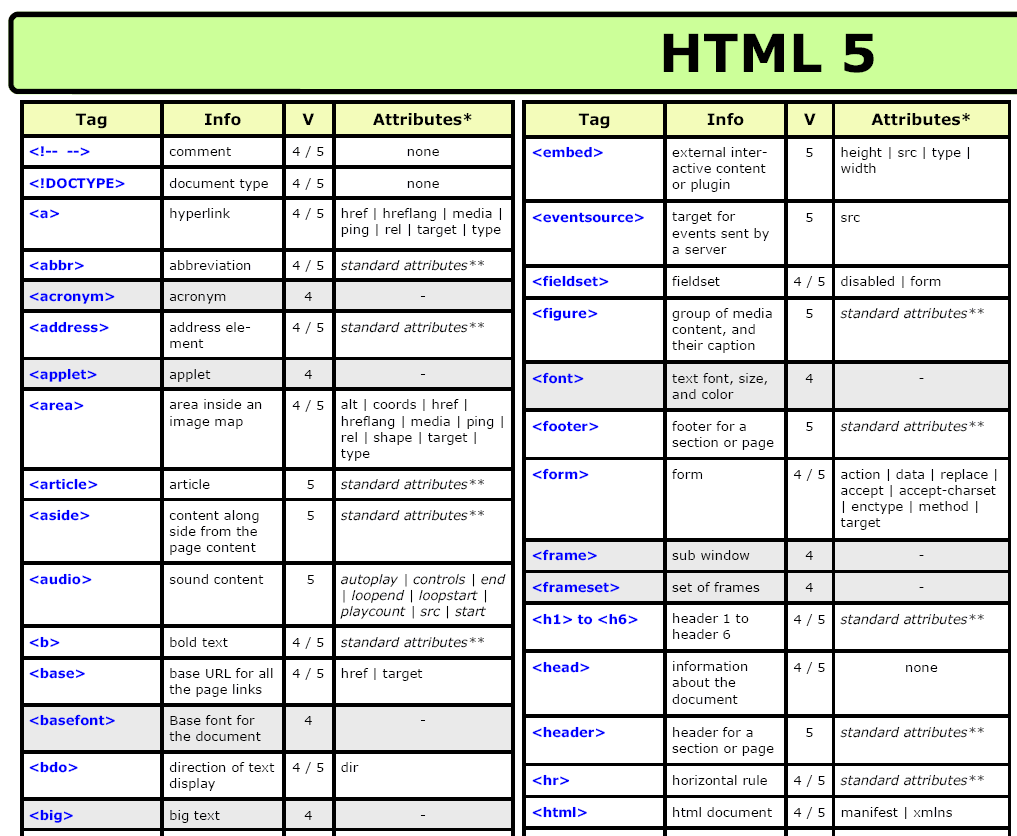
So in the spirit of the upcoming change we decided to release a handy printable HTML 5 Cheat Sheet that lists all currently supported tags, their descriptions, their attributes and their support in HTML 4.
Please notice that the specification is an ongoing work, and is expected to remain so for many years, although parts of HTML 5 are going to be finished and implemented in browsers before the whole specification reaches final Recommendation status. We’ll do our best to update the cheat sheet when new changes will become known. The cheat sheet was created by our friends from Veign.com and released exclusively for the readers of Smashing Magazine.
Download the cheat sheet for free!
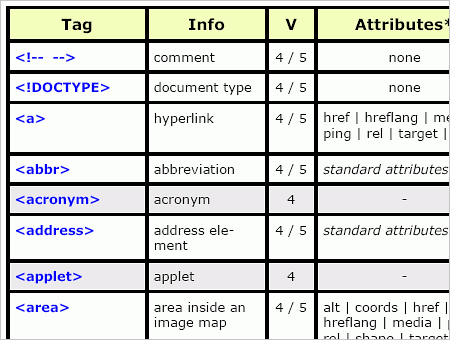
- preview (.gif, 1017×836px)
- download the pdf (76 Kb)
Thank you very much, Chris Hanscom! We appreciate your efforts.
[Offtopic: by the way, did you know that Smashing Magazine has one of the most influential and popular Twitter accounts? Join our discussions and get updates about useful tools and resources — follow us on Twitter.]
Further Resources About HTML 5
- Yes, You Can Use HTML 5 Today!
There have been many changes to the HTML 5 landscape since Lachlan Hunt’s 2007 article on A List Apart, A Preview of HTML 5. Let’s see what’s happening in the world of HTML 5. - HTML 5 Demos
A couple of HTML 5 examples and experiments. - HTML 5 Doctor
This blog publishes articles relating to HTML5 and it’s semantics and how to use them, here and now. - A Selection of Supported Features in HTML5
A Selection of Supported Features in HTML5. - 4 Useful HTML5 Browser Support Overviews
- HTML 5 Gallery
A showcase of sites using html5 markup.
Do you already use HTML 5 in your projects? Would you recommend using HTML 5? Let us know in the comments!
The team here at Smashing Magazine. Mostly Sven & Vitaly.
- 78 Comments
- 1
- 2
July 6th, 2009 1:42 amThanks.. Downloading now!!
- 3
July 6th, 2009 1:43 amwow great, thanks!!!! ;)
- 4
July 6th, 2009 1:44 amNice post!!!thanks for publishing =)
- 5
July 6th, 2009 1:47 amThanx for the Cheatsheet!
- 6
July 6th, 2009 1:54 amSo they’re still stopping short of deprecating all semantically useless elements such as “bold”, “italic” and “small”. Shame. Still useful checklist nonetheless.
- 7
July 6th, 2009 1:56 amHTML 5 will be ready by 2012, it may not have 100% support until 2020.
@Rob
Small has a semantic purpose in marking up small print. b and i were argued over long and hard and they have been given new semantic purpose. Check out the spec to see what it says because it looks like the cheat sheet lacks proper exploitation or is simply wrong.
- 8
July 6th, 2009 2:02 amthanks , i just downloaded it.
- 9
July 6th, 2009 2:03 amHmm “exploitation” above should be explanation.
Anyway here are some excerpts from the HTML spec…
The small element represents small print or other side comments.
The i element represents a span of text in an alternate voice or mood, or otherwise offset from the normal prose, such as a taxonomic designation, a technical term, an idiomatic phrase from another language, a thought, a ship name, or some other prose whose typical typographic presentation is italicized.
The b element represents a span of text to be stylistically offset from the normal prose without conveying any extra importance, such as key words in a document abstract, product names in a review, or other spans of text whose typical typographic presentation is boldened.
- 10
July 6th, 2009 2:09 amOK, but how long we should wait for support in modern browsers
- 11
July 6th, 2009 2:13 am“HTML not fully supported until 2022″ is the stupidest thing I’ve ever heard about the web. Considering the development over the last 15 years, I would hope that no-one is using anything like HTML5 in 13 years time. If this can’t be fully supported in the next 5 years, then we should all pack up and go home.
Thanks for the cheat sheet, thought, great resource. - 12
July 6th, 2009 2:22 amSo not only is the cheat sheet inaccurate (or at least insufficient) with descriptions of elements, but this article is misleading.
Here is the HTML 5 timeline as it currently stands:
* First W3C Working Draft in October 2007.
* Last Call Working Draft in October 2009.
* Call for contributions for the test suite in 2011.* Candidate Recommendation in 2012.
* First draft of test suite in 2012.
* Second draft of test suite in 2015.
* Final version of test suite in 2019.
* Reissued Last Call Working Draft in 2020.* Proposed Recommendation in 2022.
As you can see HTML 5 should be ready in a couple of years, by 2022 it should be fully supported by at least two browsers. Considering CSS2 has been around for 10 years and (afaik) doesn’t have full support by at least two browsers I think focusing on the 2022 date is daft. Heck I don’t think there are even two browsers that have complete support to the spec for HTML4 or XHTML.
- 13
July 6th, 2009 2:32 amWhen you really think about it, such a rigorous, pre-defined imposed definition of how we should build/markup our webpages is killing creativity and progress (creative and technical) in the long end. Why a tag for content on the side of the page …. do we all want to look or feel the same?
I’d say be gone with the markup spec and concentrate on javascript… build a nice set of browser built-in ui components we can use but leave enough room for progress and outside-the-box solutions! like flash …. without flash!
- 14
July 6th, 2009 2:38 amGreat! Thanks! =)
- 15
July 6th, 2009 2:45 am@simon
The problem there is you are focusing on the web visually, HTML has no interest in your presentational creativity (how things look) as it is primarily a semantic markup language and there to provide meaning to content.
The
asideelement (which I assume you’re referring to)“represents a section of a page that consists of content that is tangentially related to the content around the aside element”
. It isn’t for content on the side of a page visually, you handle that using CSS.Javascript or a Flash like alternative simply can’t replace the underlying power of HTML, but they certainly play a part in other layers outside of HTML (behaviour, presentation etc).
- 16
July 6th, 2009 2:56 amI gotta say, building Web sites was a lot more fun when frames were all the rage, the king of the hill WYSIWYG editor was Adobe PageMill, and a little German company called GoLive had a product called CyberStudio that was just starting to kick everybody’s ass.
Somewhere along the way it became uncool to use WYSIWYG, unacceptable to not use CSS, and completely “no fun” no matter what you use.
- 17
July 6th, 2009 3:02 amLet’s go whole hog shall we and start using tables again for layout…!
- 18
July 6th, 2009 3:14 amIgnore this comment, I wasn’t getting the grey backgrounds ;)
- 19
July 6th, 2009 3:41 amW3C should curl up and die already.
They are like a bunch of doctors chatting and drinking coffee in the emergency room filled with people dying.
- 20
July 6th, 2009 3:42 amI’ve been doing a lot of WebKit-specific development recently (iPhone/Android/Pre web apps) and I’m making extensive use of HTML5 elements including header, article, section, nav, time, etc. Not only that, it makes me happy to use a DOCTYPE I don’t have to look up whenever I create a new file.
- 21
July 6th, 2009 3:58 amAppreciate the effort, but, well, it’s too big for a quick cheat sheet and contains too little information for like a reference guide?
- 22
July 6th, 2009 4:02 amlol I could be dead in 2022!
- 23
July 6th, 2009 4:38 amIt’s fun that the input-tag, will have “patterm” instead of “pattern”.
Kind of… - 24
July 6th, 2009 4:56 amyup this can be so useful sometimes
- 25
July 6th, 2009 5:12 amI don’t understand why they kept both , and , .. one would be enought
- 26
July 6th, 2009 5:25 amIf only 8% of people know what a browser means, Why are Mozilla and Google not advertising on the radio to simply explain that the dumb internet explorer is not the best choice.
They can run short ads on CBS 1010Wins..
I am sure this will open the minds of non geeky people that are the only ones understanding what a browser is all about.
- 27
July 6th, 2009 5:28 amHopefully by 2022 I will have retired. Just sitting around a pool sipping on a cool drink. Seriously what’s the point of coming up with new specs if the browsers won’t be supporting them?
- 28
July 6th, 2009 5:30 amIf only 8% of people know what a browser means, Why are Mozilla and Google not advertising on the radio to simply explain that the dumb internet explorer is not there best choice.
They can run short ads on CBS 1010Wins..
I am sure this will open the minds of non geeky people that are the only ones understanding what a browser is all about.
- 29
July 6th, 2009 5:38 amFor those who don’t know, standards are built upon implementations. Standards body rarely “invent” anything. The reason for the 2022 date, which is only an estimate, is that two or more browser vendors have to successfully implement a method for it to be included in the standard. So, while the document may not be finished till then, many of us web developers are happily using HTML5 right now.
Remember, CSS2.1 was only finalized about two years ago.
Note: anyone waiting for Internet Explorer to catch up to this, Microsoft doesn’t even show up for the meetings yet they are co-chair of the working group so you’ve got a long, long wait.
- 30
July 6th, 2009 5:57 amToo bad they pulled the video tag from the specs because none of the major companies could agree on a codec.
Apple refuses to use Ogg Theora
Google can’t provide 3rd party licenses for H.264
Opera and Mozilla refuses to implement H.264 because of licensing issues
Microsoft does what it always does… sit around an say or do nothing - 31
July 6th, 2009 6:33 amDefo going to place one of these on my desktop
- 32
July 6th, 2009 6:56 amHTML 5 have no
<acronym>tag, we use<abbr>tag for both abbreviation or acronym. Check before posting.The abbr element represents an abbreviation or acronym, optionally with its expansion.
- 33
July 6th, 2009 7:28 amI don’t understand the point of this at all. If current browser’s don’t support/understand HTML 5 today, why use it?
Maybe I’m misunderstanding something, but if ie8 only just has gotten close to full support for CSS2, and not even really begun with CSS3, why would I use a spec that’s not expected to be even recommended in the next 10 years?
It’s great to be forward thinking, but I think it’s ridiculous to put out a spec and be like well it’s not ready, but you can use it, but most browser won’t support it, and we haven’t really decided what we’re keeping or not keeping… and the list goes on.
This is like the ‘N’ Band for wireless. Pointless.
- 34
July 6th, 2009 7:37 amIt would be nice to have a browser support heading, as that is my biggest hold back on adopting newer technologies into my sites.
- 35
July 6th, 2009 7:39 am@This is Stupid
How do you think this is supposed to work? HTML4 and XHTML weren’t released with full support from browsers, and as I said earlier there isn’t even 100% support for either HTML4 or the XHTML specs.
If you don’t want to use HTML 5 then don’t, nobody is forcing you but there will always be early adopters and people pushing the limits of technology. There are already sites working in HTML 5 and the more support it gets from designers and developers the more likely it will happen. XHTML 2 had barely any support at all from any angle and rightly got dropped.
Officially it is not ready to be used so I don’t see where you get the idea that this is the word.
Most browsers will support HTML 5, they’ve already started.
As I’ve already stated HTML 5 will be a candidate recommendation within 2.5 years not 10. Last call for the working draft is just over 3 months away. If you think it’s pointless until there’s complete widespread support from browsers then you may as well dump all the technology we use.
- 36
July 6th, 2009 7:40 amXHTML is dead, long live HTML 5
That kind of statment can be quite confusing for people
XHTML is not dead, XHTML 2 is / might be. As mentioned on the WHATWG Wiki, there is an XML serialisation of HTML 5: XHTML 5.
The HTML Spec tagline says it as well: “A vocabulary and associated APIs for HTML and XHTML” - 37
July 6th, 2009 7:47 amXHTML is dead, long live HTML 5
That kind of statment can be quite confusing for people
XHTML is not dead, XHTML 2 is. As mentioned in the WHATWG WIKI, there is an XML serialisation of HTML 5: XHTML 5.
The HTML Spec tagline says it as well: “A vocabulary and associated APIs for HTML and XHTML”
Thanks for the writeup and resources
- 38
July 6th, 2009 7:52 am2022??? I think’s a long time… in 2022 the Internet will be so changed…
- 39
July 6th, 2009 7:55 amThanks, in Firefox I can’t see the download links. Ie/Chrome they appear fine. I’ve noticed this on other posts too.
- 40
July 6th, 2009 7:56 amNothing to cry about. Anyway, it is a progress, not a regress.
- 41
July 6th, 2009 8:09 amI think the question people want to know – from a practical standpoint – is when would it be wise to start using html5. When a 13 year timeline is mentioned for full support, but it “could” be used within a few years, my initial inclination is to think it isn’t worth the trouble yet. Am I asking a more subjective question with too much gray area to give a solid answer? I think this article should at least make an attempt to give answers to that within certain contexts. For example, in a corporate environment where you need to support every browser possible, you might not want to switch yet. For a more tech savvy blog reading crowd, now’s the time. These are just made up examples but things i’d like to get some professional opinions on.
- 42
July 6th, 2009 8:57 amThe new tags cannot be used as normal divs. You have to put divs inside of those tags which doesn’t prevent IE rendering the markup with a chaotic result. Looking at the first htlm5-markups it look a little bit like a table layout.
By the way, there is a conflict between semantic structuring with html5 and the way of wrapping divs in current webdesign which you will take notice of when starting to code in html5 :)
To enable the machines understanding our websides a little bit more semantically, why didn’t Google just simply announce the convention, the navigation should be inside a div called “nav”, putting the content inside a div called “content”, resp. footer, header, aside etc. If you follow this convention you will get a higher page rank. This would have made the web more semantical within two years.
Long live XHTML 1!
- 43
July 6th, 2009 9:10 amFor the next 10 years, I’ll let technology take its course. Then, I will look at this posting again and it will probably evoke alot of thought. :)
- 44
July 6th, 2009 9:13 amThe danger is we end up with 2 internets – one based on HTML5 / CSS3 standards which can be accessed by Gecko and Webkit browsers and another internet specially for Internet Explorer users which relies on propriety code like Silverlight. That’s what Micro$oft wants and that’s certainly the way things are going.
Who knows, HTML and CSS may have been superseded by something completely different by 2022. The problem is that even web standards are desperately struggling to keep up with the pace of modern internet development.
- 45
July 6th, 2009 10:05 amanyone know why
acronymwas deprecated? Seems perfectly semantic and useful to me. - 46
July 6th, 2009 10:43 ami really like these articles
- 47
July 6th, 2009 11:00 amWe need better server side language so we can bypass waiting.
A lovely rendering engine for our clients needs and ours…Pipe dreams.
- 48
July 6th, 2009 12:34 pmWe destroy countries in less time than it takes the W3C to do their damn job.
- 49
July 6th, 2009 12:40 pmtnx a lot , that’s great .
- 50
July 6th, 2009 1:19 pm@Matt Barnes
anyone know why acronym was deprecated? Seems perfectly semantic and useful to me.
Many considered it confusing , people weren’t sure when to use
acronymorabbrso it was settled thatabbrwould do the job alone. - 51
July 6th, 2009 3:04 pmcan we get one of these for CSS3? I’d like to read all the comments people have about it’s implementation ; – )
- 52
July 6th, 2009 5:12 pmMaybe if Ebay, Facebook, Google…. start using CSS3 and stuff and tell there users that they drop support for internet explorer. maybe that the stupid internet explorer developers get a wake up call, until then we will have to wait 5 years!
- 53
July 6th, 2009 6:21 pmI can picture everyone having to code in XHMTL and HTML5. It’ll be a big pain in the ass just like it is to make sites look and act the same between all browsers.
- 54
July 6th, 2009 6:30 pmI’ve been waiting for this, THANKS!
- 55
July 7th, 2009 12:22 amSweet, it’s a shame we won’t be able to use all this for a few years. no time like the present to learn though.
- 56
July 7th, 2009 1:14 am2022!
- 57
July 7th, 2009 5:07 amThis is going on my wall!
- 58
July 7th, 2009 5:16 amThis cheat sheet is a piece of crap.
- 59
July 7th, 2009 6:56 amthanks good work
- 60
July 7th, 2009 11:59 pmJeremy Keith posted a really helpful summary of the whole HTML5 / XHTML2 situation. May be of interest to some who have commented here. Link
- 61
July 8th, 2009 3:38 amYour HTML 4.01 xmp element is new to me.
- 62
July 9th, 2009 12:42 amThanks ^^
- 63
July 9th, 2009 5:57 amThat’s cool, I’m going to create a HTML 5 site just for fun, to see what it’s like. The only problem I have is how it’s making coding so accessible, it’s going to turn into something anyone can do. :(
- 64
July 10th, 2009 6:39 pmThanks. I have been looking for something like this.
- 65
July 13th, 2009 2:57 ami have found an interesting website to convert html documents to pdf easily – you should have a look at html to pdf
- 66
July 13th, 2009 3:43 ammust have for every web geek….thanks
- 67
July 13th, 2009 11:38 amAll in one place! This is fantastic. Thanks. This is going to be big help.
- 68
July 13th, 2009 11:59 amthanks, will come in handy!
now for the browsers…
- 69
July 13th, 2009 8:06 pmThank you so much!
- 70
July 15th, 2009 4:05 am@Sean
the video tag HASN’T been dropped. The information about using ogg theora was removed NOT the video tag.the current situation is
Apple, Google, Mozilla and Opera ALL use the video tag
Apple won’t support ogg theora cause of possible patent issues
Google will support both ogg theora and H.264
Mozilla and Opera won’t support H.264 cause of licensing issues
Microsoft doesn’t support the video tag - 71
July 19th, 2009 11:21 amwhat i needed i am going to show a website on school so am sure it will help very much thanks a lot :-)
- 72
September 8th, 2009 11:22 amI’m attempting to use HTML5 with my latest project A Happier Hour. I started using Firefox (3.5) as my baseline, then realized how broken it was on older browsers. So far, my compromise has been to use the HTML5 elements with a div nested just inside for other browsers to hook on to. I’m not sure if that is worse than the javascript workaround, but it works on a very wide array of browsers new and old.
- 73
September 16th, 2009 9:16 pmnot bad…copy freely from it!!!
- 74
October 31st, 2009 1:27 pmVery nice! I’ll print it out and have it handy. Thanks!
- 75
December 1st, 2009 4:10 pmYour DOCTYPE information is at best misleading. The spec very clearly defines it:
http://www.w3.org/TR/html5/syntax.html#the-doctype - 76
December 3rd, 2009 8:15 amWill it be possible, within 5 years, to have HTML5 without having to hack support using Javascript?
When will IE6 die? It’s holding the whole world up! It’s getting embarrassing now.
- 77
December 16th, 2009 10:50 amits good for us
- 78
December 29th, 2009 4:24 pmHopefully by 2022 I will have retired. Just sitting around a pool sipping on a cool drink. Seriously what’s the point of coming up with new specs if the browsers won’t be supporting them?
- 00
There are no trackbacks at this time. If you are interested in leaving a trackback, please use this URL.
Leave a Comment
Make sure you enter the * required information where indicated. Please also rate the article as it will help us decide future content and posts. Comments are moderated – and rel="nofollow" is in use. Please no link dropping, no keywords or domains as names; do not spam, and do not advertise!
Interact
Popular
- 100 Wordpress Themes
- Photoshop Tutorials
- Fantastic Wallpapers
- 40+ Excellent Freefonts
- Dual-Screen Wallpapers
- Wordpress Themes for 2009
- Illustrator Tutorials
- Incredible Free Icon Sets
- High-Quality Free Fonts
- 30 Scripts For Galleries
- Photoshop Text Effects
- Useful Icon Sets
- Web Design Trends
- iPhone Wallpapers
- Before Launching a Website
- CSS Layouts And Templates
- Photoshop Actions
- Stunning Pictures and Photos
- Fantastic HDR Pictures
- Logo Design Tutorials
- Free Design Templates
- 10 Mistakes In Logo Design
- Photoshop Custom Shapes
- 40 Creative Design Layouts
- 8 Layout Solutions
- 53 CSS Techniques
- Photography Techniques
- Black & White Photography
- Styling Design Elements
- CSS-Based Forms
- 50 jQuery Techniques
- 50 Portfolio Websites
- 50 CSS Techniques
- Creative Logo Designs
- Desktop Wallpapers
- 25 Open Source Mac Apps
- 50 Free Icon Sets
- lovely-css: a grid-based CSS framework - http://bit.ly/ayA0wb
- How The CSS Selector nth-child Works - http://bit.ly/cgPMqe
- 33 New High Quality Adobe Illustrator Tutorials - http://bit.ly/bTgFbu
- How to Drastically Improve Your Designs - http://bit.ly/a9L1sb
- A Quick Look at Mobile Web Designs - http://bit.ly/9TCWCG
- How to Test your JavaScript Code with QUnit - http://bit.ly/da853c
- jQuery 1.4 API Cheat Sheet - http://bit.ly/5zYYnE


That’s exactly what I need. Thanks for publishing. Great Post!