Smashing Magazine - we smash you with the information that will make your life easier. really.

How To Respond Effectively To Design Criticism

Advertisement

Winston Churchill once said: “Criticism may not be agreeable, but it is necessary. It fulfills the same function as pain in the human body. It calls attention to an unhealthy state of things.” Regardless of where you work or who you work for, being able to take criticism is part of the job description. Whether you’re getting feedback from your boss or a client, having a proper perspective on criticism and a sound understanding of how to use it effectively is important.

Unfortunately, not many people enjoy criticism. In fact, many have developed a thick skin and take pride in their ability to brush it off and move on. However, despite its negative connotation, criticism often presents an excellent opportunity to grow as a designer. Before you can respond effectively, you need to understand what those opportunities are.

Criticism-small in How To Respond Effectively To Design Criticism

Let’s take at some important aspects of getting constructive criticism:

  • Uncover blind spots
    Doing your own thing is easy, but your habits will eventually become deeply ingrained and hard to break. Criticism gives you a vital outside perspective on your work, uncovering potential areas for improvement that you are unable to see by yourself.
  • Challenge yourself
    Feedback challenges you to be a better designer. Rather than settle for your own standards, you are pushed to take your work to the next level.
  • Develop communication skills
    If nothing else, dealing with a critic can dramatically improve the way you communicate — an essential skill for any successful design career.
  • Outside motivation
    Constructive criticism often gives you the kick in the butt you need to learn a new design skill or technique. Self-motivation is great, but everyone could use a hand from time to time.
  • A lesson in humility
    Never underestimate the importance of humility. Although criticism can bruise the ego, it keeps you grounded, making you easier to work with and more open to learning from others.

A positive view of criticism isn’t enough. You also need to know how to respond effectively when it comes. Here are eight tips you can use to start making the most of criticism today.

1. Have The Right Attitude

Design is subjective and, like any art form, has no rulebook. No one can tell you what is “right” and “wrong” with your work, but that doesn’t mean you can completely ignore your boss or client’s opinion either. However, by taking criticism and feedback with the right attitude, you can use it to your advantage and even enjoy it.

Everyone looks at design through a filter shaped by personal experience, and this filter is usually very different from your own. While you may have a degree in design and 10 years of experience, not everyone will agree with your “expert” opinion, so don’t expect them to. The important thing is to have a proper attitude from the beginning. Expect others to disagree with you, and be open to new perspectives. Align your expectations and understand that criticism is part of the process. While harsh criticism can cut deep and even scar, it can also motivate, instruct and do all of the good things mentioned above.

Last, but not least, try to remove yourself from the criticism and view it as a commentary on your actions or work and not a personal attack. While easier said than done, this distinction is key to responding effectively. If you can rise above the criticism and respond calmly and effectively, you will not only earn the admiration of your critic but feel better doing it. Set the right expectations, understand the benefits, remove yourself from the equation and, remember, attitude truly is everything.

2. Understand The Objective

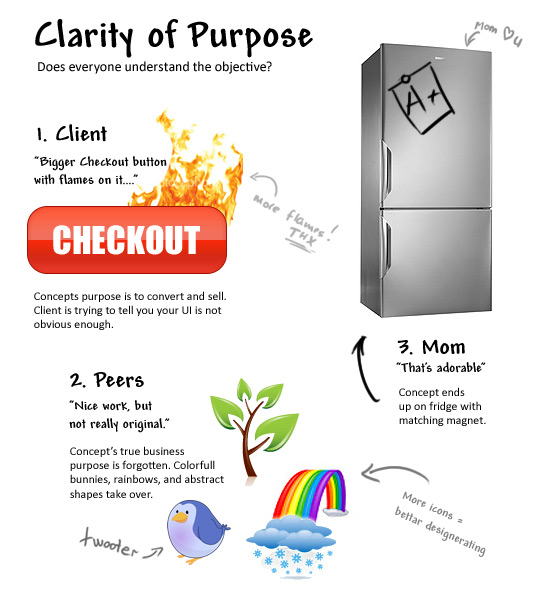
Clearly identifying the goal of a design before you share it with others is always a good idea. Are you showing it off to mom for some fridge time? Is it a client who’s trying to solve a business challenge through design? Or perhaps you’re consulting a friend with no experience or stake in the project. Regardless, a vague or confused objective will always elicit off-target feedback, so make sure everyone involved “gets it” before taking action. To respond effectively to criticism, you need to be sure that the critic understands your goals. Be specific. Present your objective in clear and concise terms; the criticism you receive will be targeted and actionable as a result.
Clarity Illustration in How To Respond Effectively To Design Criticism

3. Check Your First Reaction

For most people (me included), the first reaction to criticism is to get defensive or even lash out. If this sounds like you, take time to develop the habit of taking a deep breath and counting to 10 before responding. This simple yet effective method gives you a chance to regain composure and allow logic to prevail over emotion. The last thing you want to do is get overly emotional and give a response that you will later regret. Remember, in most cases, your critic is only trying to help you.

Despite the initial sting, you need honest feedback to become a better designer. This is especially important for enthusiasts or beginners in the trade. All visual arts have an intrinsic reward mechanism: the more you create, the more you sense the progression of your skill. It’s a loop that keeps all artists going, and when this euphoric moment is crushed by accurate and much-needed criticism, recovering may be difficult. Keep in mind, though, that your skill and perceptiveness in this field will mature over time. If you have the right attitude to begin with, the proper response will follow.

4. Separate Wheat From The Chaff

Unfortunately, not all criticism is constructive. Some people are in a bad mood, bitter or just plain negative and will take any chance to put others down. Some are also inexperienced or unqualified to give you valuable feedback. While design is subjective, being able to separate useful feedback from cheap shots and misinformation is important. However, this is not an excuse to ignore comments that you don’t like. Unless you believe a critique was given in malice or ignorance, don’t be quick to dismiss it.

Here are a few tips to distinguish between the two:

  • Specific.
    Valuable feedback is always specific. It is clear, logical and defined. “The logo is ugly” or “I don’t like the color choice” are examples of useless criticism (if you get a lot of this, see #7 below).
  • Actionable.
    Constructive criticism should enable you to take immediate action. You should come away with a clearer idea of how to improve the concept and the path to follow.
  • Objective.
    Useful feedback is unbiased. It gives you a unique perspective without an ulterior motive. Objective criticism will always be even-tempered and appropriate.

5. Learn From It

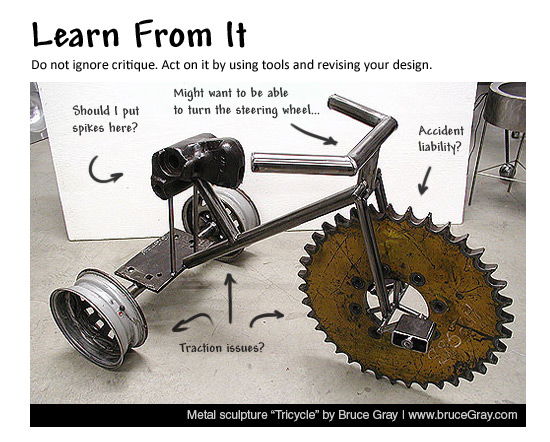
This step is possibly the hardest one in this learning experience but by far the most important. For criticism to serve its purpose, you need to act on it! Don’t just go back to business as usual; make an effort to improve. The great thing about criticism is that it uncovers our blind spots, weaknesses that only others can see. When you’re confronted by criticism, don’t let the opportunity pass: write it down and do whatever it takes to change for the better.

If someone criticizes your copywriting skills, start with baby steps. Read a relevant blog once a week. Buy a book. Practice writing headlines for 10 minutes each day. Small victories are often the quickest path to success. Eventually you will improve and have your critic to thank.
Learn in How To Respond Effectively To Design Criticism

6. Look For A New Idea

If you can’t learn anything new, look for a new idea. A different perspective gives you a chance to examine your work from a viewpoint that you would never have considered otherwise. Just as you get inspiration from a gallery or another talented designer, you can find ideas and inspiration in constructive criticism; seeing it just requires you to step back. Be curious, and approach the criticism objectively; it could be incredibly useful.

Criticism is sometimes the cold shower you need to wake up and hit the “Reset” button on a project. Remember, your work is based on your own preconceived notions of what the client wants, and you should always be open to the possibility that you have missed the mark. In the event that you do need to start over, discuss the objectives and expectations right away. Clarifying this information in the first place could have prevented a re-do altogether.

7. Dig Deeper When Necessary

At some point, everyone has received vague, unclear or unactionable feedback. It’s a part of life. Unfortunately, unless you take the initiative, this type of feedback is more or less useless to everyone involved. However, if you’re willing to dig a little deeper, you may uncover things that no one else was willing to tell you. Start by asking open-ended questions that get to the core of the issue, questions like, “I want to understand your point of view. Could you please provide more detail?” or “How can I improve?” Ask for specifics and, above all else, honesty. These kinds of questions will help keep communication lines open and allow you to walk away with practical and concrete advice.

Dig Deeper in How To Respond Effectively To Design Criticism

If you feel uncomfortable asking your critic for more detail, or if they are unwilling to provide it, approach someone you respect or trust and ask them what they think. Do they agree with the criticism? Why or why not? Assuming this person is honest and knowledgeable, you should be able to get the answers that you need to move forward.

8. Thank The Critic

Whether the criticism you receive is genuine or downright rude, make a point of saying “Thank you.” Thanking even your harshest critics can create a lasting impression, keep you humble and open the door to additional feedback in the future. Expressing gratitude will also make you feel better about the experience and help you alleviate any innate avoidance of feedback and criticism you may have. If you have followed the guidelines above and recognize the true value of the criticism you have received, saying “Thank you” shouldn’t be too difficult.

If you respect the person and their opinion, go one step further and develop a long-term mentoring relationship with them. Much like in the old days of craftsman and apprentice, an individual whose opinion you value and hold in high esteem can go a long way in developing your skills and abilities. If nothing else, a mentor can keep you accountable to your work and help you continually improve.

Do you have a technique to share or a real-life example of criticism in action? Let us know!

Further Resources

Valuable feedback is great, but getting it is not always easy. Here are a handful of free online tools you can use to start getting feedback from peers and professionals today:

  • Concept Feedback
    A free design feedback tool for designers, freelancers and marketers.
  • Smashing Forum
    A simple but effective text-based feedback forum for designers.
  • SitePoint Forum
    One of the largest forums for developers, offering website and content reviews.
  • Web Design Forums
    Smashing Magazine presents some of the better Web design forums around.

Even more forums:

More reading:

(al)

Andrew Follett is a small-business marketing director and founder of Concept Feedback, a community of designers and marketers dedicated to sharing ideas and feedback on design projects.

    Post Rating
    1 Star2 Stars3 Stars4 Stars5 Stars (2 votes, average: 5.00 out of 5)
    Loading ... Loading ...

    Tags: ,

    Advertising
    1. 1
      Ahmed Obaid
      October 1st, 2009 3:23 am

      I think the most important part is not to take that criticism as a personal attack, and deal with it with some wisdom.

    2. 2
      haydyn
      October 1st, 2009 3:26 am

      one of the hardest things i find working in a blue chip corporate environment, but honestly the more constructive criticism you take and work with it, the better designer you will become!

    3. 3
      Le Marquis
      October 1st, 2009 3:30 am

      Ow boy. This sounds just like me… I have a hard time receiving negative responses from my designs. Although my emlpoyer is one of those that gives me useless critics which I have a hard time working with. As a designer you really want to know what wrong, and not hear somthing like: “That logo sucks” or “I don”t like the design”. In all of those cases it’s back to the drawingboard, back to the beginning…
      So numbers 7 is for me to work on… This article is a true life saver…

      Many thanks for sharing

    4. 4
      FrontPage Blogsome
      October 1st, 2009 3:34 am

      Thanks Andrew. Sometime the first respon is to strike back his design, or even in ad-hominem tone. But the positive respond usually freshen our feeling and creativity. So, yes, “thank to critic.”

    5. 5
      Jayphen
      October 1st, 2009 3:49 am

      Nice article, love the illustrations!

    6. 6
      Francis
      October 1st, 2009 3:53 am

      Great reminder, all the time I had a bad critic, I’ve ended up designing something that I was really proud of. Most of these pieces are in my portfolio now! Criticism is good.

    7. 7
      Luke Jones
      October 1st, 2009 3:55 am

      I’ve always been able to take and give criticism well, without being too vague or subjective (though there’s always subjectivity in design criticism). One thing that does bug me, however, is when people are lying or telling a white lie to make a new designer feel better. It’s better to be one hundred per cent truthful to make somebody improve, rather than lie and let them carry on with something that is downright vile, and I’m sure many of you agree with me.

      A really nice article there, I even start a thread over at the Web Designer Forum asking people to criticise themselves.

    8. 8
      Paul
      October 1st, 2009 3:59 am

      I would love to work in a company where my boss actually knew what he was talking about. I crave critisim and always welcomed it in uni when meeting with my design lectures, but working for someone who is more clueless than my left foot grinds me down!

    9. 9
      Beck
      October 1st, 2009 4:43 am

      I know how hard is to get bad feedbacks from our clients/bosses because that happens all the time.

      Sometimes you get paid not to really design, but to draw and format those elements according and stricktly to the boss/client´s point of view, and that my friend, is the saddest day of work.

      However, criticism is always good, so it makes you come down to Earth and realise that those infinite hours you worked are worth or not. If not, then you realise that the one who´s needing to change is you. Sometimes criticism comes in a rewarding way, i guess, most of the time though.

    10. 10
      BJMRamage
      October 1st, 2009 5:04 am

      Love this article. I posted a link to it on a graphic design forum i peruse. I also included a tiny snippet to entice people to visit this page.

      It really is a learning tool. Don’t ignore it, a sponge and absorb it…if you don’t act on something now, it may come back to you when you feel a design isn’t there and that critique before will help.

    11. 11
      Michiel Ebberink
      October 1st, 2009 5:17 am

      Really bad criticism, I noticed that I don’t get it too often anymore, but don’t get me wrong I had my share. Sometimes I still do get a good load of criticism. The worst design processes are the ones without any criticism.

    12. 12
      Craig Wann
      October 1st, 2009 5:49 am

      I really helps me to have a boss that will rip apart my designs if need be. It was hard to take at first, but it gives you the freedom to try new ideas. You know if it sucks, it will never make it out the door…

      Andrew is right, it would be much harder to grow without someone to challenge your designs.

    13. 13
      Martin Bentley Krebs
      October 1st, 2009 5:51 am

      “Constructive” is a key word when it comes to criticism, but the reality is that sometimes we get opinions from someone who is barely qualified to give an assessment. So be it! Whether they’re qualified or not to render an opinion is not the point; sometimes, we are charged with executing to the wishes of the “internal client” first, then the external client second.

      The best lesson I ever learned over the years was to separate the issue from the tissue—who I am is SO much more than what I do.

      Great article!

    14. 14
      Harry M
      October 1st, 2009 5:54 am

      When in college I had a prof in our video classes that would bring your work up in front of everyone and tear it apart. He tore into mine one time and I never forgot it, so when I shot I made sure I took into perspective everything he said and it made me a better shooter. He was really tough on people and those that rose up he kept pushing. I was one of the only people he wrote a letter of recommendation for in the end.

      I just sat through a session Monday with clients and their print designer and had a session similar to all this. I had to defend a few things since print and web design look at different things, but the elements I have added have made my stuff better.

      Criticism is just part of this business and so few people can take it whether its nicely given or shoved down your throat you need to accept it, and smile.

    15. 15
      j
      October 1st, 2009 6:20 am

      def something i need to work on .. ha. thanks SMASH!

    16. 16
      Wib Walk
      October 1st, 2009 6:40 am

      Great tips!

      There is a big difference between “constructive feedback” and “criticism”, I just wish that people knew what it was.

    17. 17
      jennifer
      October 1st, 2009 6:42 am

      great article! criticism is necessary and helps make things better. I find myself getting very frustrated, though, when the client wants things that just look bad or tacky; I don’t want to put my name on something sub-par.

    18. 18
      mgsesq
      October 1st, 2009 6:48 am

      Great article… I definitely know some people who should give this a read.
      Being able to accept criticism is important to a designer, but almost as important is being able to defend your design decisions. I find that outside of creative fields many times people just ‘don’t get it’ until you explain it to them. The subtleties of symbolism and metaphors are sometimes lost on those lacking a background or passion for art.

    19. 19
      Ian
      October 1st, 2009 6:49 am

      I think as many have already said, its sometimes difficult taking criticism from people you think aren’t qualified to give it. A bitter pill to swallow when you know your idea is a winner.

      But yes I have been taken down different routes and from that the final product has benefited from the initial criticism. Yet many a time that criticism and client led projects have ended in a less than effective design at best.

      Many a time I try to explain to clients not to try and personalize their website and look at it through their customers eyes instead. This usually provides common ground to take things forward and get them on side with the initial drafts.

      Yet I would disagree with the above post, no criticism means I get the project billed and paid quicker, no one can argue with that.

      Great article, as always.

    20. 20
      rmlumley
      October 1st, 2009 6:57 am

      #7 is definitely the one I run into the most. The best is when people don’t like the color, but don’t suggest a different option. Sometimes I feel like they think there is some undiscovered color that we could be using.

    21. 21
      patvillaruz
      October 1st, 2009 6:59 am

      wow! a lifesaver post… it helps alot.. thnx for sharing!

    22. 22
      Stefan Reichert
      October 1st, 2009 7:18 am

      Great Article. Thank for that.

    23. 23
      Rajesh Trilokhria
      October 1st, 2009 8:00 am

      I do agree critics for your design always takes you to the next level of design where you think from others perspective :)

      Very nice article, I love this…….

    24. 24
      dlv
      October 1st, 2009 8:33 am

      lovely and great article !!
      Nice read

      Congrats for doing it, i thing it was hard to create…
      also ,thanks for share

    25. 25
      Michael Werner
      October 1st, 2009 8:54 am

      I don’t see criticism as a negative at all… because I’m working as an “owner advocate”.
      In foodservice and hospitality design especially, functionality is an absolute must, thus constructive criticism fuels great design. My role differs, in that we must bring an added level of expertise with operations and understanding what the client is trying to achieve from an operational, as well as the guest perspective. In my business, I have to see everything from the client’s point of view (including budget) so I welcome the challenge brought on by spirited discussions. Remember, “When you’re green your good, when you’re ripe you’re rotten”

    26. 26
      Erik
      October 1st, 2009 9:04 am

      @rmlumley

      #7 is definitely the one I run into the most. The best is when people don’t like the color, but don’t suggest a different option. Sometimes I feel like they think there is some undiscovered color that we could be using.

      HAHAHAHAHAHH +1

    27. 27
      Quakeulf >:3~
      October 1st, 2009 9:15 am

      Everyone I know who convinces themselves they are doing this seriously and professionally take critisism like a punch in the gut.

      Personally, most critique won’t bite me because I know in 99% of the situations I have encountered it’s nothing worth thinking of. Unless I know I am at a loss I can always argue 100% for what I am doing to the point where the one giving me critique must give up. :3

    28. 28
      Joel
      October 1st, 2009 9:27 am

      I don’t like the color blue. Everyone uses blue.

    29. 29
      B
      October 1st, 2009 9:39 am

      Amazing Article!

    30. 30
      mgsesq
      October 1st, 2009 9:46 am

      Joel,

      “I don’t like the color blue. Everyone uses blue.”

      You must be the people they talk about in number 4.
      Or the guy rmlumley is talking about in an above response.

    31. 31
      TCCBryan
      October 1st, 2009 9:56 am

      This is a great article for all levels of designers to consider. I am relatively new to the design world and am picking up the skills as a self-trained amateur. One of the really cool things has been starting a 12 week challenge with a close friend that will hopefully boost our inspiration, challenge us to try new things, but it also gives us the opportunity to leave comments and criticism. We have just started our 6th week of the “challenge” and I can already tell an improvement in my skill and design with the comments, criticisms, and suggestions I have been given on previous weeks projects.

      I think I will use this article as a key reference every so often as a good reality check! Thank you.

      Bryan – TheCreatorsClub.com

    32. 32
      Torsh
      October 1st, 2009 10:50 am

      Agree with everything…except the indictment of open, vague criticism. Everyone always complains about it, but all such criticism is saying the same very useful thing: “It’s just not right.” You don’t have to have figured out exactly is wrong to know that it’s not working. Sometimes it’s impossible to know. Maybe the work is so wrong that there’s no way to improve it via specific suggestions. Either way, creatives should take these vague, open criticisms as a sign that they need try something different. There’s always another idea. Usually, the next one is better. (Unless you’re not talented or hard-working, of course.)

      Stop complaining about vague criticism, you lazy-ass creatives.

    33. 33
      Eric
      October 1st, 2009 11:15 am

      There is an entire spectrum of criticism between “It just doesn’t work” to “Make this blue and put it here.” I love thoughtful criticism (in fact I crave it), but having someone expect you to read their mind or giving direction so minutely specific that I become a mere mindless instrument without judgment are both quite discouraging. How about an article on how to give criticism?

    34. 34
      Lisa Barringer
      October 1st, 2009 12:02 pm

      Wonderful article! Very poignant! Great points to apply ─ not only when it comes to designing Web sites but, generally, in life.

    35. 35
      Jason Collin Photography
      October 1st, 2009 12:11 pm

      I can go either way with criticism, sometimes I can just brush it off, sometimes it would keep me up all night. I guess it depends on the source of the criticism. I often ask friends and colleagues for feedback on photos I’m working on and when I was designing my photography site. I constantly ask my wife her opinion when I’m working on a set of photos for a client.

      Just as long as the criticism is meant to help, not just be inflammatory, I try to welcome it.

    36. 36
      Adardesign
      October 1st, 2009 12:24 pm

      Great Post, Its so true!

    37. 37
      David A
      October 1st, 2009 12:44 pm

      Meaningful criticism requires critical thinking. That lets out 50% of the population (in America, anyway). It also requires that egos be checked at the door. Lop off another 40%. It also requires the client to remember (and stick to) the stated objective. Subtract another 15%. That leaves us with a negative number.

      Hey! No wonder criticism is so often negative.

    38. 38
      dv
      October 1st, 2009 1:11 pm

      vague criticism often implies that people don’t care – or put in enough effort to really analyze something… and that is not encouraging to anyone on the receiving end to improve or take the feedback. the energy transfer here is super important.

      great article

    39. 39
      I. Gregory
      October 1st, 2009 1:14 pm

      Thanks for the great reminder Smashing! My designing has vastly improved over the past year because I have learned to take criticism from my peers and use it for good without compromising my work. I have found that Concept Feedback is a great site to get good quality peer review on my work.

    40. 40
      Sadalmo Glivis
      October 1st, 2009 1:31 pm

      I guess you have never worked for tools that are dumber than dirt, but happen to be a political appointee and like nothing better than throwing around their clout. Criticism is wonderful if it comes from those qualified to give it. When it comes from dolts, its time to slap on a shit eating grin and kiss ass.

    41. 41
      Nelson
      October 1st, 2009 1:42 pm

      Nice article. This is really hard stuff to deal with, but your tips are pretty good to survive in a feedback session.

    42. 42
      ByColor
      October 1st, 2009 1:58 pm

      Don’t forget the opposite: when criticism gets too specific and too often, it can turn a designer into a simple pixel pusher.

    43. 43
      Alex Komarov
      October 1st, 2009 4:57 pm

      It is a very nice article, I guess there are not too many responses because the criticism seems to be so scary and painful matter that people are afraid to read about it.

    44. 44
      Cathleen Green
      October 1st, 2009 5:48 pm

      This is a well timed article, thank you. I think all of us at one time or another have felt attacked and defensive as you mentioned to a piece of stinging criticism; I know I am guilty as charged. As a new designer, trying to find a place in this tough market, it’s especially important to understand how to productively respond to clients when things get a bit sticky.

    45. 45
      zeropx
      October 1st, 2009 6:56 pm

      This was a wonderful article! What I gained from this article will help so much in my future. I appreciate the write.

    46. 46
      Aurimas
      October 1st, 2009 7:30 pm

      Glad you liked the illustrations… I was chuckling as I was putting them together. :D

    47. 47
      Edmund Cheh
      October 1st, 2009 7:31 pm

      I guess sometimes people fail to realise that they did not listen properly. It goes both ways :- from the designer’s point of view to the client side. If you consider hearing others criticisms to the equivalent of listening to their thoughts on the project or visual and on how they see your visuals, I think you feel half as bad.

    48. 48
      louella
      October 1st, 2009 7:45 pm

      thanks for this post.. so timely :) was doing a mini outburst in my head, then i read this and thought… hehe… im gona do this instead

    49. 49
      yoxx
      October 1st, 2009 8:28 pm

      yeah nice :) but not really original..

    50. 50
      Sijeesh
      October 1st, 2009 8:57 pm

      This was a wonderful article!

    51. 51
      sharmela
      October 1st, 2009 10:26 pm

      Good article.

      I just love it when people criticise but don’t offer proper feedback; eg: Oh you know, I’ll leave to you.

      And then 2 weeks later, after the sample artwork has been delivered: “Oh but that wasn’t what I wanted.”.

      Gee dude, what do I look like, a psychic?

      Then it’s back to the drawing board.

      But otherwise, two or three brains (who more or less know creatively which direction they’re heading) is always better than one.

    52. 52
      Rafa Carrasco
      October 1st, 2009 10:33 pm

      Excuse me, are you telling me you don’t like my design?
      Arrrrrrghhhhh!!! I´ll kill u and then kill myself!
      :-)

    53. 53
      mcnuggets86
      October 1st, 2009 10:34 pm

      excellent article, it’s always good to be reminded about the little things that help make a project big.

    54. 54
      Kashif M Qasim
      October 1st, 2009 11:55 pm

      Great One! And of course very true. Keep up the good work SM.

    55. 55
      Tim
      October 2nd, 2009 1:05 am

      Glad you chose that Churchill quote and not the one where he said, “I am strongly in favour of using poisoned gas against uncivilised tribes…”

      Still, twas a helpful article all the same.

    56. 56
      Pepsuber
      October 2nd, 2009 3:54 am

      A good article…. but I never saw Stubbs or worms. Thanks though.

    57. 57
      Lauren
      October 2nd, 2009 7:40 am

      “Constructive” criticism is the hardest part of any creative job. What I’ve learned: if I keep getting the same type of correction — in my case, design elements are often seen as too low key — there’s something to the criticism and I should re-examine my overall strategy. But my least favorite approach is when someone (esp. if they’re not a designer) just says “use this” without giving me a whack at whatever isn’t working. Ugh.

    58. 58
      Phil Spencer
      October 2nd, 2009 7:43 am

      Some very salient points but I’ve got to question this:

      “Design is subjective and, like any art form, has no rulebook.”

      Design is NOT art and DOES have a rulebook which is defined by the the objective see your item number 2:

      “Clearly identifying the goal of a design before you share it with others is always a good idea.”

    59. 59
      Tami
      October 2nd, 2009 11:31 am

      Of course negative feedback stings. But its necessary.

      There are several comments above that talk about getting poor feedback i.e. “this logo sucks” or “I don’t like it”. Its usually not the critics job to give you concise, accurate feedback about a design, its our job as the designer to figure it out. That’s the point of 7. If a client doesn’t like a logo – why? Does it not accurate represent their brand? And why are they requesting a bigger logo? Do they feel the brand is getting lost by an overpowering background? When a client asked for red text its our job to understand they’re saying that text needs to be emphasized in someway, not necessarily made red. And, often time to help the client understand that too.

      To dismiss feedback as poor, or not constructive is lazy. They’re not the designer, you are and you need to be able to interpret what that feedback is. After all, design is communication, and the designer can’t excel at communication, then its the designer that’s bad, not the critique.

    60. 60
      Emily
      October 2nd, 2009 2:10 pm

      Oh, #7.

      So often my request for clarity or additional details in a client’s criticism such as “I don’t like ____”, or “this part is ugly” is met with “isn’t it YOUR job to figure out what to do??”

      What do you do with plain ornery clients who are paying the money, but refuse to be part of the creative process? Essentially, the choice is between losing that account, or spontaneously learning the ability to read minds. (At least that’s how it feels…)

      Edit: I just read Tami’s response above mine, and I want to clarify: It’s not wise to blindly interpret a client’s reasoning for why they don’t like a specific thing, or why they want some god-awful change. More information is needed to correctly interpret their desires, or else you risk designing on some tangent based on what you THOUGHT they wanted, and shooting completely off the mark. Wasting both your time, and theirs. That is why additional clarification and discussion is important, communication from BOTH client and designer.

    61. 61
      paul
      October 2nd, 2009 2:45 pm

      why was my comment not published?

    62. 62
      asdfg
      October 2nd, 2009 3:29 pm

      Honestly I don’t think clients or people that don’t know what they’re talking about, should give you bad criticism because it can never be constructive, since they don’t know what they’re talking about. What they’re saying is their subjective opinion and in my experience it rarely helps improve my design, usually makes it worse. But you have to do it anyways since they’re paying for it or you can turn the project down. Sometimes however if you’re dealing with someone that either has been working with artists or designers for a while (not necessarily a designer himself) they can really give you constructive feedback and point you in a right direction.

      And I don’t think designers should be the only people that should take bad criticism. Take your clients for example, would you criticize the way they do business if you were their customer? And if so do you think they would value your criticism? Sometimes sure, but for the most part people in their position choose who they take criticism from and I think that’s a good thing.

    63. 63
      Eliza
      October 2nd, 2009 4:43 pm

      I feel like when it comes it art & design, everyone can have a valuable opinion regardless of if they’re “qualified.” Of course I put more weight on certain opinions over others but I don’t think that just because someone has a business degree instead of fine arts or is a plumber instead of a designer that means they won’t have valuable insight.

      A problem I see often is some designers only respect feedback from other people in their industry (fellow designers / web developers / etc), which is a mistake… what appeals to designers doesn’t work for all people, especially when designing for an audience that is less comfortable with technology.

      I do think client’s criticism should always be seriously considered even if it seems silly — after all they probably have been working with their customers a lot longer and may have better insight into what works for them.

    64. 64
      percol8r
      October 2nd, 2009 6:36 pm

      Wow — you all have such good attitudes! I think I do most of the time — but I currently work in a very micro-managed environment that takes every ounce of my good spirit to survive within.

      It’s a nonprofit agency, which — I don’t know — seems to be a different beast. Several of my superiors are lacking in basic skill and savviness. So, it’s difficult to respect their opinions about my work. But they are paying my paycheck — so I do my best. (I am planning to leave for a better environment as soon as I can, though.)

      These are people who don’t have any design training but still feel as though the First Amendment has given them the prerogative to be critical in random, ambiguous ways. Sure, design is subjective. But if someone likes to change colors or layouts on their own whim just because he is an officer in a company with hierarchy over you — that’s just bad management. I can’t tell you how many times I’ve tried to argue for consistency in what we produce in order to build our “brand” — but I get told to make changes that work against that.

      Sometimes I put things out into the public that I am so displeased with — but in my environment making the director happy trumps relaying information in the most provocative, understandable ways.

      Further, in my environment, these people don’t know how to do what I do — so they are oblivious to the time things can take to change. Sometimes a designer has to weigh how much time a certain tactic might require and might decide to do something more simple to stay on track or not waste resources. I want my best focus to be on a four-color report — not wasted tweaking a newspaper ad few are likely to see. Someone without any design training doesn’t have the sensibility to make calls such as these. Their playing designer wastes your time and the company’s resources — and leads to your burn-out and frustration.

      So, ultimately, I’d just like to be treated as the trained professional I am — rather than be put in the awkward position of always having to incorporate others’ ill-advised and poorly-considered ideas into my work. I know what I am doing — I’ve won awards for my work. I would like to be trusted that I work hard, taking considerations of aesthetics into account while also having a bigger picture about time and resources. That’s the special expertise I bring to the table.

      No one would hire a lawyer and then fail to utilize him to the fullest extent — imposing their ideas and suggestions over the lawyer’s strategy. So, why would someone feel entitled to do that to other trained professionals?

      I mean, if everyone’s opinion is valid — why do we have design schools or encourage people to spend time in training? Why not just hire “just anyone” — if “just anyone” is qualified to evaluate and execute good design?

      In sum, a good attitude is a great defense mechanism. But at some point good designers have to stand by their approach and their work. You earn respect by presenting a very clear, bold and assured demeanor. Acquiesce too much and you simply appear wishy-washy, not convicted, lacking in passion and niche — and, thus, valueless in your craft.

    65. 65
      ^I-thnk-I-no-U
      October 3rd, 2009 1:30 pm

      The above story sounds strangely familiar. In fact I think I know you! This article is great and very timely. Communication skills are a must. I agree with all of the above. This is very common of nonprofits.

    66. 66
      razor
      October 4th, 2009 7:56 am

      i’ve realized specially with web projects. approx one month after the initial preview of the design. the wow factor wears out and the client tends to ask to change things. i’ve come to believe this is because they keep looking at the design and their mind gets bored of it. what you guys think abt this.

      nevertheless great post.

    67. 67
      A Reader
      October 5th, 2009 12:00 am

      Agree with Ahmed Obaid thought, this kind of thing are hard to master. It ain’t easy to take it as it comes. Especially when the clients ain’t artists at all.

    68. 68
      Selvam
      October 5th, 2009 12:34 am

      thanks….much informative….

    69. 69
      James
      October 5th, 2009 2:04 am

      I think the article needs A LOT of work! ;)
      Just kidding. Thanks for the tips.

    70. 70
      Sascha
      October 5th, 2009 2:56 am

      While most of the article is really fine and helpful, two thing are dead wrong on spot: Design is subjective and, like any art form, has no rulebook. No one can tell you what is “right” and “wrong” with your work… This is plain bullshit, sorry, and amongst the worst opinions permeating within our profession. Design is NOT art. There surely exists a grey zone between design and art, but the possibiliity that your work falls into it is extremely low, so stop considering. There are subjective decisions in design, agreed. But if you’re not able to rationalise your concept, to explain to the people you cooperate with (i.e. clients) why you did something this way or the other, you shouldn’t call yourself a designer. In design one is working with (hopefully) clear objectives and restraints. There’s a purpose. Hence, if design work does not support its purpose or even violates it, it definitely can be wrong. Or right, in the opposite case.

    71. 71
      Ted Rex
      October 5th, 2009 5:42 am

      Excellent advise and a topic not usually covered. I posted a link to this page on my daily design blog

    72. 72
      Joe Barstow
      October 5th, 2009 8:07 am

      okay good article but smash why so many ads? Check my credit score.. really? obnoxious and goes against the entire reason why I found this site to be useful. I was more able to retain information from valuable articles such as this one.

      My apologies to the author for getting off topic, and condolences for being mixed into this spam bucket.

    73. 73
      CC
      October 5th, 2009 8:30 am

      I think the article needs A LOT of work! ;)
      Just kidding. Thanks for the tips.

    74. 74
      CC
      October 5th, 2009 8:38 am

      okay good article but smash why so many ads? Check my credit score.. really? obnoxious and goes against the entire reason why I found this site to be useful. I was more able to retain information from valuable articles such as this one.
      My apologies to the author for getting off topic, and condolences for being mixed into this spam bucket.

    75. 75
      Docali
      October 5th, 2009 10:43 am

      True, true… Thanks for the tips :)

    76. 76
      sandeep
      October 5th, 2009 10:38 pm

      Honestly the more constructive criticism you take and work with it, the better designer you will become! that’s true.

    77. 77
      sandeep
      October 5th, 2009 10:51 pm

      hi,
      Honestly the more constructive criticism you take and work with it, the better designer you will become! that’s true.

    78. 78
      Fusion
      October 6th, 2009 3:37 am

      Design is not art! Don’t say that! It is much more than art! Art has = emotion and Design = function+form+emotion…

      Don`t put the things in same bag. That is why us designers sometimes get that “criticism”…

    79. 79
      Niubi
      October 6th, 2009 3:40 am

      I always accept constructive criticism – how else am I to grow and improve my work? Likewise, I always try to positively criticize my friends and colleagues when I think I can help them to improve something in their life/work. For example, DubLi.com didn’t have a search box for a long while, an omission which I thought was a bit odd for a shopping portal. Now they do! Although I doubt it was my lone pointer which changed that!

    80. 80
      Daemon
      October 6th, 2009 8:44 am

      “Design is subjective and, like any art form, has no rulebook. ”

      Stopped reading there.

      Design is not ART. Painting a picture is art. Design is science. As such, it is very strict. There ARE rules, and there IS a rulebook. Why do most sites have top-left logo? Why do buttons need to look like real life buttons? There is millions of things that DESIGN does in today’s world, and none of them can be called ART.

      Art is something everyone understands differently. Design must be understood EQUALLY by all.

    81. 81
      thehilarion
      October 6th, 2009 5:54 pm

      Thank you for the article and especially for the thread that’s followed.

      “ByColor (October 1st, 2009, 1:58 pm)
      Don’t forget the opposite: when criticism gets too specific and too often, it can turn a designer into a simple pixel pusher.”

      Amen to that, I’m constantly complimented as being ‘easy to work with’ but never happy with my work as somehow I’ve surrendered my power to the client who’s suddenly no longer consulting my expertise.

      “razor (October 4th, 2009, 7:56 am)
      i’ve realized specially with web projects. approx one month after the initial preview of the design. the wow factor wears out and the client tends to ask to change things. i’ve come to believe this is because they keep looking at the design and their mind gets bored of it. what you guys think abt this.”

      Razor, you hit the nail on the head. They definitely are enamored by the initial ‘wow’ factor then when the honey moon is over they see the real site. And surprise surprise… how often does it come full circle back to your original designs that were addressing the original requirements?

    82. 82
      Ravikumar V.
      October 6th, 2009 8:56 pm

      where is digg ??

    83. 83
      Ray Wenderlich
      October 7th, 2009 7:05 am

      The list of forums good for design feedback makes this article worth reading all in itself!

    84. 84
      lsd
      October 7th, 2009 7:06 am

      Thank you for a great article. Helped me put all the pieces in place.

    85. 85
      Jennie
      October 7th, 2009 8:50 am

      I’m don’t agree w/ the idea that “Design is subjective.” I’ve always believed that design should be OBJECTIVE and I don’t think it should be viewed on the same level as art. Art is about self expression while design is about goals, business, success, etc. I think Smashing is a highly respected source in the online design community but it’s a very irresponsible statement to make. I don’t consider myself an artist but a partner in helping my company achieve their goals using design. The proper response to #1 is to reiterate what those goals were when setting out on the design (and I hope no one here is willy nilly designing something for the sake of making it look “pretty”). Of course there are a lot of clients/bosses where that won’t fly but at least stand up for those goals and let’s base the feedback around those instead of personal feelings. As a designer, it would be a lot easier to respond to “I don’t feel that is working because…” instead of “Make this red” so I think it’s also up to us to probe deep enough to ask “Why don’t you think this is working?”

    86. 86
      tRev
      October 7th, 2009 2:00 pm

      I really have to disagree with most of this article.
      When projects are client driven they end up looking like client driven projects. I dont tell my mechanic how to fix my car, why tell the designer how to do page layout?
      I have run into plenty of clients who say something just to put their fingerprint on the project. In the end it hurts how my portfolio looks and eventually better job opportunities.
      All egos set aside, “constructive criticism” is necessary, but it has to fit in the information architecture of the design and have a purpose. “Turn color x to color y because our competitor uses color X”. Un-constructive criticism: “use reflex blue because everyone else does” is the coup de grace of the design and visibility of the company.

    87. 87
      sanyal
      October 7th, 2009 11:14 pm

      thanks for the article, this is something i always wanted to say but was never able to put in precise words. i dont know about industry but for students it is very helpful.

    88. 88
      MetroplexInteractive
      October 8th, 2009 11:31 am

      I’ve seen a number of graphic designers fall into the trap of being offended by the customer. You have to understand that if not for the customer, no one would be paying the designer to design… therefore, if the customer is not happy, it doesn’t really matter if the gaphic designer is happy. No matter how great the designer thinks their work is – the web site design, print brochure, or online advertisement – it means nothing if the customer isn’t happy. The customer is alwasy right (even when they’re wrong). MetroplexInteractive – Website Design, SEO, Social Media, Marketing

    89. 89
      frazer
      October 9th, 2009 2:19 am

      Its a subject that comes down to entirely how you are as a person, and what you are interested in achieving. Focus objectively on one person trying to improve the work, and you trying in kind. Sadly it often becomes about the people having a macho standoff of who knows best being king. Eventually people will argue anything just for the sake of disagreeing and showing they too can look at design critically, completely at the expense of the work. Online networks should change this though, running ideas through discussion forums allows anonymous feedback and people have time to calm down and think sensibly.
      blur designs network

    90. 90
      Jonathan Patterson
      October 12th, 2009 6:55 pm

      “count to 10 before responding”… this might look a little odd. Instead, just get into the habit of learning constructive AND qualified criticism from useless, haphazard remarks.

      Once you learn to take criticism well you’ll be a better designer.

    91. 91
      Krish Mandal
      October 13th, 2009 7:35 am

      One thing I’ve come to realize after a very long time is that you are only a designer when you do the first iteration or what my mentor calls (and now I do too) “A straw man.” After that first iteration, you are no longer the designer, but only the person with the skills to help the client, who is really the designer. There has to be a place to start. Don’t make the straw man so perfect and put so much energy into it that it’s your “one perfect design.” It’s meant to be offered as a place to start, so the client / boss can feel like they have had a say and are involved in the process.

      Then, after this first iteration, the design is no longer “yours.” With input from the client or boss, the design is now becoming “community property” and what you can bring to the table is guidance on design principles and to take in what they are asking for and finding ways to solve problems. That is what design is, a way to solve problems. People get too caught up in the “beauty” of the design. The question, the goal, is “does this design do the things we need it to do, and if not where does it fall short?”

      As a designer, you are only a guide. Your job is to help the client or boss explain their requirements, and within the constraints of your industry and media, offer a solution that addresses those requirements. Note that their requirements may not be solidified, or even “correct;” they may even be in flux because of internal disagreements at the client site.

      So when people get overly arrogant about “He doesn’t know how to design, I’m the designer here,” they are surely not recognizing their role. The designer is there to help bring to life the idea that the client has. And if you think that everyone sees the reds, greens, and blues in exactly the shades that you’ve picked, you’ve got a long climb ahead.

    92. 92
      Gem
      October 20th, 2009 6:21 pm

      I found this article led to a whole lot of internet beef about designers… that designers in general should analyse themselves to death and get a ’self help’ program going on so they can sit their and absorb limitless banal crap that comes out of peoples heads. Seriously people. Wisdom and a sound judgment as well as constructive criticism are all useful and welcome tools people seem to throw out the window when they ‘want it the way they want it’ regardless of expertise or insight. So if you’re thinking…”Why are the designers on their high horse, why do they never want to do it my way… wa-wa-wa..” maybe you should get some humane perspective on how to respect and treat other people properly. Stop and think before you open your mouth. ‘Do unto others as you would have done unto you’ is a good starting point when you are providing feedback and criticism. Unless you’d rather drive individual designers into the ground so that they do not want to talk or work with you, or they feel like grabbing a BB gun and shoving it down your throat!

      Reference here to great article by Paul Rand
      http://www.andyrutledge.com/human-frailty-and-design-professionalism.php

    93. 93
      Juliet
      October 21st, 2009 4:35 am

      Hi

      Good advice. Criticism can be hard to take and to put to good use.
      Also, one important thing is to not take it personally and to not let it affect self-esteem.

      Juliet

    1. 00

      There are no trackbacks at this time. If you are interested in leaving a trackback, please use this URL.

    Leave a Comment

    Make sure you enter the * required information where indicated. Please also rate the article as it will help us decide future content and posts. Comments are moderated – and rel="nofollow" is in use. Please no link dropping, no keywords or domains as names; do not spam, and do not advertise!


    Advertisement Advertise with us!
    Join in Smashing Forum
    Post your job