Smashing Magazine - we smash you with the information that will make your life easier. really.
Brand = User Experience: The Interface of a Cheeseburger
In the first part of a series on the UX = Brand, the adventure of a web designer starts in a McDonald’s, where he discovers that there is a worm hole between the world of Branding and User Experience Design. Years later he learns that it is the Interface that connects both worlds. This is the first part in a series.
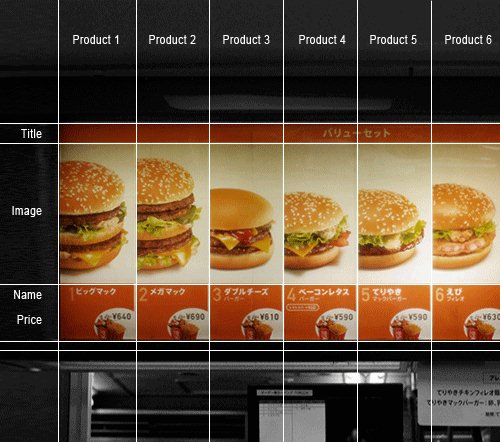
There he goes, the web designer, stepping up to the counter of an empty McDonald’s at 3 o’clock in the morning. He is scanning the overhead menu, putting a cheeseburger in his mental shopping basket. “Cheezubahga, onegaishimasu,” we hear him say, “with an iced tea.”
Waiting for his order, he examines the wireframe of the display on the cash register, the mechanical logic of the deep fat fryers, the input/output logic of the ice cream dispenser. Coming late from work, with his mind still in design mode, he starts tracing the restaurant’s interaction model, drawing arrows from the entrance to the counter to the tables to the trash cans; seeing how the conveyor-belt kitchen, the trays with the paper liners, the bolted down seats and the meals comprise a single, complete customer interface. “They must have run usability tests,” he thinks, taking his tray to the table.
Hungry for Food = Hungry for Words
When we are hungry for food, we follow similar patterns as when we are hungry for information. Similar, infantile patterns. At both times, we fall into a mode of dull impatient demand. We want everything immediately with as little interaction as possible. We want exactly what we expect in the way we are used to get it. When hungry, the last thing we fancy is thinking or making difficult decisions. Because, well, that’s how our body works. And that’s why after a hard day of work we often sleepwalk to McDonald’s.
When we are hungry for knowledge, we inevitably become mentally passive and use all our energies to receive information. Because that’s how our brain works. And that’s why we blindly return to Google search when looking for data.
McDonald’s = Google
McDonald’s is designed for you to switch off your brain as soon as you enter the door. Buying and consuming a Cheeseburger is an automated routine — simple and mindless, like tying shoelaces or riding a bicycle. You don’t need to analyze, guess, evaluate or make difficult decisions because McDonald’s is built in a way that minimizes conscious action. Once learned, the transitions between each step of the ordering process are automatic and seamless. Moreover, in any of its franchises anywhere in the world, McDonald’s provides one consistent user experience. Once learned, ordering, buying and eating becomes an easy routine. It’s just like Google: blunt, focused and clear.
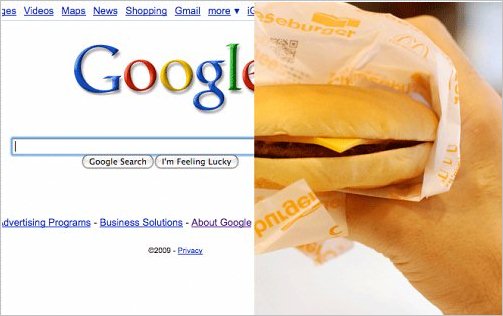
Both McDonalds and Google have a lot in common: both are designed for you to switch off your brain as soon as you enter the “door”.
McDonald’s was driving “user centred design” to the extreme before interaction designers even thought of the notion. From its logo to its tables, from its hamburgers to its trash cans, it’s all designed to be practical and useful rather than aesthetically pleasing.
This functional approach is applied all the way down to the cheeseburger. Standardized in shape, taste, and consistency, it has an identity that is clearly distinct from that of the sandwich. There’s no need for a knife, fork or spoon, plate or pair of chopsticks. In fact, it has a simple hand-to-mouth interaction model not unlike that of baby to breast.
Fast Food Epiphany
The look, feel and taste of McDonald’s food is as branded as its logo. The design of the cheeseburger is a core component of McDonald’s corporate design, just like Ronald McDonald’s and the ketchup and mustard colors of its packaging. Its interface is its brand; its brand is its interface. But so what? Of course, everything at McDonald’s is designed and standardized. Of course, everything is calculated and controlled in a huge global franchise.
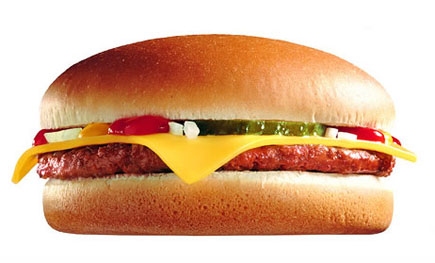
My epiphany that night was not that McDonald’s success is based on cold calculation. It was the realization that McDonald’s apparent lack of culinary and aesthetic taste is the result of ‘cold’ user interaction design. McDonald’s design is as user-focused as a high-traffic website. It’s designed so well that it makes us blind like sucklings. Just like Google’s search interface, its beauty is in the interactive experience and not in the object.
A Worm Hole between Branding and UX
In my experience old school branders and interaction designers fundamentally misunderstood and hated each other. They lived in parallel worlds. In one world the designer controlled everything, in the other the user was in charge. What confused me was that the longer I studied McDonald’s frameset, the less I was able to tell whether I was looking at a brand or at an interface. Is this branding or is it user experience design?
I had found what Astronomers call a ‘worm hole.’ A shortcut through space and time that acts like a magic elevator between different realities. McDonald’s seemed to lay at a critical point: the gravitational center of branding, where everything slants into a funnel that leads to a parallel world of user experience design. And back again. Ironically, worm holes have two so called mouths that are connected with a throat:
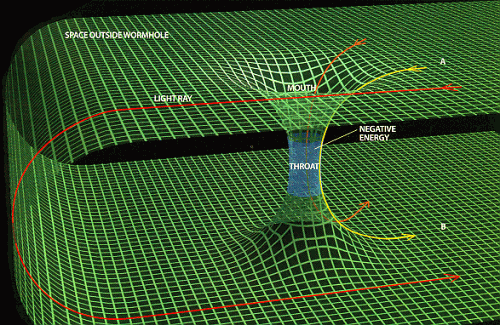
After discovering that this fascinating indeterminacy between brand and user experience applied to most of the recently successful brands — be it the iPhone, the Wii or Star Bucks — I decided to investigate it by thinking about it and writing about it.
Learning from Babies
Just by watching my baby grow and interact with its world, I learned more about interfaces than I could have possibly imagined. Most of what babies do is learning to interface with their surrounding. Observing the baby drinking its milk, I noticed that the interfacing does not happen on the nipple. It happens more generally between the mother and the child. In other words: The nipple is not an interface; it’s just one touch point. The interface is in the whole experience a child makes during breast feeding. The interface is the way they connect. And this experience defines the brand “Mama” in the beginning.
By studying breast feeding (the blueprint of user interaction) live, I was more and more certain that the correct equation was Brand = User Experience. Translated back into theory: The Interface was in the equals sign, not on the other side of the equation. The interface is what connects the worlds of Branding and User Experience Design. It’s the tunnel. The elevator. The wormhole. The throat.
Make sure you don’t miss the second part of the series on Brand = UX. In the next part we’ll look at the tricky question “What is an Interface? And can it be intuitive?”
Would you like to see the next parts of this series on SM?
Hopefully you’ll find this new format inspirational and interesting. What do you think? Please let us know and comment on this article! Your feedback is very valuable for us and it helps us to meet your expectations. Thank you.
About the author
Oliver Reichenstein is the founder and CEO of iA, a user experience design agency with offices in Tokyo and Zurich.
- 116 Comments
- 1
- 2October 24th, 2009 4:31 pm
Breastfeeding and McDonalds and Google. Never thought I’d see those together! I’m still a bit blurry on what you are trying to convey however…
- 3October 24th, 2009 4:34 pm
I’m interested in the things that you’re discussing but not the way that you’re discussing it. We get the relationship between Google and McDonald’s, there was no need for any of the crazy metaphors.
- 4October 24th, 2009 4:39 pm
Great piece, Oliver. Though I rarely visit マクドナルド, I’m sure the next time I do, I’ll be reminded of UX = Brand. Looking forward to the next part.
@Paul: ‘crazy metaphors’ are certainly more memorable.
- 5October 24th, 2009 4:41 pm
Very interesting way of going about this. Excellent article, can’t wait for the next in the series!
- 6October 24th, 2009 4:44 pm
bullshit
- 7October 24th, 2009 4:45 pm
Nice epiphany! I think this is exactly the understanding that companies like Apple have built into their character (Apple especially in the Jonathan Ive era) and exactly what so many other companies either refuse to understand or are struggling to get their head around.
Nice article.
- 8October 24th, 2009 5:19 pm
I’m kind of with Jurica on this; there’s a few obvious points surrounded by a lot of tripe.
The quote, “… designed for you to switch off your brain…”, comparing Google and McDonalds, is rather humorous. Maybe I’m going out on a limb here, but aren’t most Google users in search of an answer to their question(s)? If it could be considered a doorway to knowledge, I fail to see how that’s any form of brain deactivation. The comment reminds me of the obviously false statement that you can’t learn anything from television.
- 9October 24th, 2009 5:27 pm
So many burgers together in one article… damn, I’m hungry now! :D
- 10October 24th, 2009 5:27 pm
This is really interesting and quite true. But does the thought that you might be designing McWebpages horrify you as much as it does me? I know that wasn’t your main point, but the last thing I want is to make characterless cookie cutter pages with no soul–not to mention bad for the digestion. (although at least Mcd’s has a healthy choice menu these days!)
- 11October 24th, 2009 5:27 pm
@Colin deactivation on the interface level I believe is what Google is after. However, good point. Not sure that we turn off our brain the same way on Google as in McDonald’s as implied. but I could be wrong.
- 12October 24th, 2009 5:30 pm
I’m very conflicted about this article.
At first glance, it’s… really, really stupid.
But looking deeper, I mean, fast food menus are some of the most intuitive menus there are, aren’t there? You don’t have to think, except with your stomach.
So it’s an interesting theory … - 13October 24th, 2009 5:56 pm
I did get hungry while reading this article…
- 14October 24th, 2009 6:29 pm
Nice article. Sadly our internal conversation are not that deep or philosophic when we make decisions like this. Everything is very subjective and very superficial. But yes, I can agree that at the end is “all about ‘cold’ user interaction design”
I will look forward for the second part.
- 15October 24th, 2009 6:55 pm
This is a good exercise in demonstrating that UIs are all around us, but we don’t notice them unless we look. But isn’t this the hallmark of a well-designed UI; one that is so streamlined and painless that we barely even notice it?
Thankyou SM for the push to start looking for UI inspiration in places I never would have before.
- 16October 24th, 2009 7:22 pm
great article, quite interesting the connections you make!
- 17October 24th, 2009 7:22 pm
We want everything immediately with as little interaction as possible. We want exactly what we expect in the way we are used to get it. When hungry, the last thing we fancy is thinking or making difficult decisions.
Be careful not to extrapolate the desires of others based only upon utilitarian expectations. This isn’t the only modality, and possibly not even the most common one that adults naturally have. Many of us enjoy socializing, and spending time ruminating, during, after, and even before consumption of food. Visual and olfactory impressions can be at least as important as taste (if not moreso) in the consumption experience of fine cuisine, as well. Certainly, many of us like the idea of picking up a menu and imagining the choices to be brought before us enough to defer satiation while increasing satisfaction.
I think that what McDonald’s does is not merely reactionary to our demand, as your piece seems to suggest. I think their success lies in shaping our demand to meet their needs as well: when we want something fast, McDonald’s has trained us to forgo the interesting by accepting a dull but uniform (and therefore “safe”) product, and then to consume it fast and then leave, or forgo eating on premises altogether, because it fits their needs from an efficiency standpoint. (The garish color scheme reflecting mustard and ketchup that they’ve had up until recently in all their locations isn’t because it makes the hamburgers pop out the window any faster, but probably because it makes us unsettled enough to not want to stick around.) Most importantly, they’ve also promoted the idea of eating fast (eating from the car or at least in a hurry) as a good thing.
I’m not a committed slow foodie, but I do think we’ve been conditioned to accept this and even think of it as normal behavior for us to participate in regularly, when perhaps we shouldn’t. Yes, babies instinctively go to mom’s breast when it’s available. But as there are no ready alternatives for babies themselves to select among (in fact, all they can do is basically suck or not suck), that hardly provides a good analogue or blueprint for adult decision making and interaction. And even those early feeding transactions are at least partly reinforced and shaped by the emotional and physical responses the mom gets, feeding her child.
- 18October 24th, 2009 7:35 pm
“Buying and consuming a Cheeseburger is an automated routine — simple and mindless”
Buying most food is like this, the analogy is horrible. I put little thought into what I order at takeout/resturants. Provided it does not suck it will be fine.
“But looking deeper, I mean, fast food menus are some of the most intuitive menus there are, aren’t there? You don’t have to think, except with your stomach.”
Unless the menu is in another language ALL menus are as simple as fast food. Pick something and eat it. You could goto a very very expensive resturant and still get a good meal. Goto main courses, random whatever, order. How hard is that? It is not the menu that is complicating anything it is the person ordering. Find a menu that is more complicated, they dont exist or are an extreme minority.
- 19October 24th, 2009 8:51 pm
awesome!!
- 20October 24th, 2009 9:34 pm
Wow! I really do like the theory.
The relation with the human nature is a good look at UX design and a right one imo. Don’t focus on the examples my friends, think about the main idea.Looking foward to the 2nd part ! Real good stuff :)
- 21October 24th, 2009 10:43 pm
Interesting, in a wierd way.
- 22October 24th, 2009 11:03 pm
i think the whole analogy turned the idea of the word interface upside down. the word gives the chance to transfere the idea of action and reaction into the digital/technical world. going back to everydaylife and showing that action an reaction can be found there as well (especially on the metaphore of a LEARNING baby) is kind of invalid.
i know that feeling when you’ve been working like hell and suddenly it seems like everything you do is linked to the topic you’re working on. it feels a bit like a conspiracy theory in a positive way but it’s an illusion. seems to me like something like that happend here as well.
- 23October 24th, 2009 11:26 pm
a little hard for me..
- 24October 25th, 2009 1:26 am
Even more awesome than the first time round.
- 25October 25th, 2009 1:30 am
I think what we are really looking at here is Unconscious competence. – The individual has had so much practice with a skill that it becomes “second nature” and can be performed easily (often without concentrating too deeply). He or she may or may not be able teach it to others, depending upon how and when it was learned.
- 26October 25th, 2009 1:51 am
Awesome article, the inappropriate analogies were fun and made complete sense.
- 27October 25th, 2009 2:27 am
Haha that was an awesome article! Thanks for sharing :)
- 28October 25th, 2009 2:40 am
Normally I would NOT read an article like this. But, “The Interface of a Cheeseburger” (huh?) …
hooked me in and the continuing metaphors kept me hooked all the way through the article.
@Colin. Google is in the equal sign. Or, Google is the (open) doorway, no brain activation required to walk through it.
@Paul. I guess if one succeeds as a McWeb page designer, no one would “see” you or your work. Same as no one “sees” the architecture or interior design at a McD’s.
Good for the designer’s ego? Nope.
Good for the user. Yup.@Simon Robb. Well Said!
@artifex. Ah! You, or someone like you, probably designed those websites that I’ve never entered because I couldn’t find the right way to get in! In other words, I’m not dressed well enough to enter your fine dining portal.
- 29October 25th, 2009 2:46 am
Okay…you’re smart. Okay, you know few buzzwords and you can finish those complicated “bizness” sentences…but otherwise the whole article is about “okay, the sky is blue, but I’m going to explain this observation in a whole new perspective and in a very sophisticated manner”. Phew…
- 30October 25th, 2009 3:29 am
A decent entry but it is a given that design is often meant to make you switch off your brain. It’s simply the fact that most consumers seek quick answers to their problems. Google products themselves do not make you switch off your brain entirely but they do make you not sweat the small stuff. The interface allows you to interact easily and to find your answers quickly.
The same goes for McDonald’s. They want you to get in, spend money on food and get out to make room for the next customer. They don’t want you to sit and stare at the trash can for an hour.If you want to talk about UX in retail brands let’s dive into Chiptole. Their restaurants are designed to look sleek and provide an experience that enhances the food (as if it were necessary :), but they are also purposely not designed to house the volume of traffic that they receive. This is why those lines are massive at peak hours. What does that do to new Chipotle customers, it reassures them or pushes them into the store. If the line is this long it must be good right.
Now the company is getting into servicing the returning customer which shows that they are progressing further into brand loyalty. Online ordering and App orders are on the rise and they work well. I could write an entire article just on their UX all around. Since they are a relatively new brand it is a great topic of discussion because you can see them eMerging their brand.
Get more into your topic next time. Otherwise…it’s a decent piece.
- 31October 25th, 2009 3:30 am
Very interesting, but … very funny. This is an unusual approach of the problem.
- 32October 25th, 2009 4:15 am
McDonald’s = Google. Mhhh… I’m going to eat something by Google :p
Great article! :)
- 33October 25th, 2009 4:32 am
Beautifully written piece. Looking forward to part two.
- 34October 25th, 2009 5:10 am
GREEEAT article!
In the right moment for me. Helped me a lot in a project currently working on.More! More!
- 35October 25th, 2009 5:13 am
Crazy and amazing at the same time.
Great article! - 36October 25th, 2009 5:21 am
@Colin : By “designed for you to switch off your brain” I clearly understand that the interface is made to avoid any distraction between the user’s purpose and the way to accomplish it, in a way you “don’t have to think” to get it done. The article itself is rich in such analogies.
- 37October 25th, 2009 7:11 am
Very interesting. I am french and it would be too approximative in words to reply, but great feeling when reading this article
- 38October 25th, 2009 8:36 am
This article made me think. I like when that happens.
- 39October 25th, 2009 8:52 am
@ Johnny Nothing :
Yes, exactly the same for me : “This article made me think. I like when that happens” - 40October 25th, 2009 9:41 am
Me, personally, I’m not afraid of long articles. If you describe your ideas more thoroughly, it would be great.
- 41October 25th, 2009 10:54 am
I don’t see the analogy, I prefer Burger King over McDonalds any day, but I still don’t go out and use Yahoo! I would like to use Yahoo! more than Google, least it doesn’t become the Big Brother we all fear. But I am just SO used to Google that I use it anyway, like my brain shuttting off like you say (which might be an acomplishment on the programmers side, but on my side it’s just making me look dumb, like being controled by a puppeteer or something).
PS: Sorry for my crappy iPhone typing in case I missed any typos. - 42October 25th, 2009 11:25 am
Unless the menu is in another language ALL menus are as simple as fast food. Pick something and eat it. You could goto a very very expensive resturant and still get a good meal. Goto main courses, random whatever, order. How hard is that? It is not the menu that is complicating anything it is the person ordering. Find a menu that is more complicated, they dont exist or are an extreme minority.
I completely disagree. It feels almost as if you are just trying to disagree with the post without having thought about what the author is arguing.
If we look at the comparison of McDonalds to an expensive restaurant, there a several stages that impede ordering before you even get to look at the menu. There is no way you can argue that it is as simple as walking in the door, staring up at the wall, and moving in a slow progression towards the counter—drones. In the expensive restaurant, you must interact with a third party—the hostess—to get a table and a menu. Then you can talk to your waiter to order drinks, and decide whether you will be having appetizers, or going straight for the entrees. And after everything, another decision: will you be staying for dessert? All of that is glossing over the often-confusing wording of menus. What exactly is included with the fillet-mignon? How large is the pizza?
And even in other fast food places, the menus are not always as simple. Ironically enough, have you ever been to McDonald’s affiliated chain, Chipotle? Don’t get me wrong, I LOVE Chipotle, and will eat there over anything, but their menu is horribly confusing for newcomers. I cannot count the amount of times a new customer in front of me has asked me questions about the menu because they could not understand it.
I’m just not sure how you are even making the argument that you have made. It just seems like your just hunting for disagreement.
- 43October 25th, 2009 11:50 am
Some of you have missed the point to this article completely. It’s not to say that we don’t want to use our brains at all, but that most users want to get to the point as quickly as possible without having to use their brains in a way that will divert them from the original objective. With McDonald’s you want to eat a hamburger, so the user experience is designed in such a way that you can walk in, order your burger, and eat it. With Google, you want to get information about a certain subject as quickly as possible. They both make this experience extremely simple so that you don’t get sidetracked from your original path. Websites that don’t obey this as a UX standard, Keep It Simple Stupid, will often confuse their users and lose conversions. Users like to get what they want with as little thought process as possible. That, as I see it, is what this article is about.
- 44October 25th, 2009 12:09 pm
Hey,
Interesting, but please, don’t talk anymore about meat ;)
I am vegetarian, but this is an excellent analogy.Charles, from Paris
- 45October 25th, 2009 12:11 pm
Intriguing article with some modest analysis. I have to agree with this article from a marketing perspective – a clean, simple to use interface which is easy for customers to use and repeat use precedes success. There are surely other factors however – this article touches on some points to ponder. Thanks for it!
- 46October 25th, 2009 12:14 pm
Very good read!
“Cheezubahga” :D - 47October 25th, 2009 1:07 pm
Cheezubahga, onegaishimasu — What does this say? I know the first word is Cheeseburger, but the second word?
- 48October 25th, 2009 1:44 pm
@TM Take a look here for “onegaishimasu” : http://japanese.about.com/blqow15.htm
- 49October 25th, 2009 2:15 pm
Nice article, very interesting.
- 50October 25th, 2009 2:34 pm
I like where this is going and the level at which it is going there. Let’s see the next part(s).
- 51October 25th, 2009 2:39 pm
“If we look at the comparison of McDonalds to an expensive restaurant, there a several stages that impede ordering before you even get to look at the menu. There is no way you can argue that it is as simple as walking in the door, staring up at the wall, and moving in a slow progression towards the counter—drones.”
Are you a social retard? “Table for X”
“In the expensive restaurant, you must interact with a third party—the hostess—to get a table and a menu. ”
You order at mcd without third party interaction? Interesting concept. I have been to a noodle place that had terminals for ordering and the service was horribly slow due to how many options were presented. Given the average mouthbreather that purchases dinner from mcd I imagine self service with terminals would be about as reliable.
“Then you can talk to your waiter to order drinks, and decide whether you will be having appetizers, or going straight for the entrees.”
How does this not also apply to mcd? Unless we are talking about ONLY ordering a cheeseburger meal it does not. And if it only applies to ordering a cheeseburger meal the same can be applied to any decent resturant. There will be something similar across the board you can order without though
“And after everything, another decision: will you be staying for dessert?”
And ordering desert is not a consideration at mcd? Maybe where I come it is somewhat different, none of the meals come with desert. Fat USA is leading the way there. But a decision still needs to be made (I assume there would be options to include a desert or not).
“All of that is glossing over the often-confusing wording of menus. What exactly is included with the fillet-mignon?”
Not relevant to anything. What is on a cheeseburger? Just because you know does not invalidate my question.
“How large is the pizza?”
How large is the cheese burger? What is the point of this?
Your argument revolves around your assumption that because mcd is a brand name everyone knows everything about them.
- 52October 25th, 2009 7:12 pm
I’m the author of this article. Thank you all for your insightful feedback. At this point I’d like to refrain from engaging in the discussion that seems to regulate itself pretty well without my interference. For more context I just want to add three things:
1. This series is a prerelease of an upcoming larger text body. This article is the introduction.
2. The articles are shortened down to fit the medium. Please take in account, that there is some editing from Smashing Magazine as well to fit their format and to avoid all elements that might be percieved as self-advertisement.
3. In the original the transition from McDonald’s to breast feeding is considerably smoother (what is missing here is mainly the famous topos “The nipple is the only intuitive interface” — more on that next time).Best
Oliver
- 53October 25th, 2009 7:32 pm
great article… I would like to see an article about modern HCI techniques.
- 54October 25th, 2009 8:02 pm
I found this article little bit important but most of the part was very confusing , if the article was written in straightforward manner then it would be more intereting to read the article,
Regards,
- 55October 25th, 2009 8:04 pm
i like how you guys seem to smoke a bunch of weed before you write your articles, it makes it interesting.
- 56October 25th, 2009 9:02 pm
I loved the examples! Brilliant!
- 57October 25th, 2009 9:58 pm
I cant understand anything. May be since I am new in this field.
- 58October 25th, 2009 10:17 pm
Interesting!!
A bit confusing, but interesting.
- 59October 25th, 2009 10:30 pm
Thank you, Oliver! A lot of examples and “food” for the brains.
- 60October 25th, 2009 11:25 pm
Love the McDonalds vs. Google metaphor.
Wormhole? eh… no.
Breastfeeding? What? Huh?
“The Interface was in the equals sign, not on the other side of the equation”
This makes no sense at all. If I need to be on acid to understand this article, that should probably be noted on top.- 61November 1st, 2009 8:15 am
Lol, I think he was trying to say that user interface bridges user experience and brand.
- 61
- 62October 25th, 2009 11:51 pm
Quite agree with post 2…I have no idea what point this article is trying to make. I mean seriously, Google is the same as a McDonald’s Cheeseburger? That’s just management baloney taken too far.
- 63October 25th, 2009 11:57 pm
“When we are hungry for knowledge, we inevitably become mentally passive and use all our energies to receive information. Because that’s how our brain works. And that’s why we blindly return to Google search when looking for data.”
A lot of the time, I’ll pick up a book from the shelf rather than wade through pages of search engine spam at Google, or any other search engine. How does this relate to “UX” design exactly?
The more I think about it, the more I think that this article is from the friggin’ MOON. Seriously. I might be being really stupid here, but I have absolutely no idea what you’re getting at.
This is the sort of thing I’d have to sit through if one of my bosses was giving us an overview of the company. “Our company is like a Cheeseburger… …on the outside is the customer, which is the bun……on the inside is the burger, which is us…….and then the cheese is the money.”
- 64October 26th, 2009 12:02 am
Here’s what I think about McD being easy to use. I like burgers, but I hardly buy them. I’m so confused about what taste I can expect from which burger & all the different names at McD, and the many people in line and that super stressfull atmosphere…. I never had enought time to how do you say “learn the ordering process”. I usually just go there if I want a McFlurry ice-cream…..
- 65October 26th, 2009 12:10 am
My point being…. it’s way to hard to learn because it’s so without interaction that there seems to be no time even to explain me what’s in a burger. So if you learned the process you can get your food fast, but if you are new you can easily get lost because of the lack of it being friendly to first-time customers. I feel totally lost each time I have to order food at McD!! My brain has to triple its speed of working just to process the messy signs & wordings!! I just order a 1 Euro hamburger and a coke if hungry and leave. It’s horrible!!
- 66October 26th, 2009 12:24 am
Jurica and Allen did misunderstand this article in my opinion. The article is about how you use these.. lets call it services. Google and MC Donald’s are both simple to use. You don’t have to fight your way trough checkboxes, lists, text or so to ask google the question. And that is the same way with MC Donald’s. The interiors are all the same so you can always find your way. Choose, buy, eat. Thats all there is to it.
I must admit i don’t like MC Donald’s because of there no-brainer style but once or twice a year they trap me in to buying a burger. It does work!
- 67October 26th, 2009 12:29 am
nice article.. thanks
- 68October 26th, 2009 12:45 am
The idea behind the article is great, still it needs some empirical research.
But Yeah, i like a lot your examples about observing kids and how they interact with objects. - 69October 26th, 2009 12:48 am
what the hell is this article about
- 70October 26th, 2009 12:54 am
Get yourself sorted, this article sucks.
- 71October 26th, 2009 1:03 am
Why so much words? You could make your article much more usable with summarizing it to one or two sentences.
- 72October 26th, 2009 1:15 am
Great article, straight to the important stuff and makes an excellent point. Top score!
- 73October 26th, 2009 1:16 am
I really liked the article and I don’t mind going a little abstract sometimes, it reminds us that we’re all animals ; )
Perfect introduction, looking forward to next episodes. - 74October 26th, 2009 1:25 am
weird T_T it makes me hungry
- 75October 26th, 2009 1:44 am
If we look at the comparison of McDonalds to an expensive restaurant, there a several stages that impede ordering before you even get to look at the menu. There is no way you can argue that it is as simple as walking in the door, staring up at the wall, and moving in a slow progression towards the counter—drones. In the expensive restaurant, you must interact with a third party—the hostess—to get a table and a menu. Then you can talk to your waiter to order drinks, and decide whether you will be having appetizers, or going straight for the entrees. And after everything, another decision: will you be staying for dessert? All of that is glossing over the often-confusing wording of menus. What exactly is included with the fillet-mignon? How large is the pizza?
Completely not true!
The entire idea of McDonald’s is that you have EXPERIENCED it at least once in your live. From that point you can go over and over again without thinking. Now, if we extrapolating this into a decent restaurant that we visit over and over again we will see that it is ABSOLUTELY the same. Maybe the learning curve is a little bit more high comparing with McShit, but the important part is that once you have experienced something it’s easy to repeat it. It is as simple as that. - 76October 26th, 2009 2:47 am
Glad to see SM is staying green by recycling articles. :)
http://informationarchitects.jp/the-interface-of-a-cheeseburger/ - 77October 26th, 2009 2:49 am
Nice Article.
Though it’s quite abstract… but i like it and get your point.
- 78October 26th, 2009 2:52 am
Worst.Article.Ever.
- 79October 26th, 2009 3:55 am
loads of metaphores and poetic images there…never thought i’d see these in MC’donalds & google:D….i agree with all of the above. Creative article, even though it can be translated in a much shorter way, but i guess what matters is that the reader doesn’t get bored, and that’s what didn’t happen at all ^_^, u kept us eager for more.
keep those articles rollin!!
- 80October 26th, 2009 4:15 am
I completely agree with Johny above. Even monkeys can learn complex processes. The important thing is to experience it first. The article is a total mess.
- 81October 26th, 2009 5:27 am
Are you a social retard? “Table for X”
Again… are you an interface “retard”? No matter how you want to argue it, that is one extra step.
You order at mcd without third party interaction? Interesting concept.
This one is my fault for not making it more obvious for you. At McDonalds, you talk to one person at the register. (Or in drive-thru its even more removed as you talk into a machine that someone is listening to on the other end). In an expensive restaurant, you talk to a hostess and a waiter (and possibly even a server). I don’t understand how you aren’t getting that there are many more steps in an expensive restaurant.
How does this not also apply to mcd? Unless we are talking about ONLY ordering a cheeseburger meal it does not. And if it only applies to ordering a cheeseburger meal the same can be applied to any decent resturant. There will be something similar across the board you can order without though
Are you seriously trying to argue that at an expensive restaurant they will often give you the choice of a pre-made meal denoted by number? McDonalds has dumbed it down so much you don’t even have to say the name of the any of the parts of the meal you are ordering… just a single number.
I really don’t understand how you are trying to argue that an expensive restaurant offers the same experience as McDonalds does. The point the author is trying to impress upon people like you is that both McDonalds and Google have perfected the art of simplification to promote conversions.
Completely not true!
The entire idea of McDonald’s is that you have EXPERIENCED it at least once in your live. From that point you can go over and over again without thinking. Now, if we extrapolating this into a decent restaurant that we visit over and over again we will see that it is ABSOLUTELY the same. Maybe the learning curve is a little bit more high comparing with McShit, but the important part is that once you have experienced something it’s easy to repeat it. It is as simple as that.Being easy to do, and actually converting a customer into action are two very different things. Pretty much anyone is able to order a jacket online, but some stores make the process much more difficult, and in return they see fewer conversions.
I’m not trying to argue that I simply cannot understand how the process of eating at an expensive restaurant works. I am arguing against the idea that the two experiences achieve the same level of simplicity.
Even monkeys can learn complex processes. The important thing is to experience it first.
Yes but the question is whether the monkey will bother to repeat the process or go somewhere else for food.
- 82October 26th, 2009 5:46 am
Absolutely great article. Actually I was expecting something like this since the idea of creating a “global common experience” is a constant on the big American multinationals… (and not americans!)
In any case, congrats for such a nice article.
- 83October 26th, 2009 6:04 am
This is ridiculous and quite a stretch. I understand the parallels you are trying to draw, but really …. come on. Has Smashing Magazine jumped the shark?
Also… seconded:
http://informationarchitects.jp/the-interface-of-a-cheeseburger/ - 84October 26th, 2009 6:55 am
Hey, great article, thanks, learned a lot about this!
- 85October 26th, 2009 8:30 am
Love this article… when I read it 3 years ago. I still love it, but you might as well just have pointed us to: http://informationarchitects.jp/the-interface-of-a-cheeseburger/
- 86October 26th, 2009 8:33 am
Should have been:
In-N-Out Burger = Google
- 87October 26th, 2009 9:05 am
Very nice to see Oliver’s articles on SM. The most intelligent, provocative and dandy web thinker.
- 88October 26th, 2009 9:41 am
Fun read! I soaked up some useful information on how to see more parallels in the real world and apply to UI. Thanks!
- 89October 26th, 2009 1:15 pm
While I do think the definition of brand is shifting (based on UX AND behaviors) I am not sure I agree with the examples.
Let me explain…
Not all McDonald’s are created alike. Interiors and exterior designs, their materials and even signage (or what is pushed) shift/change per location. I have a sweet Micky D’s with granite, lower lighting and comfortable seating. Or how about the golden arches in Sedona? They are teal not golden at all.
I would have agreed that years ago the UX may have defined the brand but unsure of that these days without mixing in behavior and community/social (not 3.0 social but reality) into that equation now. In the past the McDonalds experience was MUCH simpler (menu, interior/exterior design and signage)—but now the brand is shifting (menu, interior/exterior design, signage) based on the BEHAVIOR of the consumers in that location/community/reality. They are morphing (and almost personalizing it) to where they are located and who they are trying to attract/sell-to—as well as complicating the menu to try and appeal to wherever that community the brand lives in.
And one thing I think that is happening is that large brands (like McDonalds) are trying to do too much. Too many options, too complex, too many choices in an effort to personalize where perhaps they don’t need to—and in the end they don’t keep it simple. I mean how many ways does one need to configure a cheeseburger besides perhaps small and large?
Recently I was running errands way past my (and my toddler’) lunch time as time just got away from me and I realized this in the car when my toddler started to freak-out. So, I had 2 choices…(1) drive home, make a late lunch and then put him down to nap which would take about 45 minutes and my toddler would be cry/screaming the whole time or (2) make a right into the McDonalds I spotted up ahead. I chose #2.
I grabbed my toddler and rushed in (no drive-thru as he is too young to sit in the back and eat on his own). Anyway I looked at this insane-huge menu of selections and choices. In my head I was like why is this so complicated? I did not want to read, learn or try—this is not a Michelin rated joint after all. And I went with what I know—a small cheeseburger, small fry, small nugget and a milk. Within 2 seconds I had my (fast) food and able to calm my screaming kid.
So, if the golden arches just stuck with the brand experience (which was simpler in my opinion) of yesteryear they wouldn’t need to spend so much dough on trying to convince me that this is a destination I want to be. It is what it is—fast food at a reasonable price served quickly in a clean environment. Get in and out. I don’t need granite or crazy-ass salads (and believe me I love both)—nice, but I am never going to eat there everyday and when I need something on the road and fast I will be eating what they are good at. A small cheeseburger and fry.
- 90October 26th, 2009 1:54 pm
no “deep throat” jokes? what will the analogies be in part deux?
- 91October 26th, 2009 3:58 pm
Oliver,
Thank you SO MUCH for this article. As a self titled “brand and experience design strategist”, your article could not have hit harder to the truth that I am still figuring out how to articulate in my space every day.
I come from the side of branding, and I see the distinct parallels to UX design in every single touchpoint of a brand. In particular, one frustration I have is the world of new urbanism (proper urban dev), where the UX design of an urban dwelling is a brand, where every touchpoint must be managed to come to a desired result – but urban planners don’t understand this in terms of “branding” – just statistics and completely utilitarian measures. It drives me nuts and I see this all over product design, retail, and urbanism – just to name a few. It HURTS. The EXPERIENCE needs to be designed with EVERY touchpoint in consideration. Branding is the emotional side, UX design the functional. Both complimenting each other in harmony. Not one without the other. Otherwise you get a congruent pile of shit, or an unemotional, unmemorable, and undirected experience.
It’s an incredibly simple concept that I find not many people understand. Even worse, I want to fix so many things but have no idea where to start! :)
Thank you so much again, for your insight in this article. I am looking forward to reading the followups.
- 92October 26th, 2009 4:05 pm
@ Johny
I think after reading through so many comments, this one makes the most sense.
It’s how we act and respond to our environments.
Everything new scares us at first, but as soon as we’ve experienced it we become more accustomed to it. Of course you can incorporate elements in your designs to make them more familiar for the user, but it doesn’t mean you have to check originality and inventiveness at the door.
Just look at google labs to see it all first hand. YouTube, Google Wave, Blogger etc. Or non-google applications: FaceBook, Myspace etc. None of this would ever have been possible if we didn’t push people to learn how to interact with new online applications/inventions. Yes make it easy for people to jump in, but don’t assume the majority of people are half-wits and don’t want to enjoy and explore new experiences online.
Also, Google itself is probably not the best comparison when talking about UI of websites, as Google is more of a stop-gap on the way to a website experience.
Like the car ride before you get to your destination – of course you want it to be as quick and easy as possible, but it doesn’t mean you don’t want to enjoy yourself once you arrive. - 93October 26th, 2009 8:18 pm
nice, articles…cheeseburger is a fastfood seems like a google is a faster in searching words or anything u want :D
- 94October 26th, 2009 8:59 pm
Where McDonalds and Google are similar is that their processes require cognitive load. This is because they offer few options. McDonalds only has a few items per category (http://danallen46.homeunix.org/BA1931.jpg ), unlike other fancier restaraunts which can have multiple pages of listings. Similarly, Google only has a few things that people can do at their website and these choices are very different to eachother so it is unlikely that a user will be confused as to which of google’s services is right for them. Having few choices means that the users arn’t overloaded by so many choices. The more choices we have the more of a hassle it becomes to actually make a decision.
In his book The paradox of Choice (Ecco, 2004), Barry Schwartz writes about another “jam study in which a group of people was given the opportunity to sample a selection of high-quality jams. In one instance, there were six james available to sample; in another, there were 24.
The smaller sample of jams attracted fewer people. However, 30% of those people went on to buy some jam. Of those who had the opportunity to sample 24 jams, 3% made a purchase.”
Choice takes time and thinking and too much thinking can stress you and lead to indecision. The more options we are prsented the less attention we can give to one particular thing.
So in terms of offering an intuitive and easy user experience I agree that McDonalds and Google are alike.
- 95October 26th, 2009 10:40 pm
I think someone got a crazy pickle in their burger!
enjoyed the article:)
- 96October 26th, 2009 11:58 pm
I really like this article and I am looking forward for the next part!
Smashing Magazine should definitely release more of those
theoretical
articles and less of theselink-soups
… - 97October 27th, 2009 7:57 am
I thought the connections made were very imaginative & the article allowed the reader to toy around with the ideas creatively. Well done.
- 98October 27th, 2009 8:02 am
Ohhh this is way too close to this post http://informationarchitects.jp/the-interface-of-a-cheeseburger/
Same author?
- 99October 27th, 2009 10:58 am
Just met with a client this morning and we were thinking about how to package a new service. This article came at just the right time as we formulate how to effectively connect with new customers.
- 100October 27th, 2009 7:33 pm
I really enjoyed reading through the comments. I understand the frustrations of those who reject the thought that to a degree every (usable) artifact has an interface. I understand the suspiciousness of those who think that it’s bullshit to claim that everything that is designed to be used has an interface (haven’t seen and can’t think of any good arguments against that).
I also fully understand that for most people even understanding what an interface actually is–is a struggle. And even after writing tons and tons of (mostly trashed) text on the matter, I still need to concentrate when I explain what exactly meant with this labyrinth of a sentence:
“The way you accomplish tasks with a product, what you do and how it responds – that’s the interface.” (Jeff Raskin)
More on that next week.
As for those who complain that SmashingMag is just recycling an old article: Relax. This text has been worked over again and again and it comes to a different conclusion than its predecessor. I purposely use it as an introduction as it has proven itself again and again to bring across the main point. I agree though that it should have been pointed out more clearly that there is a predecessor. This is not sort of a trick, but an unfortunate side effect of editing: As matter of fact, in the director’s cut of the current article I make that very clear. Smashing Mag has edited it out because it seemed too personal and to advertisy (which I understand as well):
After discovering that this fascinating indeterminacy between brand and user experience applied to most of the recently successful brands–be it the iPhone, the wii or Star Bucks, I decided to investigate it by writing a blog post. I was curious to see what the few dozen or so readers of my website had to say. Entitled “The Interface of a Cheeseburger,” it was quickly picked-up by Internet hubs.
Learning from Babies
That was in the autumn of 2006. I began elaborating on the “Brand=Interface” theory (hence the original title) by posting blog entries and discussing it with the iA community. As the blog posts grew in number, the idea of compiling all those texts into one cohesive body became more and more concrete.
In 2008, my wife got pregnant which influenced my writing: In chapter one of the original draft I examined the most popular quote on interfaces–that “the only intuitive interface is the nipple.” After the baby was born, I naturally had no time for the book anymore. I let the manuscript rest in the drawer for a couple of months.
Watching the baby grow and interact with its world I learned more about interfaces than I could have possibly imagined. Most of what babies do is learning to interface with their surrounding.
Observing the baby drinking its milk, I noticed that the interfacing does not happen on the nipple. It happens more generally between the mother and the child. In other words: The nipple is not an interface; it’s just one touch point. The interface is in the whole experience a child makes during breast feeding. The interface is the way they connect. And this experience defines the brand “Mama” in the beginning.
By studying breast feeding (the blueprint of user interaction) live, I understood that the correct equation was Brand=UX. Translated back into theory: The Interface was in the equals sign, not on the other side of the equation.
The interface is what connects the worlds of Branding and User Experience Design. It’s the tunnel. The elevator. The wormhole. The throat.
Interface design is an extremely complicated matter and rest assured that every sentence I wrote here was thought through back and forth. Smashing Mag and me have agreed that before the next article is released they will double check with me if their final editing is OK to avoid the misunderstandings that arose here.
I am currently finishing the next article for release. Looking forward to your reactions on that.
Best
Oliver
- 101October 27th, 2009 7:42 pm
long time reader – first time commenting – dumbist article I’ve ever read – my experience coming here has dropped considerably.
How old are you?
- 102October 27th, 2009 10:39 pm
As fun as this is, I rather stick to the usual content. Sorry. I skimmed over it. This is a nice April fools article, and should just occur once a year. *shrug*
- 103October 28th, 2009 3:14 am
not much impressive…….
- 104October 28th, 2009 10:07 am
As a web designer and day dreamer, I think like this about my surroundings also. But the deeper you look into the way our already ugly surroundings are designed to guide us to the wallets of the fatcats, the scarier it becomes and the less I feel like designing.
Just to throw some anarchy into the mix, if I EVER set foot in a McDonalds again, I’ll feel compelled to walk in backwards, order the least popular, least profitable morcel of mutant cow tongue…at the bin, downsize it, give it back, paint a carrot on the wall in mustard and go find some green space outside in the fresh air, where I can find real design inspiration in the clouds or something.
- 105October 28th, 2009 3:00 pm
Wäre ください (kudasai) nicht die bessere Formulierung, wenn man dringend Cheeseburger benötigt?
- 106October 28th, 2009 3:30 pm
Is there any way we can turn off while reading this article? Wait, that’s what made me not want to read this article. There was too much content that wasn’t formatted well for my tastes. I would suggest reading this article: http://www.copyblogger.com/bad-writing-habits/ That or take usability into consideration for the next article, because this one was a stale read.
- 107October 28th, 2009 7:59 pm
Designers sure are a whiny bunch.
- 108October 29th, 2009 1:27 am
Nice article though the meat association makes me throw up (I’m a vegetarian, and also as we all now, hamburgers are very environmental unfriendly to produce). Maybe next time fries :D
- 109October 29th, 2009 6:54 am
Great article and great name! I think some of the connections you have made between branding and user experience are valid, although I do worry that some readers will not get past some of the over-the-top metaphors. I personally liked them.
I believe the world is filled with these sort of examples. Often designers mistaken beautiful designs with good UI. How many times have you been in an expensive hotel when you encounter a glass door and you think to yourself … “What way does this door open, from the left or right? Do I need to push or pull on something?” and so on.
- 110October 29th, 2009 5:24 pm
bullshit
- 111October 29th, 2009 10:06 pm
sorry guys but this article is just dumb – its a perfect example of pseudo-content – sounds cool at first glance but no real substance
- 112October 30th, 2009 2:35 am
ux for no brainer….awesome
- 113October 30th, 2009 3:33 pm
I’m quite surprised to hear that you spent so long rewriting this as it reads like a rambling train of thought from someone who’s just woken up to the reality that there’s a world that exists outside of web design.
I think you need to try and establish in this article (and for yourself) what you mean by brand, interface and experience, and then explore the relationships between them.
Brand = interface = experience sounds like a nice simple theory, but it would be much more interesting to read about how and why these things are interconnected rather than the crap about wormholes.
I didn’t get your statement about “old school” branders misunderstanding UX designers. Your own example demonstrates that restaurants pay a great deal of attention to user experience, and it’s no secret that UX has been an important part of retail branding (especially in supermarkets and dept stores) for several decades before the web existed.
Oh, and shame on you for eating in McDonalds! ;-)
- 114November 2nd, 2009 3:43 am
Nice article. Another one which might be of interest is here: http://www.uxmatters.com/mt/archives/2006/07/brand-experience-in-user-experience-design.php
Thanks,
Stu Collett
- 115November 7th, 2009 9:54 am
great article. thanks
- 116November 17th, 2009 8:21 am
Funny post, thank you!
- 00
There are no trackbacks at this time. If you are interested in leaving a trackback, please use this URL.
Leave a Comment
Make sure you enter the * required information where indicated. Please also rate the article as it will help us decide future content and posts. Comments are moderated – and rel="nofollow" is in use. Please no link dropping, no keywords or domains as names; do not spam, and do not advertise!
Interact
Popular
- 100 Wordpress Themes
- Photoshop Tutorials
- Fantastic Wallpapers
- 40+ Excellent Freefonts
- Dual-Screen Wallpapers
- Wordpress Themes for 2009
- Illustrator Tutorials
- Incredible Free Icon Sets
- High-Quality Free Fonts
- 30 Scripts For Galleries
- Photoshop Text Effects
- Useful Icon Sets
- Web Design Trends
- iPhone Wallpapers
- Before Launching a Website
- CSS Layouts And Templates
- Photoshop Actions
- Stunning Pictures and Photos
- Fantastic HDR Pictures
- Logo Design Tutorials
- Free Design Templates
- 10 Mistakes In Logo Design
- Photoshop Custom Shapes
- 40 Creative Design Layouts
- 8 Layout Solutions
- 53 CSS Techniques
- Photography Techniques
- Black & White Photography
- Styling Design Elements
- CSS-Based Forms
- 50 jQuery Techniques
- 50 Portfolio Websites
- 50 CSS Techniques
- Creative Logo Designs
- Desktop Wallpapers
- 25 Open Source Mac Apps
- 50 Free Icon Sets
- The Big Showcase Of Online T-Shirt Stores - http://bit.ly/5Tq8uA
- @ilmv oh ok then ;)
- @ilmv no, the SM Book will not be out of date :) We made sure it contains universal design, usability and marketing principles.
- Apple ad bombing Windows 7 on Google - http://bit.ly/28ctPq
- Atatonic - a fresh CSS framework - http://bit.ly/4oOV2w (via @umutm)
- @HrvojeKC yes, that's an interesting idea. Maybe when the waiting is over, we'll write a detailed post about it.


FIRST! Great article, pretty funny