I Want To Be A Web Designer When I Grow Up

Advertisement

Editor’s Note

This article is a rebuttal of “Does The Future Of The Internet Have Room For Web Designers?,” published in our “Opinion Column” section a couple of days ago. In that section, we give people in the Web design community a platform to present their opinions on issues of importance to them. Please note that the content in this series is not in any way influenced by the Smashing Magazine team. Please feel free to discuss the author’s opinion in the comments section below and with your friends and colleagues. We look forward to your feedback.

— Vitaly Friedman, editor-in-chief of Smashing Magazine

Last Thursday afternoon, I spent about 30 minutes doing a question-and-answer session over Skype with a Web design class in Colorado. I was given some example questions to think about before our session, which were all pretty standard. “Who are some of your clients?” “What do you like about your job?” “Who is your favorite designer?” I felt prepared. Halfway through the interview, a question surprised me. “So, are there any jobs in Web design?” When a teenager from a town with a population of 300 asks about job security, and the others sit up and pay attention, he’s not asking out of concern for my well being. He’s asking out of concern for his own future.

My response was, Yes, there absolutely are jobs in Web design. “Web design is a career that will take you far, if you’re willing to work hard for it.” And that’s the truth.

Two days later, I go onto Smashing Magazine and see Cameron Chapman’s article, “Does The Future Of The Internet Have Room For Web Designers?” and nearly choke on my cereal. After reading what amounts to an attack piece on my blog, and after corresponding with Smashing Magazine’s editors, I suggested that they let me write a counterpoint. They agreed.

We’re Not Web Designers

One of the biggest misconceptions about designers (and usually Web designers) is that we’re just Web designers — that the scope of our skills begins with Lorem ipsum and ends with HTML emails. This is ridiculous.

Everyone in this industry fills dozens of roles throughout a given day. On a call with a prospective client, we take the role of salesperson. After the contract is sorted, we become researchers, combing through the client’s outdated website, looking at analytics and identifying breakdowns and room for improvement. Soon after, we become content curators, wading through the piles of content in PDF format sent by the client, identifying what works and what doesn’t.

Then we’re architects, laying out content to get the most important messages across, while ensuring that everything in our layouts remains findable. We design the website itself. We manage client expectations and work through revisions. We write code. We introduce a content management system. We carefully insert and style content. We create and update the brand’s presence on Facebook, Twitter and YouTube. We help to create an editorial calendar to keep content fresh and accurate. We check in on the analytics and metrics to see how the website is performing.

Notice that “design” is mentioned only once in all of that work.

You have only to look at the topics covered on websites such as Freelance Switch and Smashing Magazine to see the range of roles we fill. We’re used to adapting and changing; and as the Web adapts and changes, Web designers follow suit. Just as video didn’t kill the radio star, Twitter won’t kill the original website.

Scrivs wrote a great article on Drawar highlighting some fallacies in the original article on Smashing Magazine. I think he sums up the “You’re just a Web designer” issue well:

You can’t get caught up in the term “Web designer,” because if you do then you are taking away the idea that a great designer can’t learn how to translate his skills to another platform. If we are designing applications that slurp content off the Internet to present to a user, then soon we will all be Internet designers. That removes the Web designer burden and changes things a bit.

Content Has Long Been The Undisputed King

Let’s make something very, very clear. Good Web designers know that their job is to present content in the best way possible. Period. Bad content on a beautiful website might hold a user’s interest for a few moments, but it won’t translate into success for the website… unless you run CSS Zen Garden.

In her article, Cameron gets it half right when she says:

As long as the design doesn’t give [the user] a headache or interfere with their ability to find what they want, they don’t really care how exactly it looks like or how exactly it is working.

I agree. The user is after content, not your gradient-laden design and CSS3 hover effects. Your job is to get them there as painlessly as possible. At the same time, great design can enhance content and take a website to the next level. Great design not only gives a website credibility, but it can lead to a better experience. Mediocre design and great content lose out every time to great design and great content. It just makes for a better overall experience, where content and design both play a role.

Photo
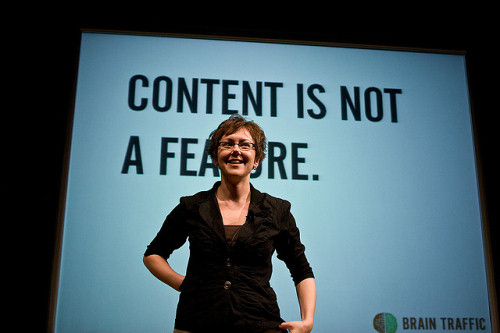
Kristina Halvorson, habitual content supporter, giving one of her famous content workshops. (Photo: Warren Parsons)Image credit

You Can Always Go Home

Cameron makes the argument that feeds are taking over the Web and that, eventually, companies will just use them to communicate with customers.

The idea to simply rely on facebook.com/companyname instead of running an independent website where content originates and filters out simply won’t take with companies. Companies will always need a “home base” for their content. The change will be in the media through which healthy content filters out (such as Facebook, Twitter and RSS).

Scrivs makes this point in his Drawar article:

In essence, what is happening is that sites have to realize that their content is going to be accessed a number of different ways, and if they don’t start to take control of the experience then someone else will. RSS didn’t kill website traffic or revenues because there are some things you simply can’t experience through an RSS feed Just because how we consume content is starting to change doesn’t mean that design itself is being marginalized.

Content isn’t just about press releases and text either. Ford would never give up ford.com for content in a variety of feeds and aggregators. Ford.com lets you build a car: where’s the feed or application for that? Ford’s entire business depends on the functionality of its website. Its Web team has worked hard to create an inviting user experience, unique to the brand’s goals and issues. No company wanting to preserve its brand or corporate identity would give up its main channel of communication and branding for random feeds sprinkled across the Web.

In the same vein, no company would suddenly give up its carefully crafted creative and regress to a template. Templates have been around for years, and no company with any kind of budget would use a $49 packaged solution from Monster Template if it can afford to pay someone to address its particular needs and mold a website to its content. A template doesn’t take needs or goals into account when content is pasted in. A good designer makes choices that a $49 template won’t make for you.

Cameron talks about how businesses will gravitate to standard templates and away from hiring designers:

Companies won’t see the point in hiring someone to create an entirely bespoke website when they can just use a template and then feed all their content to Google and Facebook and Twitter.

Web designers don’t just add borders to buttons and colors to headlines. Web design is as much about problem-solving as anything else. And part of the puzzle is figuring out how best to deliver and promote content. Not everyone has the same issues.

JulesLt lays out this argument in the comments:

[…] But I don’t think any business that would previously have actually employed a designer to create their web presence, brand, will shift over to a standard template. For most businesses, Facebook, YouTube or Twitter may be alternative channels to reach their customers, but they don’t want their brand subsumed into someone else’s. […] The right way to do this is to build a re-usable core, but understand the differences between platforms — and make sure your clients understand any trade-offs.

Nick adds to this argument about templates:

Templates have no business in a world where personalization trumps everything else. Prospective clients are going to a website not just for content, but for the experience that the brand is willing to offer. Not to mention that if you’re in the business of selling yourself, a high profile custom website speaks volumes about your dedication to your chosen niche market.

Andrei Gonzales eloquently sums up the difference between Web design and decoration:

Design isn’t about eye-candy. It’s about problem-solving. If your Web “design” isn’t solving quantifiable issues, then it isn’t design: it’s “decoration.”

And moreover, we’re already in Cameron’s bleak future scenario where web designers should be a thing of the past. Companies today can buy a template and feed their content to whoever they so please. And yet, they aren’t. When the designer created that template eight months ago, he didn’t know that their business was having trouble marketing to middle-aged women. That designer didn’t know they’re a family-owned business in a market where that kind of thing leads to improved revenue and sales. How could he? He’s Andrei’s decorator, solving the issues between lorem upsum and dolor sit.

In Conclusion

Web design has changed drastically during its brief existence. The changes in the medium year after year are actually quite amazing. The industry looks vastly different than it did in 2005, and we’ve changed with it. Change is inevitable, and it is the reason you visit websites like this one: to stay current. That hunger is the key to ensuring the survival of our industry.

The bottom line? Web design is a secure and growing job market. Two sources that are something of authorities on jobs and Web design agree on this point. The United States Department of Labor predicts that positions for graphic designers will increase 13% from 2008 to 2018, with over 36,000 new jobs being added. It also states that “individuals with Web site design […] will have the best opportunities.”

And in the 2008 A List Apart Survey For People Who Make Websites, 93.5% of respondents said they were at least fairly confident about their job security.

I’ll sleep well tonight knowing that the industry I love isn’t going the way of the dodo… and that I didn’t lie to a class full of eager young designers in Colorado.

(al)

Michael is a designer working in Washington DC to create beautiful and useful web experiences for an array of organizations and their users.

  1. 101

    chromax

    October 4th, 2010 1:03 pm

    the most boring and exaggerated article ever.

    Just because social media is popular you must not have existential fear. If you´re talented you will always have enough work…today web designer, tomorrow app designer and then maybe something else.

    Use your time to get clients if you have not enough to do and stop writing this boring cant.

    +1
  2. 102

    vashyoung

    October 6th, 2010 10:02 pm

    wow web designing today is like a business :( they lost it

    i grow up with the love on art, drawings and colors.
    when i got to high school i tried to apply my talent to computers.

    web designing is more like an expression to me, as a form of modern day art.

    0
  3. 103

    kenpark

    October 12th, 2010 5:38 pm

    “One of the biggest misconceptions about designers (and usually Print designers) is that we’re just Print designers — that the scope of our skills begins with Lorem ipsum and ends with HTML emails. This is ridiculous.”
    Does this sound familiar?

    +1
  4. 104

    loosing the face with facebook

    October 14th, 2010 8:21 pm

    the article is bullshit, like the article befor about webdesign will be simply replaced by content.

    sorry guys with this attitude all patent office in the world are for nothing, developing a logo is useless since you can use a avatar and just use the name as brand……

    bullshit, bullshit, bullshit.

    look at the fashion industry. everybody is fighting to make the brand remakable, new, unique, fresh etc.

    do you think, this would be possible if you are limited by facebook rules, raster and content stealing….? i dont think so.

    i promise you guys. not the designer is replaceabele. it will be the developer. when i started with web design i couldn imagine to create and code websites. now since all this becomes easy with plug ins, templates and thousand tutrorials. the web developer for me becomes useless and i just hire some for special jobs or big jobs. because its nice to have a web 2 aproved raster but the customers dont want to have the same crap like the competitor maybe.

    design is inspiration – facebook and social media is for people who want to have a number tattooed and a barcode on the arm with a facebook logo, no – better. the wish a future with implemented chips in the ass so facebook can strike them with a thunderstorm when they pass a umbrella shop.

    if this is the future. i am out..

    +1
  5. 105

    alvin john

    October 22nd, 2010 12:41 am

    It may be true that most of the users are after the content of a website. Web Designers likewise elevates the user experience not just by fancy buttons etc. They conceptualize how content will be presented on users. Its more likely how big products got successful without considering how their product will be presented in market from packaging to extensive advertisement. That is no more different when we talk about web designs.

    0
  6. 106

    Jason

    October 27th, 2010 6:37 am

    So if Cameron is a “professional Web and graphic designer with over 6 years of experience” writing about web design, why do I not see a portfolio that contains something other than blogging and writing?

    Credibility, get some.

    +1
  7. 107

    John Smith

    November 3rd, 2010 6:34 am

    Web designing is really cool profession. I know a little bit about but don’t know complete work.

    0
  8. 108

    wansai Ounkeo

    December 30th, 2010 12:58 am

    Our profession was always one of flexibility and constant learning and upgrading. Web design has grown to such a state that now it is a collection of professions and skills. It’s sales, customer service, relationship management, marketing, branding, design, user experience, copy editing/writing, architecture, info systems, admin, programmer/developer, reasearcher, consultant; and the list goes on and on.

    I’ve been doing this well past a decade now and every year, more and more professions get folded into the role. In 2011, we will see social media experience and marketing as an essential role addition many must learn to stay relevant. More companies are looking for designers who have this experience and thus far, there’s more demand than supply.

    That will only elevate the web designer so long as the designer knows that the social media sphere is *just* a communications platform. Even if much of our work shifts from pure web design, it is supplemented by campaign work; something we should all have experience and skill in.

    In the end, companies will need their own home to operate from. It is never smart to submit control of a company’s destiny to a 3rd party unless that company was built specifically to leverage on that 3rd party platform. Facebook is just a tool. It is one of many, many tools. Smart companies will not/should not surrender their company in this way; And one of our jobs is to let our client’s know that. It simply is not a smart online strategy.

    As long as we designers continue to learn and adapt, the profession will thrive. Even the hoohaa over apps is just another area of expertise we must learn to survive. And in the end, we already have a strong base for this in usability/UI. It’s just one more thing. If anything, our profession is now at a state where many of us can choose to be generalists or find a perfectly servicable niche in any of those combination of roles. Previously, those niches were few. The profession has grown and looks likely to continue to grow as quickly as anything the web has to offer in the future.

    0
  9. 109

    wale

    November 2nd, 2011 6:32 am

    can you post me the list of software one’ can use in designing a web site

    0

  1. 1

    Scrivs

    September 27th, 2010 1:18 pm

    1) They aren’t abandoning their site. Placing a heavier focus on social media doesn’t mean they have left things alone. Not sure if we are seeing different sites, but the adidassoccer.com website for me is still fairly active. If they are producing media it makes sense to place it on YouTube/Facebook and Twitter over their own website because who is going to visit the site constantly to check for new media?

    2) If everyone moved to Facebook you don’t think that they will try to differentiate themselves with a custom experience? The best brands on Facebook all have custom designs and they certainly weren’t selected from a Facebook template. Someone has to design it.

    +12
  2. 2

    Michael

    September 27th, 2010 2:22 pm

    I’m not the author, but let’s look at the history of Social Media. Yes, Facebook is huge right now, yes, ignoring it is something you do at your own peril, BUT a few years ago, the same was said of MySpace, and look where it is now. Fallen from grace, and struggling to find out how they can become relevant again. If you put all your eggs in the Facebook basket, and they suffer a fall from grace (which WILL happen, even Google will likely fall to another at some point) then where are you? Lost. Alternativly, you create a dynamic, plesant web site, push the content from that site to Facebook, Twitter, Tumblr, etc, then when the next new thing comes along, you add to your exisiting base, you’re not left out in the cold.

    +12
  3. 3

    ilabs

    September 28th, 2010 10:58 am

    Blah, blah, iPhone, blah. Just as with the Apple vs. Adobe debate people keep going on about smartPhones and how they’ll change the internet, just as the cries have long been heard and faded away about dozens of other ‘net killers’. A smart phone will never have a 23″ screen.

    Content is King… but unmanageable content is crap. I don’t care how great the content is, if a reader cannot easily navigate the source they’re clicking the back button.

    A perfect example in my mind is a recent website I re-designed. We changed no content whatsoever, but by implementing an eye-catching design and easy to use interface my client saw literally a 3-fold increase in sales.

    As for simple apps, perhaps many of these apps are simple because the world of smart phones is still relatively new.

    What is going to happen when there are hundreds of news feeds that all use the same template to deliver practically the same news? The smart ones will hire a designer to make their delivery system stand out from the rest… and how will they do that? Why by design of course.

    Seriously, history repeats itself, and looking at the simplicity of mobile apps now is sort of like looking at the simplicity of the web when it first took flight. Then what happened?

    Ahhhh the ‘Web Designer’ was born.

    And something can be said about simplistic “design’ as well. There is a great difference between a wordpress base template and a well-designed simple layout.

    Also, I’d like to say I agree completely with the author here on the definition of today’s ‘web designer’. Heck, the least amount of work I do involves actual graphics, I spend most of my time coding and running servers… and yet I’m a ‘web designer’.

    +8
  4. 4

    Oskar Smith

    September 28th, 2010 3:15 am

    “Bigger brands and companies will always need their own site. So there will always be a need in that regard (either in-house or agency).”

    I was about to pick up on this and comment on it too. The article rebuttal is good and I agree with a lot of it but, like many articles, a point is made using Ford as an example. The trouble is, for the vast majority of us, our client base consists of small to medium sized businesses. Taking a quick look at the budget ranges of other local companies on a site like http://sortfolio.com/ confirms that most small web agencies or freelancers deal with budgets of under $10,000, and more typically much less than that. It’s these small clients paying $3-$5k that make up a lot of the “bread and butter” work for web designers, while the larger digital agencies (with a branding division) will suck up the clients with bigger budgets, where they act as an extension of the brand’s marketing department.

    So while this is true for someone like Ford or whoever…

    “…no company with any kind of budget would use a $49 packaged solution from Monster Template if it can afford to pay someone to address its particular needs…”

    …smaller companies may well be tempted, and who can blame them; a lot of the templates out there do look pretty good these days, and a business leader from an SME might well be happy sacrificing a few of their online objectives to save themselves $4k or so.

    So while web design isn’t dead, I would say if you’re currently pitching to the SME market, it’s going to get a whole lot tougher in the coming years as we get squeezed from both sides (digital agencies picking up the low hanging fruit and template sites and off-shore outsourcing picking up the SMEs. Not to mention the huge competition there is in our sector ‘cos there’s so damn many of us. ;-)

    Time to panic? No, but just keep your eyes open I would say.

    +7
  5. 5

    javier

    September 27th, 2010 12:31 pm

    I’m glad to read this article. After reading “Does The Future Of The Internet Have Room For Web Designers?” I was a bit worried, though I was also encourage to learn more about development. So thanks for this article.

    One thing my page inside Google page and Google making money with my content. Is that right? So how much access should we give to Google to our content?

    Something that really worries me is the Google Monster and I would like you guys to re-consider the role of Google. In the past we have managed to avoid Coca-cola, not eat in Mc Donalds and resist huge monopolies but can anyone resist Google?

    +7
  6. 6

    Nico

    September 27th, 2010 12:26 pm

    “The idea to simply rely on facebook.com/companyname instead of running an independent website”

    Adidas is slowly moving all of its sports promotion on facebook, especially for soccer, where unlike Nike, they’ve left their main site almost blank and never updated with media. They also advertise their facebook in every major ad these days. Seems like they’ve given up on the traditional site for promotions and sticking only to social media, namely Facebook. How do you comment those kinds of moves by such big companies. Will we be reduced to creating content and design for Facebook custom tabs?

    Great article in general, hope you’re right!

    +6
  7. 7

    Michael Aleo

    September 28th, 2010 4:12 am

    You’re missing that web design has always been this way – as a lot of jobs are. Does the CTO of a company only have one skill? Not a chance, they probably have even more than 5. How about surgeons? Police officers? Soldiers in the army? Same deal.

    My point is that good designers are already practicing multiple skills every day, and those skills help make them more marketable and their job more secure. You’re much more likely to hang onto your job in a recession if you’re helping the sales team close new business than if you were only doing Photoshop work.

    It also makes you more diversified in the event that the industry did turn away from custom design. You suddenly have this toolbox of appreciable business skills to draw from.

    Best of luck in finding your one skilled profession :)

    +6
  8. 8

    Aaron

    September 28th, 2010 10:37 am

    Cameron Chapman was absolutely 100% right. In fact, all of you should start looking for new career paths right now. I mean it. Get out of the business. But before you do, please send all of your clients to me. Thanks.

    +6
  9. 9

    Davor

    September 28th, 2010 1:46 am

    I was wondering how much gifts&perks Cameron got from Apple to write that pseudo article. It’s nothing new. Doctors get that type of things all the times from pill makers in order to push their products. Don’t be scared, iPhone is not internet. It’s a phone that can display online content. And quite frankly it’s a really bad phone.

    As long as the internet doesn’t come up with a thing like “native website GUI elements” web designers are safe. Even the ones that can’t code. Even them.

    There is no amount of letter “i” in front of a product or an application that can supplement for a unique, personal, crisp and smart design of a well thought of website.

    And I don’t care how many times one can repeat the word “wonderful” and “awesome” at the presentation of a god damn phone which screen size is 320 x 480 px.

    +5
  10. 10

    Jesse

    September 27th, 2010 1:57 pm

    Yep.. you’re right.

    The “Template will kill design” argument is old and laughable. Most companies, organizations and corporations, when they aren’t failing or going out of business, have money to spend. When you have $100,000, or even $10,000, to spend on marketing, you spend it on something custom and exciting… Not a $49 template. Those cheap templates are used primarily by “I’ve got an idea for a business!” people that aren’t really committed to their ideas.

    I also keep trying to push the idea that it isn’t about “Web Design.” A designer who refers to herself as a Web Designer is like a Graphic Designer that refers to himself as a Brochure Designer. The World Wide Web is one application that utilizes the Internet. Those that call themselves Web Designers should be able to design almost any type of interface for almost any digital medium.

    In fact, I don’t even like Graphic Designer. I prefer to call myself a Designer. What do you need? I’ll design it: Logo, Website, iPhone app interface, board game, Xbox 360 game interface, Poster, CD, book.. anything. We are living in a world where Everything is Designed. Everything.

    Regardless of the specific application, the need for all things to be designed is only going to increase. The key to being a designer in this world is just that: be a designer. If you apply yourself to one application you will rise and fade along with it.

    +5
  11. 11

    Thomas

    September 28th, 2010 4:09 am

    Good article overall.

    I would like to add one thing that so frequently gets forgotten when talking about social media:

    In many very big organizations all of these social sites are blocked. And as long as there is B2B business (just to name one thing), as long there will be independent business sites that can not be grouped behind one category.

    It sounds so nice to import feeds from twitter, photos from flickr, videos from youtube etc. (and you should) but what good does all of these do, if the target audience can not access them? Never take anything for granted.

    +5
  12. 12

    Mike

    September 28th, 2010 5:35 am

    I think I started programming when I was about 16 in 1979, and turned professional when I was 19. About two years later I started being inundated with articles in the trade journals and magazines informing me that computer programmers where going to be obsolete in a few short years, because the industry was quickly developing expert tools that could generate code faster and better than any human. These warnings were everywhere in the 1980s, and they went on for several years until people came to their senses.

    Thirty years later I’m still programming professionally, and have been developing for the web for the last ten years. I am reminded of the Arab proverb: “The dogs bark but the caravan moves on.”

    +5
  13. 13

    Andrea

    September 28th, 2010 8:32 am

    A web designer that doesn’t have to code, is a photoshopper

    +5
  14. 14

    Steve

    September 29th, 2010 5:40 am

    Exactly. Lets not forget how many of us have personal Facebook accounts, and then another Facebook account at work for clients. I personally have 3 Facebook accounts….since Facebook doesnt allow you to delete an account at all. The numbers are obviously skewed.

    +5
  15. 15

    karl escritt

    September 27th, 2010 1:39 pm

    Excellent post, makes much more sense in the real world of web design than “Does The Future Of The Internet Have Room For Web Designers?” posted the other day, which was in most part nonsense.

    As a web designer of over 10 years i have seen sites move from basic 3 page layouts to where we are now, sites of rich content and engaging with the audience. Any designer who has designed for a major client knows that company sites will always be around and will never be replaced by templates. We as designers simply have more areas on which to design for, if anything a designer has more work to do now than ever before and this will only grow.

    @nico As for adidas moving much the main adidas site to facebook, this is very much a marketing thing – it is easy to promote small features or new product lines to a mass audience via facebook, however as soon as you start clicking most things take you to the adidas ecom site. This is how most big companies are and will in the future use both sites together, as a result it doubles the designers work which on all accounts is great for the job security.

    +4
  16. 16

    Carlos Restrepo

    September 29th, 2010 4:50 am

    In addition to this, I’m not sure if people are forgetting that although companies might be focusing on social media to reach out to their consumers, they still need that corporate presence to reach out to the big chains, investors, partners and anyone interested in the company as a whole and not just the product.

    +4
  17. 17

    Alison Fay Binney

    September 28th, 2010 12:00 am

    Tony. You know what, I think you have a very good take on this here. I was batting for both sides, but if I am honest, then I tend to agree with you. I applaud Cameron’s very insightful view on this. And Michael, you also have some very strong points. BUT. I have been a professional in the communications industry since 1991. Options for making a ‘Good’ living from design are damn hard to manage.

    In 1996 I started steering my journalism (writing) career into predominantly print layout and design. I worked hard. I was excited about the future of design. I quickly grasped new media technologies. I pushed myself into new work environments eager to learn even more from colleagues. I managed a design studio in London. I was employable. I developed over the years such an army of skills that I then decided to go out and work solo. I wanted the full control over everything from which clients I worked for, how much I was paid and how my designs developed.

    I would say I am expert in print and web design. I know the principles of layout and also have excellent technical know-how. And I am a communicator… not only a designer.

    I have freelanced solo since 2004. I built a client base (in the UK and across Europe). I managed accounts. I paid tax. I acquired new clients. I developed pretty good and technically sound designs for the clients that were unique and not out-of-the box. The clients were always happy.

    However, what we need to realize in these arguments here that Cameron and Michael present, and what I have also realized during the past 2 years, is that clients have changed drastically. Expectations of what is possible with new web technologies (and print) is growing at a speed faster than designers can actually keep up. How consumers digest information is drastically changing. I know some of you have argued that media technology is and has always been an evolutionary process. That is true. But the speed of that evolution has parabolically grown.

    Also, a major sad truth is that those of us who prefer to build unique designs are being out priced by those who draw on all the blogging and other website templates to produce websites. I mean, it actually makes sense to start with a WordPress template and build on it with an array of plugins and tinker with the CSS to add a few unique client design elements. Hey presto. Job done.

    It would be interesting to actually examine whether designers who started their career in the past 2-5 years are more design savvy than those who have been in the industry more than 10 years. And, also to see what skill sets differ and success rates.

    The upshot for me has been to draw back from the design industry. I am moving back into writing, as Cameron and Michael actually both pointed out, content is king, always.

    This is not to argue that design is dead. But I think the industry could do with a whole new marketing campaign itself. We need to sell our services differently… all over the world.

    If designers are happy sitting in studios, in TEAMS, then I see a future for designers specializing in niche markets. Not just in terms of offering niche technical skills, but certainly in serving niche client bases. As always, success stems from being exceptional in YOUR field. Jacks and Jills of all trades won’t all win in the future design industry. That is to say, I think that it is not intelligent at all to constantly be trying to keep up with changes in web technology just to stay ahead of the game. I am certainly not prepared to now learn how to design an iApp, for example.

    I would suggest to all budding new designers to NOT fly it alone. Join up with one or two other designers/communicators/programmers at least, and work together. Build a team that is capable of offering a range of skills. And don’t be afraid to say NO to clients who don’t really fit into your business plan.

    +3
  18. 18

    Mike R

    September 28th, 2010 12:46 am

    A few questions.

    Is facebook becoming the internet? Is the internet facebook?

    One thing i notice about history is that people tend to rebel against evil empires. How many films and political arguements are about this premise. The evil empire, nazi germany, iraq, Total recall, Highlander 2, The matrix and many many more.

    This might sound like a mad list but they all have one thing in common. When people are forced down one road something will eventually give, people will fightback and go it alone. Give other options and try something new. I loved facebook, i love the freedom it gave me and the opportunity to embrace old friendships and keep in touch with people i’d forgotton or lost touch with. Now i hardly ever check-in.

    Apple was an unknown at one point then it’s everywhere. Now people are apple haters and only use google to fight the’oppressive’ OS.

    My point ‘i think it’s in there somewhere’ is that there will alaways be a need to new designs, new systems, other options. These will always need to be designed, not just asthetically either.

    p.s How many magazines are there in the world. You don’t see one template that all magazines print into…just a thought :)

    +3
  19. 19

    Owen Perry

    September 27th, 2010 2:23 pm

    Web designers unite! They may take our jobs, but they’ll never take our FREEDOM!!

    +3
  20. 20

    Michael

    September 27th, 2010 2:24 pm

    Bring on the newbies, if they’re serious, and good, they will have business, if they suck and fail and give up, that gives us a bed of clients to tap in to :)

    +3
  21. 21

    Jon-Paul Lussier

    September 27th, 2010 3:34 pm

    A response with regard to the web as it was outlined and rebut in this article:

    So, you have a Facebook fan page, you’re pretty heavy in to it. Over time, you have managed 2,000,000 “unique” users. This is a huge number! Clearly, you have a lot of influence, people love you(or your product) and they need more!

    This is a little false. Having those users is awesome, it allows you to reach customers completely free of charge; with rich media and messages that can create awareness, desire, and loyalty. But what does that really amount to? What can you do to create unity? A common purpose is lost on Facebook, and users struggle(visibly) to fell like they can be heard. It’s not creating relationships, it’s creating a mob; use this as a tool to drive your social user collection, because that’s all this really is — a collection of users.

    The web won’t “move here”, nor will Facebook become the profile for our web. Twitter won’t become the new method of message delivery, either. How could an entire community of worldwide peoples honestly suggest “Content is King” but believe that a presence like Twitter or Facebook will outlive their livelihood as professionals? I vividly remember an era of the web where it seemed like no one would ever communicate outside of AOL.

    The face of communication, and the internet, is changing. But we all have one clear advantage that was outlined here; the term web designer isn’t exclusive. We learn, and grow(if we are successful) and when technologies change, evolve, or die — we adapt, utilize, and find new ways. Do we all have things to learn from human-computer interaction? Are there points in any career when the things you had learned to establish yourself no longer prove relevant?

    Perhaps that is a fair question. But, is it also fair to say that AngelFire or GeoCitites once ruled the web? That any professional organization once managed their online identity with a uJournal? Tools, they come and go in the web, but corporations and business — they lean toward success. There isn’t a time in technology that anybody should stop learning. Web design, application development, and any other profession in the technical community understands there is no terminal date for their education. The intrinsic value of the web stems from this. Communication is a property inherit within humanity that, though out all known history, has never found obstruction. It is in this, we will all find purpose in our passion, and value therein.

    +3
  22. 22

    Ian Lloyd

    September 28th, 2010 3:47 am

    “Companies want rockstars who are savoring to make better sites, better the company”

    Rockstars? Dammit! I thought it was all about Ninjas, these days. So confusing! :D

    +3
  23. 23

    Michael Aleo

    September 28th, 2010 4:04 am

    Uh, what? No 12-13 year old is “schooling” anyone who has spent years and years working with front end and Photoshop.

    When I wrote my first line of HTML, they were in diapers.

    If you think teenagers as a whole can “master design” from a few years of experience you’re dead wrong.

    +3
  24. 24

    Nils Geylen

    September 28th, 2010 5:53 am

    This is the kind of content Smashing and its readers deserve: high quality, thought through, well-written.

    Web creatives (my term) have one extra benefit over a theme or a Facebook page: they contemplate the state of their profession and have strong ideas and visions about it. And they write smashing articles as a result.

    +3
  25. 25

    Michael Aleo

    September 28th, 2010 7:01 am

    If someone says synergy, I’ve got buzzword bingo :)

    +3
  26. 26

    peter

    September 28th, 2010 9:25 am

    Unless we start weeding out self appointed “designers,” the term “web designers” will be phased out.

    The problem that I see is not so much the extinction of web designers/developers, but rather a overflow of bad to mediocre websites built by those who do not understand the foundation of HTML/CSS (I’m looking at you Dreamweaver!)

    I for one agree with the fact that the traditional web designers (those who slices up photoshop mockups) is better of fading away. But if you’re a hybrid (design & development) then you will rule the web world.

    +3
  27. 27

    peter

    September 28th, 2010 9:33 am

    Good point,

    However, you should also realize a flood of terrible designers mean that the industry as a whole would be characterized by those designers.

    Yes, time will weed out the bad, but it tarnishes the good in the process.

    +3
  28. 28

    Tiana

    September 28th, 2010 1:48 pm

    An architect still needs to know their materials and how they can be used with their design – even if they are not the ones laying the brick. Otherwise it could all fall down.

    +3
  29. 29

    Andrei Gonzales

    September 28th, 2010 6:07 pm

    My father is a successful architect, having designed buildings, retail shops, and homes in different countries.

    He also does his own DIY, can do carpentry, and sometimes designs the furniture needed to finish off an interior, even having “ironsmiths” build custom TV stands that he designed in order to install his client’s TV on a rock-face wall.

    His other colleagues are well-versed in which materials to use, their pros and cons, and keep up with new technology (electric glass, computer-cut and treated pre-fab wood, etc.)

    Architects know their “code”.

    Designers in the automobile sector aren’t much different. Their work deals with solving quantifiable issues such as drag, interior space, safety zones, accessibility, making a car child-friendly, luggage space, sound isolation, and knowing which parts and materials are the better choice to ensure that they can be shared across platforms to reduce cost, yet without diluting the experience of the car or the brand.

    They too, know their “code.”

    As I’ve said: design is about problem solving. How can you truly solve a problem when your “knowledge” is so severely limited that you don’t even know the pros and cons of your decisions due to your ignorance?

    Anyone who calls himself a web designer and can’t code should just take up scrap-booking.

    +3
  30. 30

    Luis

    September 29th, 2010 4:36 am

    When I first read the previous article, I also felt a bit disturbed. And, just like many, my first reaction was: “wait a minute! I’m a designer, first of all! I do NOT build websites. I build communication, relationship, brand recognition, innovation. My clients come to me NOT asking for a PSD and XHTML or whatever acronym we may use. They ask for commercial results and revenues!” You see?

    And that’s extensible to almost any kind of product, service, object in our daily lifes. Why cars aren’t all equal? Why smartphones aren’t all equal? Why even cigarette lighters aren’t all the same? Why there are still designers and engineers all around the world, working day after day, to build cool new stuff, if we could simply stick with what we already have?

    Cameron, the author of the previous article, simply started with a completely distorted idea of what we and our profession are. And from there on, nothing else more made sense.

    +3

Leave a Comment

Yay! You've decided to leave a comment. That's fantastic! Please keep in mind that comments are moderated and rel="nofollow" is in use. So, please do not use a spammy keyword or a domain as your name, or it will be deleted. Let's have a personal and meaningful conversation instead. Thanks for dropping by!

↑ Back to top