E-Commerce Services ComparedSelling Digital Goods Online
There’s a realization that every freelance designer must go through at some point: client work isn’t enough to ensure your long-term financial security. What if you get sick? What if you can’t find clients? What if you want to take a vacation?
One possible answer to this problem is earning passive income — i.e. selling products or services instead of selling your own time. A common way to do this is to sell digital goods such as eBooks, PSD templates, WordPress themes, icons, and so on. But how exactly should you sell them?
Although there are lots of marketplaces for selling digital goods, they often take a big cut of the profits. What’s more, they don’t let you customize the sales page, or let you use your own brand. This is where digital goods services come in. These services only take care of the payment, file storage, and download, and let you do the rest. This means you can easily sell your products from your own website, or through social networks.
I recently wrote an eBook about UI design and needed to find a way to sell it, so I compared five such services: Quixly, FetchApp, Pulley, E-junkie, and Gumroad. I’ll tell you which one I picked at the end… but in the meantime, here are the results of my research.
How Does This Work?
First of all, let’s see how those systems actually work. Simply said, all these services let you upload some files, provide you with a link that you put on your site, and take care of the rest. The customer flow usually looks something like this:
- Alice clicks the “Buy” button on your website
- Alice briefly goes through the digital goods website, and is automatically redirected to the payment processor
- Alice pays for your product with Paypal, Google Checkout, etc.
- Alice is then redirected to the digital goods service, where she can download the product
Payment Processors
Let’s take a moment to look at that second step. Most digital goods services do not deal with the big credit card companies directly, but instead go through payment processors such as Paypal or Google Checkout.
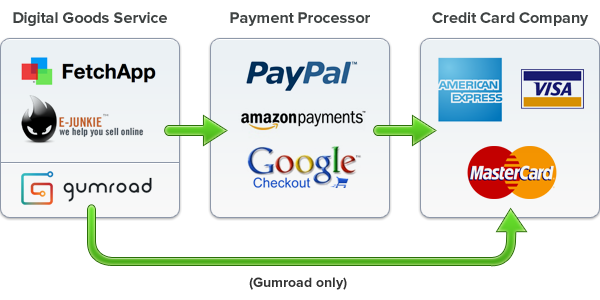
This means that you need to take into account the additional fees charged by these companies (the standard fee for both service is a 2.9% charge plus a $0.30 fixed fee per transaction). The only service which does notgo through a payment processor is Gumroad, meaning it lets customers pay right there on Gumroad. Now that we have a basic understanding of how things work, let’s take a look at each service.
Quixly
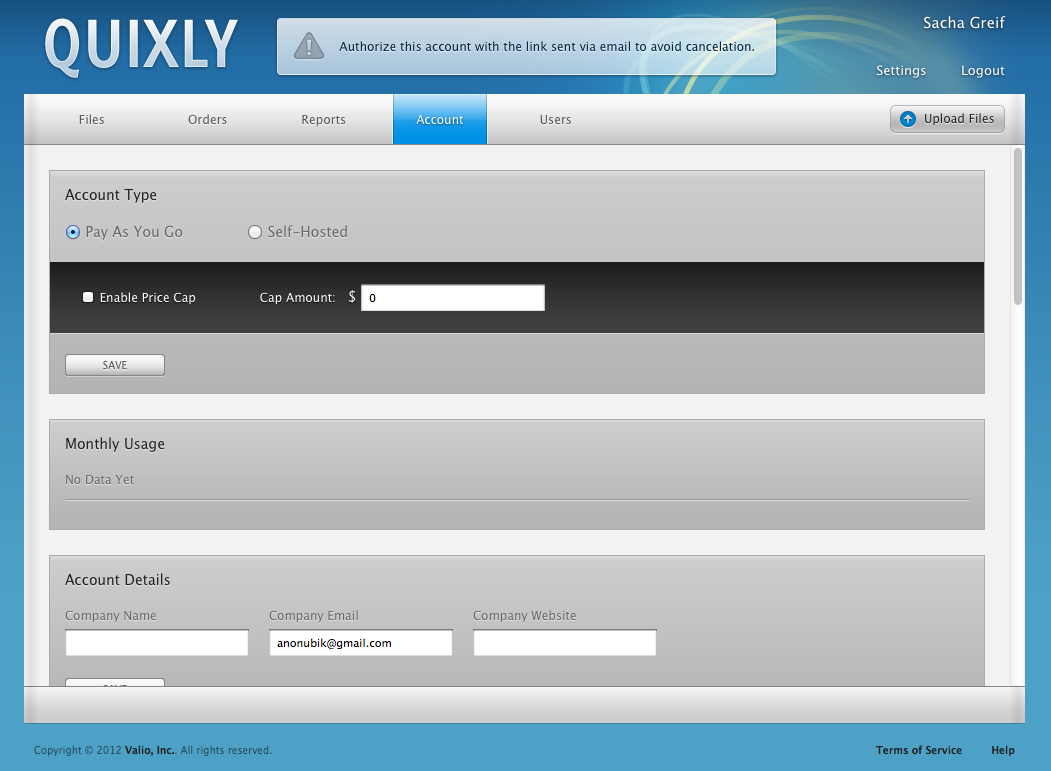
Quixly is the brainchild of the tireless Drew Wilson, who’s also the man behind BuildItWith.me, Pictos, and many other projects.
- Supported payment processors: Paypal, Google Checkout
- Used by: Kyle Steed, others
- Pros: cheapest option in many cases; nice UI
- Cons: limited bandwidth
- Special feature: sales reports and visualizations
FetchApp
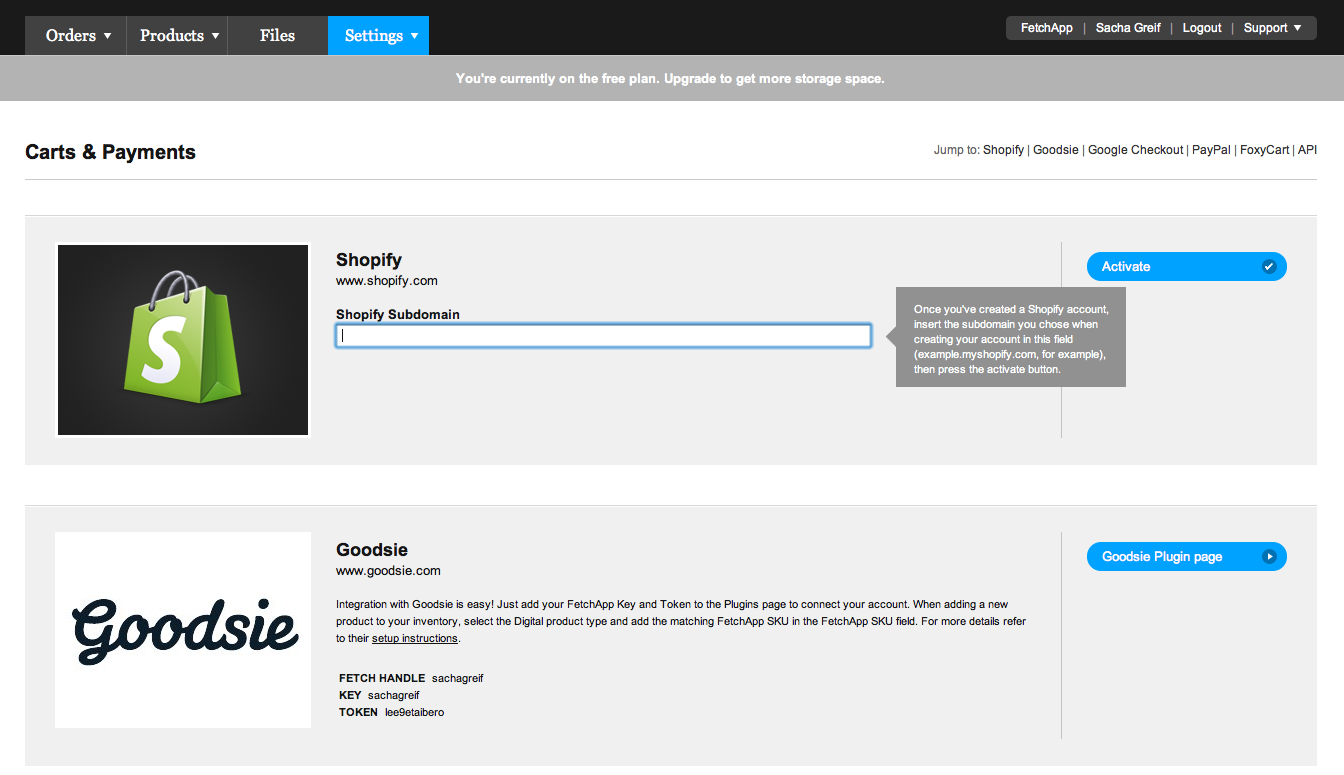
FetchApp was originally — and still is — a Shopify app (in fact, the first ever!) but has since taken a life of its own. According to FetchApp’s Mike Larkin, it’s “simple enough to be used to sell a single product, but large enough to also accommodate record labels selling hundreds of tracks”.
- Supported payment processors: Paypal, Google Checkout, Shopify, Goodsie, FoxyCart
- Used by: A Book Apart, Vector Mill, and others
- Pros: can be easily integrated with Shopify; has an API; lots of documentation
- Cons: doesn’t provide stats
- Special feature: lets you create multiple products without re-uploading the same files
Pulley
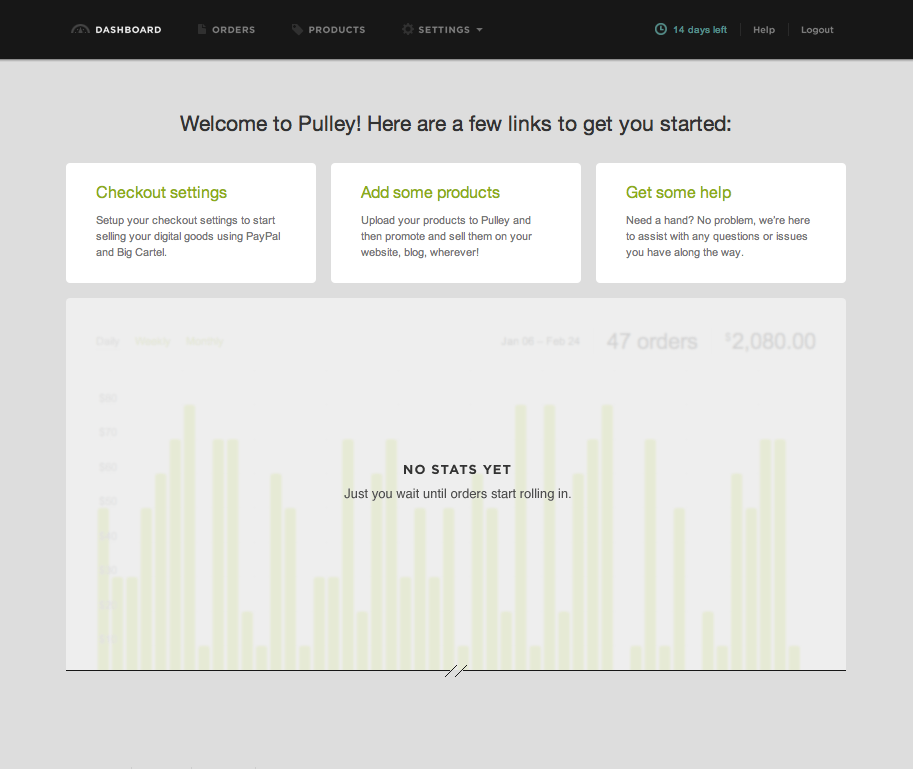
Pulley is an offshoot of BigCartel; a hosted shopping cart system similar to Shopify.
- Supported payment processors: Paypal, BigCartel
- Used by: Cameron Moll, Fine Goods, and others
- Pros: can be easily integrated with BigCartel
- Cons: no direct download step (users have to check their email)
- Special feature: cheapest 100MB storage plan
E-junkie
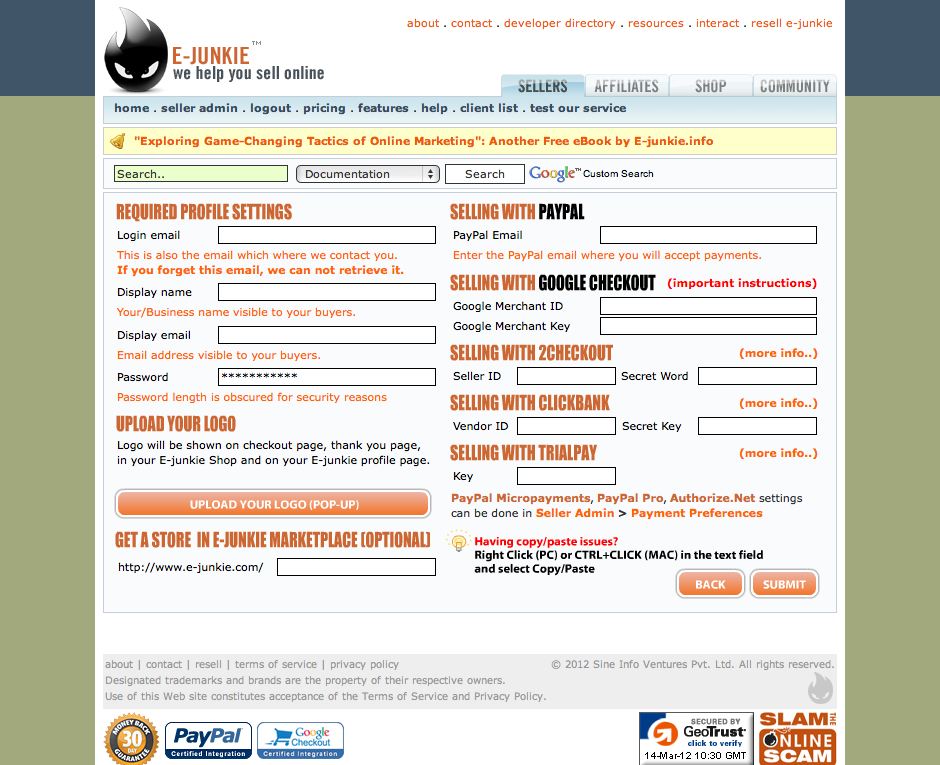
E-junkie has been around for quite a while, and it shows in its homepage and dashboard’s design. But it’s also the most full-featured service by far.
- Supported payment processors: Paypal, Google Checkout, Authorize.net, Clickbank, TrialPay, 2CheckOut
- Used by: SimpleBits, and others
- Pros: lots of features (discount codes, many payment processors, etc.)
- Cons: looks like a bad site from 1998; can be expensive
- Special feature: most full-featured by far
Gumroad
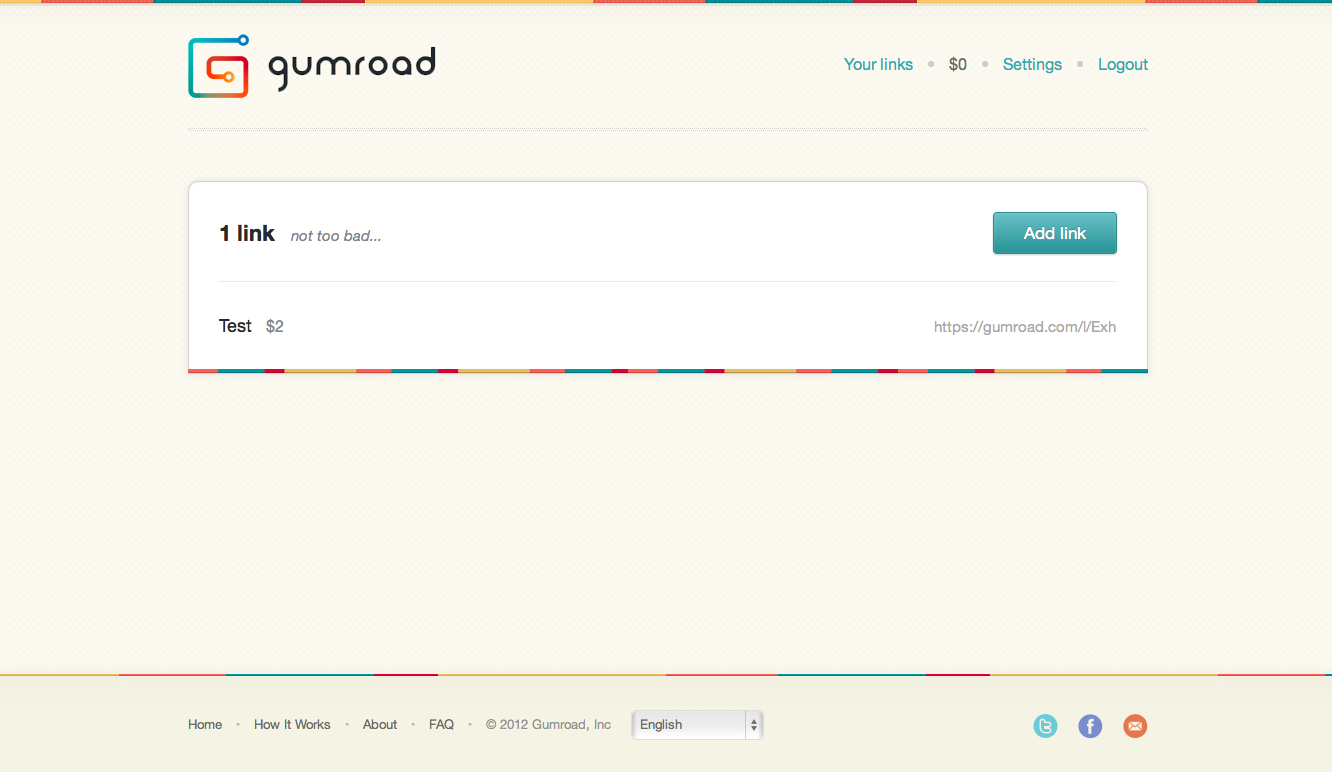
Gumroad is a relative newcomer in this field, but has been generating a lot of buzz. Unlike the other systems, it doesn’t have a monthly fee, and instead charges a fixed cost plus a percentage on each transaction.
What’s more, Gumroad founder Sahil Lavingia points out that his service is the only one to deal with credit card companies directly: “everyone else uses PayPal as their main processor or sole processor. This means that they’re just making PayPal bigger, and will never own the entire experience.”
This is a strong argument in Gumroad’s favor, since having to deal with less intermediaries is always better. And this means Gumroad works even in countries where Paypal isn’t available, such as Serbia or Pakistan.
- Supported payment processors: credit card
- Used by: 39Argyle, others
- Pros: no monthly fees; supports credit cards; works in countries where Paypal doesn’t (Serbia, Pakistan, etc.)
- Cons: expensive for cheaper, high-volume products
- Special feature: pays you all of your profits at the end of the month
Other Options
Of course, there are a lot of other options, such as Payloadz, Digital Delivery, and one of Paypal’s many confusing services. But I decided to focus on these five because they seem to be the most commonly used among Web designers. Hopefully this article will give you the tools to evaluate other options by yourself if you need to.
Pricing
FetchApp, Pulley, Quixly, and E-junkie all work the same way — they have pricing tiers corresponding to file sizes (and sometimes the total number of files you’re selling), but all have unlimited bandwidth.
Note that Quixly has relatively cheaper pricing tiers (free, $10 / month, and $30 / month), but charges $0.40 extra per GB of bandwidth when over the limit for each tier.
On top of this, all four services require a payment processor, which charges its own fee (usually 2.9% + $0.30).
On the other hand, Gumroad’s pricing model is completely different. Instead of charging a fixed monthly fee, Gumroad takes a fixed fee ($0.30) plus a percentage (5%) for each sale. It’s important to point out that Gumroad does not charge Paypal’s 2.9%, even when it’s time to transfer your earnings to your Paypal account.
For this comparison, I’ll imagine three use cases and then see which service works best for each of them.
Use Case #1: Selling A Short eBook
Let’s say we’re selling a short eBook for $10. The file is pretty light, let’s say 9MB, and we sell 100 a month, using up 900MB of bandwidth, earning a total of $1000.
| Website | Monthly Fee | Bandwidth Costs | Percent Charge | Fixed Fee | Total |
|---|---|---|---|---|---|
| Quixly | $0 | $0.40 | $29 | $30 | $59.40 |
| FetchApp | $5 | unlimited | $29 | $30 | $64 |
| Pulley | $6 | unlimited | $29 | $30 | $65 |
| E-junkie | $5 | unlimited | $29 | $30 | $64 |
| Gumroad | - | unlimited | $50 | $30 | $80 |
Quixly is the cheapest option, since we’re within the limits of its free plan. Although FetchApp also has a free plan, it’s only for files up to 1MB. So for small files, Quixly comes out ahead unless you really plan to use up a ton of bandwidth.
And what about Gumroad? Well, since they charge you extra for each sale, it doesn’t make sense to use them in this case unless you know you’re only going to sell your product a couple of times.
Use Case #2: Selling A WordPress Theme
Our WordPress theme comes with all the PSD sources and a lot of documentation, so it weighs in at 70MB. We sell 50 per month for $30, coming up at 3.5GB of bandwidth per month and $1500 of revenue.
| Website | Monthly Fee | Bandwidth Costs | Percent Charge | Fixed Fee | Total |
|---|---|---|---|---|---|
| Quixly | $10 | - | $43.50 | $15 | $68.50 |
| FetchApp | $5 | unlimited | $43.50 | $15 | $63.50 |
| Pulley | $6 | unlimited | $43.50 | $15 | $64.50 |
| E-junkie | $5 | unlimited | $43.50 | $15 | $63.50 |
| Gumroad | - | unlimited | $75 | $15 | $90 |
For our second use case, Pulley is the best option, thanks to their entry plan that goes up to 100MB in storage. That being said, for a couple of megs (more or less) another service might reveal itself cheaper.
So I’d say the mid-size files category has no clear winner — but Quixly, FetchApp, and Pulley are all safe bets.
Again, Gumroad’s model reveals itself a little expensive for our use case. So who exactly is that service for? Read on to find out…
Use Case #3: Selling A High-Def Video
Our video is high-def, 1080p goodness and it’s a whopping 4GB. We expect to sell 10 per month at $50, so that’s 40GB of monthly bandwidth and we’ll earn $500.
| Website | Monthly Fee | Bandwidth Costs | Percent Charge | Fixed Fee | Total |
|---|---|---|---|---|---|
| Quixly | $30 | - | $14.50 | $3 | $47.50 |
| FetchApp | $49 | unlimited | $14.50 | $3 | $66.50 |
| Pulley | $49 | unlimited | $14.50 | $3 | $66.50 |
| E-junkie | $185 | unlimited | $14.50 | $3 | $202.50 |
| Gumroad | - | unlimited | $25 | $3 | $28 |
The clear winner here is Gumroad, since it doesn’t care about bandwidth or file size. For files that you only expect to sell a couple of times, it can be a very interesting model, especially if those files are big and you sell them for a low price.
Quixly is also an attractive option, but if you’re dealing with big files, watch out for Quixly’s extra bandwidth costs! Let’s say instead of selling 10 videos, we sell 100, putting our bandwidth at 400GB. That’s 400-60=340GB over the limit, which will cost us 340*0.4=$136 extra!
Thankfully, Quixly will warn you before you reach that limit, which will give you the time to switch to another provider. Still, if you expect to have big bandwidth costs, you might be better off choosing another service from the start.
What About Marketplaces?
Marketplaces, like ThemeForest or the other Envato websites, are also a great way to sell digital goods, and should be seriously considered. Sure, you give up a big chunk of your earnings (one usually keeps between 50% and 70% of each sale). But on the other hand, a lot more people will see your product and buy it.
And don’t forget you can also sell your stuff non-exclusively (i.e. in addition to one of the services we’ve already discussed), although be warned that if you choose to go that route, you’ll get an even lower cut of the profits (only 33% on Envato websites).
I would say that marketplaces are a good fit for people who would prefer not to take care of their product’s marketing, or are selling a lot of similar items. They also make more sense for certain items (like WordPress themes, or stock photography) than others.
The Self-Hosted Solution
Another solution is hosting the whole thing yourself. For example, WordPress users can get the free WooCommerce pluginto set up a shopping cart and then hook it up to Paypal or many other payment processors.
While this approach is cheaper in the long run, it does take a lot more time to set up, and requires more technical skills (so it’s not for everybody). But if you’re trying to build a business out of selling digital goods, it can be a very interesting option.
Conclusion
So which service is best for you? Without generalizing too much, here are some broad guidelines:
- If you want to avoid payment processor limitations: Gumroad
- If your file is small (<10MB): Quixly
- If you need the exposure: A Marketplace
- If you need a shopping cart: FetchApp or Pulley
- If you need advanced features: E-junkie
- If you want to build an online store: WooCommerce
You might be wondering which service I picked for myself. I hesitated between Quixly, Pulley, and FetchApp because they all looked great, but in the end Quixly’s beautiful user interface and detailed reports won me over.
After using it for a few days, I have to say the visual reports, although not a core feature, are a very nice touch to see how your sales are doing. But I did get a sizable number of people who encountered problems with Paypal, or didn’t buy altogether because they didn’t have a Paypal account.
So I’ve decided to let people choose for themselves between Gumroad (if they want to pay by Credit Card) or Quixly (if they want to pay via Paypal). The great thing is that since Gumroad doesn’t charge a subscription, there’s no extra costs in adding it as a second service. And I will probably give FetchApp and Pulley a try soon as well to compare them with Quixly.
The great things with having so many options is that everybody can find the one that suits them the best. So I encourage you to try out and compare these services for yourself!
What I’d like to see
This is clearly a very dynamic space, and I’m sure we’ll see lots of evolution in these products in the coming month. Here’s some of the features I’d love to see:
- Let user pick their own preferred way of paying: Even though most services support multiple ways of paying, the seller can only pick one at a time. I would love to see an intermediary step that lets users choose their own favorite payment method.
- Improve stats and reporting: I would love to see reports generalized across every product, as well as more advanced features like filtering, export, etc.
- Discount code support: When marketing an online product, you need every tool in the arsenal!
- No fixed fees: Paying a fixed $0.30 fee on every transaction is a killer when you’re selling something for under $5.
I’m definitely going to keep an eye on all five services to see what they come up with. In the meantime, I hope this guide has been useful to you, and that you’re now ready to start making money!
(jvb)


Jenni
March 29th, 2012 4:10 pmAny chance you can list which services are available in which countries? Or are they all worldwide?
Sacha Greif
March 29th, 2012 7:16 pmAll those services are available worldwide. What might not be, however, is the payment processor. For example Paypal is not available in Pakistan and Egypt, if I’m not mistaken.
So a service like Quixly that only supports Paypal and Google Checkout will only work in countries where at least one of those two is available.
Sugabelly
March 30th, 2012 11:57 pmNot necessarily. I tried out a whole bunch of epayment services and everything goes fine until they find out I’m from Nigeria.
Suddenly I get emails with ridiculous excuses about why they have to shut down my account and so on.
I create a webcomic and I was hoping to be able to let users buy volumes of the comic online and get them immediately as ebook downloads, but from what I’ve seen on the Internet with a lot of these amazing startups and web services is that they claim they are for everybody but obviously, “Everybody” = Americans and their friends (Europeans, Canadians, and the Japanese … oh and don’t forget South Africa – obviously in spite of having the highest rate of crime in the entire world, South Africa is OBVIOUSLY safe since there are like five white people there)
At the end of the day, the fact of the matter is that the web is segregated.
There are the digital haves (the people in the western world and their associates), and the digital have nots (people like me from sub Saharan African countries) that are not allowed to participate in any of the online progress.
Even if I wanted to progress, I can’t because I’m not allowed to sell any of the stuff I create online by American payment companies and payment gateways.
If I create software, I can’t sell it online. I have to give it away for free forever. Which isn’t necessarily a bad thing, but unlike you guys, someone like me can NEVER profit from my own hard work creating because I CANNOT SELL A DAMN THING.
Yeah, so maybe the gist of this comment is, if once in a while you could do a post about payment gateways or ecommerce solutions that will actually let Africans sell their stuff online without discriminatory and patronising messages about how they’re not sure I can afford XYZ or asking us to jump through a million hoops, that would really help.
Colt McCormack
April 3rd, 2012 10:46 pmThere is nothing stopping you from installing any of the open-source e-commerce platforms such as Magento, opencart, etc. and a payment processor available in Nigeria. It took me all of 10 seconds to search Google and find one. If you don’t go out and look for things yourself then how do you expect to succeed?
Sure the digital divide makes things tougher, but things like:
“If I create software, I can’t sell it online. I have to give it away for free forever. Which isn’t necessarily a bad thing, but unlike you guys, someone like me can NEVER profit from my own hard work creating because I CANNOT SELL A DAMN THING.”
are just blatantly false.
Emily
March 29th, 2012 4:14 pmThere’s a wealth of good information presented here, but I can’t help responding to the premise of the article’s introduction… Who says a freelancer can’t support themselves long-term on client work? At what point does it become a non-sustainable business venture? Plenty of people who are self-employed can find the time to take sick days, to take vacation days. What’s with this presumption that client-work equals a non-stop grind to stay afloat?
Adam
March 29th, 2012 4:46 pmAgree.
In fact, I opened the article for purpose of learning about other possible e-commerce solutions for my clients, not myself. Drupal/Ubercart has been great but I’d like to see a round-up of online cart software options for some of the bigger CMS — most of which come with out-of-the-box support for downloadable purchases.
Sacha Greif
March 29th, 2012 7:18 pmMaybe I was a little too categorical, but I believe nonetheless that everybody should strive to establish as many sources of passive income as possible. And the sooner you start, the longer you’ll enjoy the fruits of your labor.
Christina Williams
March 29th, 2012 7:53 pmI think we all would appreciate side income streaming in to cover down times or slow periods. I just think the trouble lies more in finding the time to create the sources to generate the side income. Ie, just maintaining your own personal website/portfolio for professional purposes while keeping up with client projects already sucks up so much spare time and that isn’t usually an income generator at all, just a necessity. We all need personal assistants … ;-)
Liam McKay
March 29th, 2012 4:19 pmBig fan of Quixly, and nice to see it doing so well in your little test. For anyone who’s just looking to get something online ready to sell, it is unbeatable. You only really start paying once you’re making enough to cover the costs (in most cases) too. Great read, super useful.
Sacha Greif
March 29th, 2012 7:19 pmGlad you enjoyed the article! I liked Quixly a lot as well, but ran into a couple problems. So I’m now giving Pulley its chance, we’ll see how it compares.
Jestep
March 29th, 2012 4:19 pmThe $.30 is pretty tough to being down especially with the new debit regulation. Absolute hard costs for most transactions are about $.20. If there are other networks, or communications platforms the transaction needs to go across, the price goes up even more. The credit card infrastructure is not designed for micro payments in any way.
Sacha Greif
March 29th, 2012 7:22 pmThat’s a good point. I know Gumroad is trying to bring those costs down as much as they can, but obviously is the credit card infrastructure doesn’t play along, there’s not much anyone can do…
Maybe a solution would be to aggregate many purchases into a sngle charge, like what Apple does with the App Store?
Steven Maybee
March 29th, 2012 11:47 pmThe reason Gumroad or any other service that uses Stripe can’t aggregate purchases into a sngle charge is because Stripe does not support Authorize and Capture. And according to Stripe they don’t play on supporting this feature ever. So for these services to bring the cost, they would have to make deals with all the major credit card companies to process.
Roger
March 30th, 2012 3:52 amI’m pretty sure paypall offers a micro transaction payment system… look into that…
Gary Byrd
March 29th, 2012 5:09 pmNice review of some of the more popular carts/services available.
I would like to mention another great cart/service that IMO is better than the ones in this review … Cartloom.
Cartloom has an awesome feature set ‘as is’ but a little bird told me that a forthcoming update will add some great new features (Stripe support being just one).
Sacha Greif
March 29th, 2012 7:24 pmCartloom does look interesting! Hopefully, my article can give people the tools to make their own choice among the cart systems best suited to their own needs. My intention was not to imply that the five services I picked are the only ones worth considering.
Mide
March 29th, 2012 6:03 pmGreat article, well researched and written. There’s another payment service called stripe. Did you also consider this?
Sarah Bauer
March 29th, 2012 6:11 pmA great guide for improving customer convenience in e-commerce transactions. The PayPal barrier can be a make-or-break for some users, even when the option to skip sign-up and use a credit card is presented. Gumroad as an accompanied option for users who would prefer to pay with a credit card sounds like a smart plan.
Cheers,
Sarah Bauer
Navigator Multimedia
Avinash D'Souza
March 29th, 2012 6:46 pmWhat would be an appropriate choice for a non-subscription service payment?
Sacha Greif
March 29th, 2012 7:25 pmNone of the services I mention are subscription-based, so they should all be fine for you.
But if what you mean is making a singl payment to gain continuous access to an online service (like Pinboard does), then I’m afraid you’ll have to hack something together yourself with Paypal.
Sean McCambridge
March 29th, 2012 7:43 pmI’m curious how things look when you consider recurring payments. I suppose there’s an extra level of complexity here, but going on your premise of adding as many passive sources of income as possible, then what about software-as-a-service? How do these providers handle recurring billing/SaaS? That’s one big potential source of passive income.
Sacha Greif
March 29th, 2012 7:47 pmFor SaaS, you’d have to look in to completely different services
It’s a lot more complex because you need two-way communication between your app and the payment system.
mamcx
March 29th, 2012 8:10 pmGumroad look like use paypal to:
” We credit to your Paypal account the purchase price for all Digital Goods sold by you using the Service”
Also, I ask if they provide suscription support, and tell me:
“If you use PayPal, sure. We don’t support subscriptions for now.”
For suscription based:
Sacha Greif
March 30th, 2012 9:43 amGumroad does use Paypal, but only to transfer funds to you, not to charge people who buy your products.
Kimi
March 30th, 2012 11:02 amIt looks like that in case of Gumroad you pay for CC processing twice.
First time when customer buys your product and then when you cashout trough PayPal.
Doesn’t seam very efficient to me…
Nathan Corbier
March 30th, 2012 9:52 pmThis really depends on how they’re sending you the money through PayPal. PayPal to PayPal transactions are free, its when a buyer sends you money via e-check, ABN, or Credit/Debit Card that you incur fees.
If they’re simply sending you money from their PayPal account to yours, then you get 100% of that transaction as its internal to PayPal.
Vincent Le Moign
March 29th, 2012 8:30 pmGreat article, it was something missing!
I’ve used successively (by order) Fetchapp, Pulleyapp and Quixly.
They are all quite good, but it always miss something, or I didn’t have enough way to customize the shopping experience.
Until I’ve found.. Tatata ! … GetDpd -
Yeah I know, a weird name, and I’ve never heard about them before I’ve found them by chance.
I’m using them for 3 month now, and that’s the best system I’ve ever used.
They were very reactive when I’ve asked an improvement (time difference improvement to be linked to Paypal), and they regularly improve it.
Tons of functions included, but the ones I love and are not so common:
- Multistore (yeah!, with pulleyapp I needed 2 accounts for 2 stores, because I’ve got 2 different paypal accounts)
- Affiliation included! (so I stopped using an expensive affiliation software, and now I’ve just got one place to do everything)
- Tightly linked to paypal, so when I refund a customer the sales stats on GetDpd are updated.
- Coupons, MTD sales statistics, etc.
That’s impressive for just $10 a month!
Disclaimer: I’m not linked to them, just a happy customer :-)
I’m using GetDpd to sell 2 different products with hundred of sales already:
Good sales to everybody, hope you will have all your 4 hours workweek soon ;-)
Vincent
Sacha Greif
March 30th, 2012 9:46 amThis does sound like a great service. It’s too bad their site doesn’t really inspire trust, it looks a little bit too much like a wordpress theme.
I think that when it comes to services that deal with your money, presenting a good image is important.
Nathan Corbier
March 30th, 2012 9:57 pmYou were right! Its a WooThemes template for WordPress. I thought I recognized it.
Francis
March 29th, 2012 8:47 pmWe started Peaxl by using Quixly and we ran into different problems. A 2.0 version was on its way but we never saw it coming. We could not wait so we moved to Digital Delivery app. They had everything we wanted + affiliation + discounts + a GREAT support. These guys really try to improve their product. I personnally tried Pulley, Fetch and e-junkie. Pulley and Fetch are really good but no real flexibility. Fetch can be interesting to use with Big Cartel. E-junkie is a great app but the design is terribly AWFUL !! :P
Brent
March 30th, 2012 12:40 amYep totally agree with you.
Sacha Greif
March 30th, 2012 9:48 amSupport is really important. I loved Quixly, but they’ve yet to answer my support query. FetchApp and Pulley have both been a lot quicker to respond.
And I’ll check out Digital Delivery, looks promising too!
Steven Maybee
March 29th, 2012 11:45 pmHow do you feel about Stripe? Gumroad also uses Stripe to process their payments and pays the 2.9% + 30 cents a transaction. And Stripe is literally <100 of code to implement, I feel like a lot of the creator folk on the web can save a lot of money there, while just hosting the files on something like Dropbox which is on S3, same as Gumroad's files.
Sacha Greif
March 30th, 2012 9:47 amStripe looks great, but it’s big drawback is that it’s only available in the US. Plus, I don’t think it offers a hosted digital delivery service, so it’s not a valid option for non-developers.
Jess Johnson
April 1st, 2012 1:24 amPeople anywhere in the world can use Stripe to make a payment. However, the person selling the product must have a US bank account.
I have been using FetchApp’s API for digital delivery and Stripe for payment processing, and it is an awesome combination. The good thing about Stripe is that customers never leave your site, so you have control over the whole checkout process. This means you can get data on cart abandonment rates, run a/b tests, and upsell.
It does require some code to setup, so might not be the best option for non-developers. I wrote an article that.
Brent
March 30th, 2012 12:35 amGreat article and very timely for me. But what about DigitalDeliverApp?
I looked at all of yours and think that I may just just DigitalDelivery. Check them out and tell me what you think.
They have a FLAT FEE and don’t take a cut at all. For me, $9/month.
Ulf
March 30th, 2012 2:06 amAwesome! This is exactly what I needed as we will be looking to put up an ebook for sale in the very near future. Thanks so much for your very thorough blog post!
George Palmer
March 30th, 2012 8:57 amHi Sacha,
Good article reviewing the various options. I’m the founder of Digital Delivery App and are a little disappointed we didn’t feature higher in your article. Feature wise I believe we’re right up there with support for Stripe (and were by far the first to implement this), discount codes, being mobile optimised, and having a built in system to mention just a few
So why have you not heard of us? Well firstly we’re self funded. We’re currently the quiet kid at the back of the room – no investors, no go big or go broke approach. We don’t need 25 employees, a plus office and to splash ourselves across TechCrunch to get going. We’ve focussed on building a solid platform, providing excellent customer support and have grown quickly just by word of mouth. With no investors our business is sustainable as we don’t hire more employees than we can afford. We’ll still be here in 10 years time.
Secondly up to now all our focus has been on getting new features in to provide the best possible platform. We’ve been growing at break neck speed and it’s been as much as we can do to keep up with customer requests and add in the new features on our roadmap. That said we’re finally now in a position where we can start thinking about marketing. So hopefully in the next few months you’ll see and hear a little more of us.
I think you’ll also find us the cheapest in each of your options. Price isn’t everything though, the two bits of feedback we consistently hear is how easy our service is to use and how great our customer service is (you wouldn’t believe how much people appreciate a quick response with an honest answer).
Anyway just my 2c – a great article reviewing all the options available to everyone,
George
P.S. In the interest of fairness, and having fully evaluated all the options over the last 18 months, GetDPD is our 2nd favourite (after us obviously!)
Sacha Greif
March 30th, 2012 3:08 pmSorry for not featuring Digital Delivery, to be honest I simply hadn’t heard about it before.
I learned about Quixly, Pulley, and FetchApp by stumbling on other designer’s sites and buying their products through these services. I think these app’s nice UIs and strong branding go a long way towards convincing designers to trust them.
So I’m sure once you start focusing on marketing and communication name, it won’t be long before Digital Delivery becomes a household them (well, at least in that particular market ;)
Gemma W.
April 2nd, 2012 11:08 pmI stumbled across your service via a developer selling his app using your service. I’ll likely use it as it is one of the few that offers subscription support.
Drew Clarke
March 30th, 2012 9:58 amA UK perspective.
I use EKMPowershop.com been using it for about 3 years, hosted PAYG £20 per month linked with SagePay also £20 per month (EKM integrates with paypal etc) has catalogue and cart only mode if you have your own website, allows bulk upload of catalogue data. rock solid, very happy.
They claim to run about 5% of UK ecommerce. Some big name people use it such as Michelin maps and Guides UK, Lotus cars lifestyle stuff. and loads of little shops too.
Adam Nemeth
March 30th, 2012 2:16 pmCome back to reality: payment processors are used so you don’t have to give your credit card details to a startup company with limited responsibility.
In case you deal with VISA or MasterCard, you likely have to comply with their rules, namely the DSS security standards. Wether that is enough or wether if it’s enforced enough is a good question (see Sony’s case where it wasn’t stored securely enough), but the deal is simple: you pay for security.
I wouldn’t recommend anyone to build a payment system for themselves, having participated in one myself at a well-known high-traffic website.
Compared to the amount of effort (and paid workhours) it needs to make it secure, PayPal is a cheap solution.
Or you could give your customers a not-so-secure one, after all, it’s their money, not yours to loose, right?
Do you trust a company which thinks that it shall risk your credit card details for additional comfort and price decrease, and uses this as their Unique Selling Point?
Scott Richardson
March 31st, 2012 12:13 amGood article. But why not just build this functionality into your site yourself? I would love to see a step by step article detailing how to do this. I personally know how to, but I’m sure a lot of folk here would like to know how. Storing the files outside your web root, using a php script to grab the file for the user after they have paid. They could pay through the usual means, such as paypal, and then have paypal send POST data back to your web site to confirm the payment has been made, and to run the script to release the file and display a thank you. That way you negate the need for these fees.
Sacha Greif
March 31st, 2012 12:38 amI really think most people would rather pay $10 a month than spend 20 or 30 hours developing their own custom service, even if they have the skill. After all, why reinvent the wheel?
Heather Craik
March 31st, 2012 3:45 pmFound this really useful and its good to see at least one service now cutting out the middle man!
One question though; do you happen to know if any of these would work for a subscription model?
I’m in the middle of costing out a membership site at the moment and payment is one of the more confusing aspects, any advice you have would be appreciated.
Wayne
March 31st, 2012 7:17 pmI think you missed the most important aspect of ejunkie.
With ejunkie you can host your file on your own servers and not use up any of their bandwidth.
So you can get an “unlimited” $5/month plan from hostgator or wherever and host all your files there, and sign up for ejunkies $18/month plan, and now you have unlimited products, unlimited space, unlimited bandwidth with all the features of ejunkie (discount codes, variety of payment options, shopping cart, etc etc) for only $23/month + merchant fees ($0.30+2.9% with paypal).
This is the best deal, and beats all other options out of the water. If only ejunkie would update their UI though it would be perfect!
Edited:
I did not realize that quixly offers a $7/month plan in which you can self host your files, this might be the new best option.
Gemma W.
April 2nd, 2012 11:12 pmIt’s not the best option if you’re relying on cheap $5 hosting.
Wayne
April 19th, 2012 5:03 amI agree, but it has worked for me with about 97% uptime for 4 years now, but then again I’m only doing about 300Gigs a month.
Laurent Bedubourg
April 1st, 2012 4:44 pmA few days ago I put a project named DIEMIDS on GitHub (MIT license).
Its final goal is to make it damn easy to create your own secure delivery system and integrate whatever payment system you like/have a good deal with.
It’s not complete yet nor that easy to use but it already contains a working example of AWS + PayPal digital goods usage which might help coders create their own system in a mater of hours (I may be optimistic sometimes).
The system uses Amazon CloudFront signed URL with expire date, it means that unlike gumroad you keep the control of your delivery and can cancel a download link given to a customer if you detect some abuse. If you can code you can imagine stats, download thresholds, payment plugins, backoffice, multi-users, upload handling, etc. etc.
I hope it will help a dude or two ;)
Laurent
Taron Foxworth
April 1st, 2012 5:54 pmGreat article! You saved me some research.
However Quixly has a self-hosted option. How does that play into your comparisons?
Jason
April 2nd, 2012 3:13 pmWe rolled our own digital goods platform utilizing a subscription model that integrates WordPress, the Wishlist Member plugin, PayPal’s Direct Payment API and Amazon’s S3 for selling virtual sets for video podcasts . We use Payloadz for similar projects and have been pretty happy with them.
Dr John
April 6th, 2012 12:30 amI was asked by a client how they could sell digital downloads, and used mals-e . com , linklok and paypal. Cost? A one-off $29.95 for linklok script, plus paypal’s fee. The client already had a free mals-e shop (selling about six items very successfully) and a paypal account, so this was the obvious way to go. Nothing fancy admittedly, but easy to set up. (And I’ll get a 50% discount if a second client needs their script.)
An alternative script that integrated with mals – dlguard – cost $147.00, which simplified the decision on linklok.
Ryan
April 8th, 2012 8:24 amI must say, this is a great article. I’m currently in the beginning stages of starting my own comic book company and was looking for alternatives to apple which chargges $0.30 per the dollar on a transaction. Due to a shift in the market, consumers are only willing to pay $.99 – 1.99 per a comic book, which seems reasonable until you factor in apples 30% take. There are other competitors like Graphicly, Comixology and so on but I’m pretty sure they all charge the same percentage amount which they consider to be the industry standard.
Quixly seems like the best option from what your article has stated, compared to the other options.
Another option I was thinking about was using an online cloud service like skydrive, google drive or dropbox linked with my paypal account as an alternative, utilizing paypals micro payments option ($0.10 per the dollar) but the issue of stat tracking and url download codes came to mind.
Siobhan
April 20th, 2012 2:00 amHi Love this article, But My question to those who make these apps, maybe the product limit is a thing to look at,, My Products are light, maybe 4mb compared to say 10000mb products,, not fair with product limits,,and it totally turns my off signing up when there is this limit
Matt
July 25th, 2012 3:10 amHi, I was kind of upset that Direct Digital Delivery was not included in this list. If you are looking for a digital goods delivery system that allows you to sell your products from your own server, then you may want to consider Direct Digital Delivery, which is a PHP application that allows you to automate the entire process of selling your digital goods. This includes the delivery of the digital goods and emailing the purchaser. It also works with your existing website and can work with any of today’s popular CMS Please check it out at http://directdigitaldelivery.com
Channing
August 23rd, 2012 4:39 pmNone of these compare to eJunkie imo. Always reliable. Lots of special features and opportunities included.
Ellen Finkelstein
September 19th, 2012 5:34 pmI use e-junkie and am very happy with it. I use the discount codes a lot and their affiliate plan (so others can sell for me) a little. One thing you didn’t note is that you don’t have to host all your electronic products with them. I have some with them, but now put most on Amazon S3, so I save a lot of money. I have 70 products and pay $18/month and for that I could go up to 120 products and have 1 GB of storage.
Jesse
September 20th, 2012 9:07 amHey Sacha,
I’m starting a new experiment in this space called Upvend — “Upload & Sell Digital Goods”. If you are interested in following our progress, you can join our waiting list and we’ll contact you about our private beta when it’s ready: https://upvend.com
We hope to nail the core UX for both sellers and buyers and we’re working on some ideas that attempt to solve some of the distribution problems sellers have.
Would love to hear more of your ideas/feature requests for a re-imagined solution.
Maria Noel
September 28th, 2012 12:38 amI definitely agree that there’s nothing worse than having to pay to sell your products online. I found Cityblis.com to be a real great multi-platform commerce site to sell products. I’ve been using it to sell from my small business it was free and invite only. Wish they would start selling digital goods though!
Chris Badgett
January 31st, 2013 8:41 amI’m a gumroad user and love the simplicity of the process and easy integrations.
Mohammed Omer
February 17th, 2013 8:06 pmIf I wanted a marketplace for Digital goods that supports other online payments methods such as liberty reserves or Perfect Money where do I find them??
Cause these are the ones listing my country in this lists when come to registration (Sudan) and when I try to open Paypal I have to login with a VPN connection like the one uses “Shield Hotspot” cause the say I am from a “Sanctioned Country” even Facebook and google forbids some certain marketing and money making services and if I managed to to open a paypal it will stay limited cause I can’t verify my address with the details in the profile nor my country has credit cards services So i am kinda STUCK
what I want is to have some generating money business that can give some starting money online to use it then on other projects like Forex for example
but can’t even affiliate in any site cause I don’t have a paypal account and every marketplace I find also wants paypal (also moneybooker and payza don’t support Sudan not even allow to register or login)
Rich
April 3rd, 2013 3:11 pmThanks for the interesting info; it made for a good read.
I have a question and that is, do most customers prefer paying by credit card or going through a service like paypal? I can imagine some may be a little reluctant to share their c.c. info but others may feel the whole paypal/alternative is a bit of a pain. Any thoughts/facts?
Len
April 7th, 2013 8:26 amThank you for saving me from the endless searching for information. You have given me a clear understanding of the options available without confusion.
Joan Altres
May 6th, 2013 10:43 pmGumroad is the best plan to offer customers who don’t have a PayPal account. Most people with PP will want to use that, but others can use their credit card with Gumroad from 190 countries.
Something else not mentioned here is that Gumroad has an “overlay” checkout option. You can set it up easily and when someone chooses Gumroad to check out, they can do so without ever leaving your site.
Also, the checkout process with Gumroad is lightning fast. I mean REALLY FAST! As soon as they submit their CC information and it processes, a dropdown box immediately shows up with both the download link to the product and the seller’s message where you can thank them and include your support email. Gumroad also sends the buyer the link to their email and a notification to the seller.
It’s the most simple payment processor I’ve seen and one can hope it will only get better as they become more established.
I’m in the process of setting everything up on my PLR ebooks site, Favorish.com, with Gumroad, but not exclusively of course. Just as an alternative to those not wanting to use PayPal, and maybe to generate sales by sharing the link and discount offers that can easily be created within the Gumroad product creation page.
Rachel Probert
May 9th, 2013 4:12 pmanyone got any advice on selling digital goods from the uk world wide and how to collect the relevant VAT information…… because this is melting my brain :-(